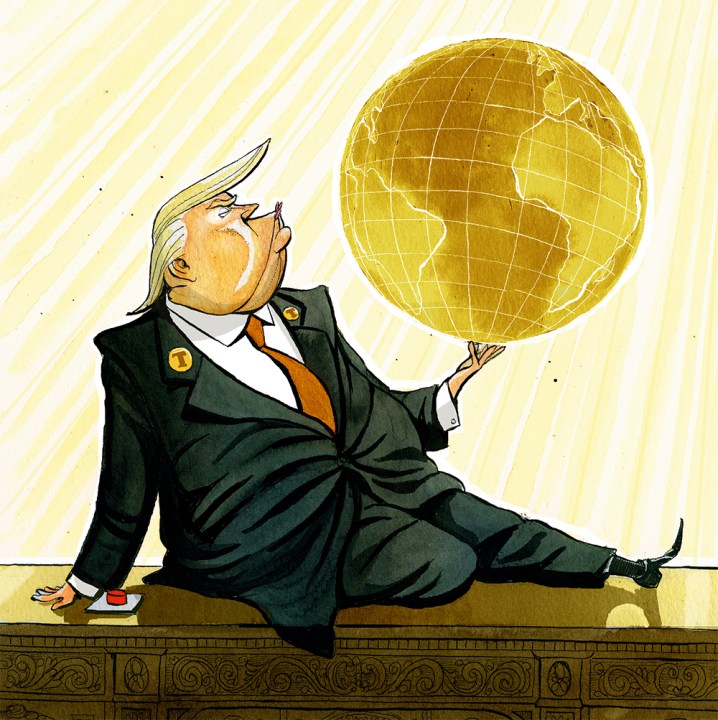
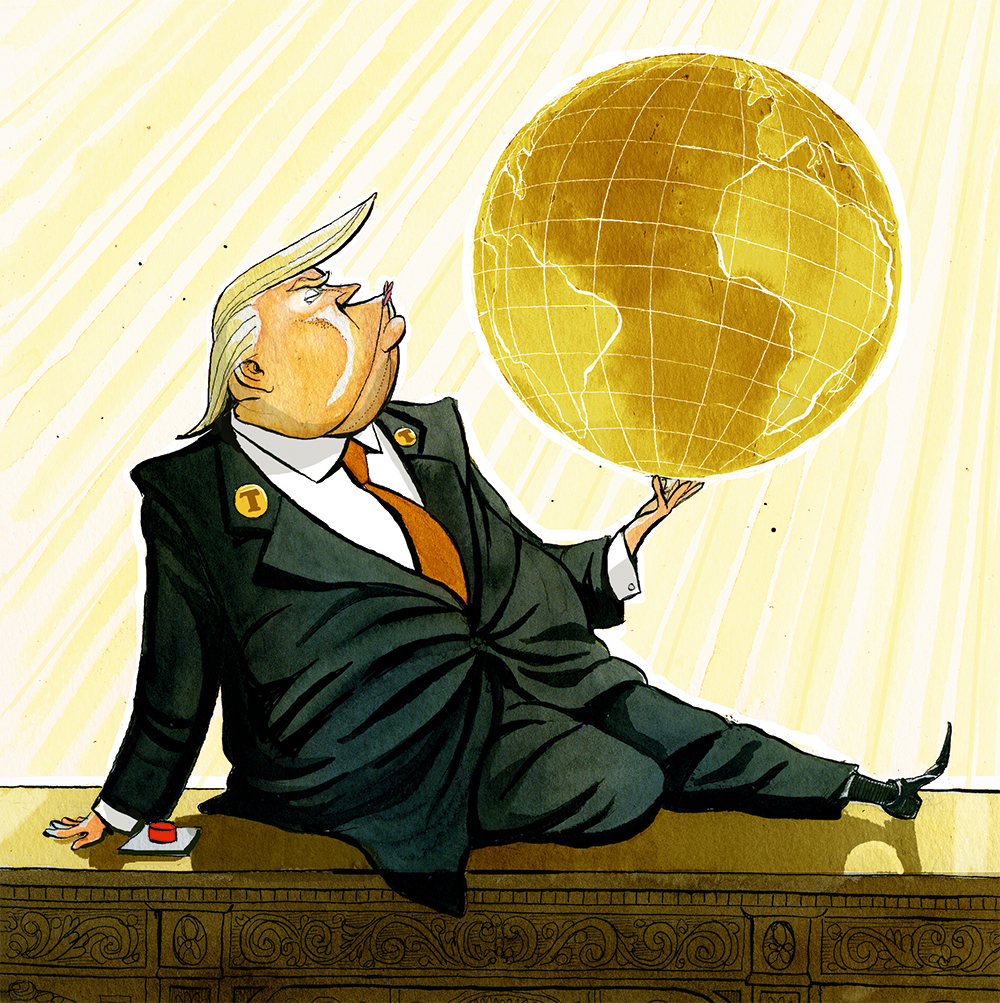
Almost all media commentators seem convinced that Donald Trump’s foreign policy in his second term is a disaster. He is bogged down in Iran, snookered in Ukraine, his tariff agenda has failed and he has alienated his NATO allies. But this consensus has been too hastily formed. Looking at the bigger global picture, Trump’s foreign policy has been a spectacular success.
Take the western hemisphere. We have the so-called “Donroe Doctrine,” the updated version of the 19th-century Monroe Doctrine. In 1822, president James Monroe, having welcomed South America’s overthrow of Spanish and Portuguese imperial rule, stated that Latin American nations should “henceforth not to be considered as subject for future colonization by any European power… we should consider any attempt on their part to extend their system to any portion of this hemisphere as dangerous to our peace and safety.”
Today, “European power” in this context should be replaced by “Chinese power.” And it is against the metric of Chinese power that Trump’s foreign policy needs to be judged.
The latest Peruvian presidential election results are currently too close to call and the final tally may not be released until July. If the left-wing Roberto Sánchez is able to secure a win, Chinese mining conglomerates may be able to tie up supply of Peruvian copper and iron ore, as well as control of a planned deep-sea megaport. Happily for Trump, Sánchez’s Together for Peru party remains a long way short of a majority in the Senate and the Chamber of Deputies.
Contrary to the opinion of the world’s media, the Xi-Putin meet was a gathering of geopolitical losers
Nevertheless, this potential setback aside, Trump’s presidency, both by good fortune and design, has seen a realignment of South American politics with the political right. President Nayib Bukele in El Salvador led the way with an election victory in 2019 based on a fearsomely tough law-and-order strategy. Trump has successfully leveraged his own crackdown on crime gangs by using El Salvador’s infamous prisons to house alleged South American gangsters operating in the US. Despite recent protests about rising inflation, Bukele’s popularity rating stands at 94 percent.
Libertarian President Javier Milei in Argentina is another right-winger who led the way with his elections two years ago, a victory for the right that was reinforced by sweeping success in midterm elections last October. It was a victory against the odds no doubt helped by a $20 billion lending pledge from the US President.
This victory for Trump was topped by an even more aggressive intervention in South America with the decapitation of Xi Jinping’s South American ally, Venezuela. The capture of President Nicolás Maduro and a deal done with his vice president cut off China’s access to its oil. This was not only a blow to China but also to Xi personally. Xi’s family, through his older sister Qi Qiaoqiao’s conglomerate, were reportedly selling oil in China bought at a discount from Venezuela. The change in Venezuela represents a remarkable victory for Trump’s muscular foreign policy.
Furthermore, the toppling of Maduro’s regime has brought the Communist party of Cuba to its knees. The Trump administration is already anticipating its surrender. Because of oil and food shortages, President Miguel Díaz-Canel may well have to reach an accommodation with the United States. Secretary of State Marco Rubio who, as a son of Cuban refugees, is not an uninterested party, has said: “We’ll engage with the Cubans… at the end of the day they need to make a decision. Their system just doesn’t work.” Any deal might include the handover of 95-year-old former president Raúl Castro, who has been indicted for the murder of US citizens.
However, the reestablishment of US power in South America is a trifle compared to Trump’s wrongfooting of China in other parts of the world. Last month, Russian President Vladimir Putin, hot on the heels of the show-stopping Trump-Xi meeting in Beijing, arrived in the Chinese capital. Contrary to the opinion of most of the world’s media, the Xi-Putin summit was a gathering of the geopolitical losers.
America, over the past year, has won a stunning geopolitical victory over China. Xi’s abandonment of the “slowly-slowly” approach to world power fostered by Deng Xiaoping in the 1980s, and his adoption of a “wolf warrior” foreign policy strategy with the aim of overtaking America as the major world power, has ended in failure. It is a victory for an American leader who has aggressively sought to reverse the defeatism of presidents Barack Obama and Joe Biden.
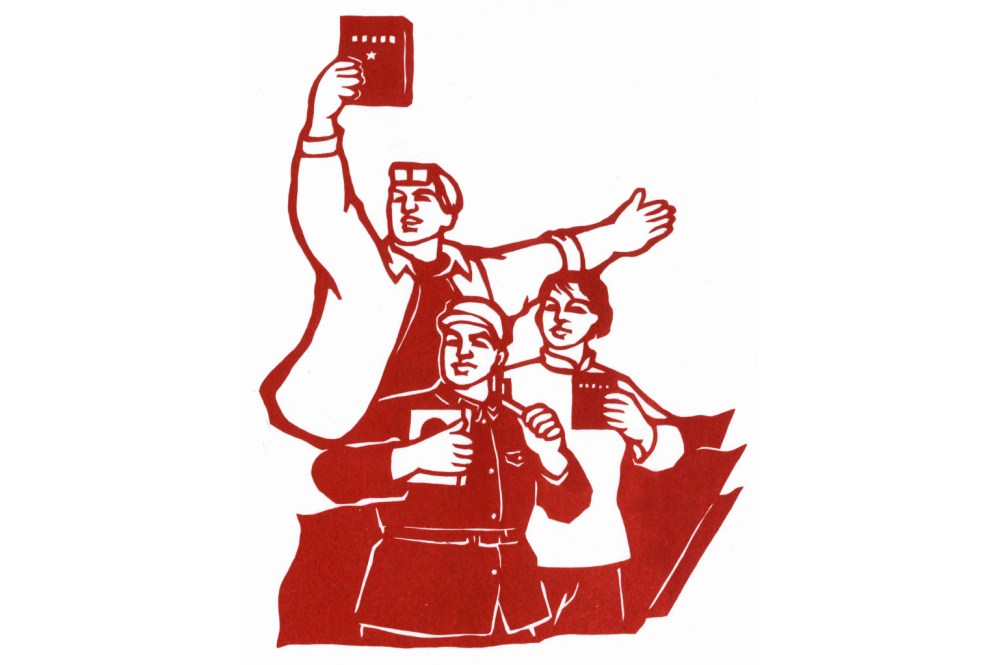
Trump has successfully sought to “Make America Great Again” by the judicious use of force, both in economics using tariffs, and militarily by deploying its unparalleled capabilities. With its fleet of 11 nuclear-powered carriers, the US is the only country in the world capable of projecting power globally. The strength of the alliance of anti-American states built by Xi since coming to power as General Secretary of the CCP and Chairman of the Central Military Commission in November 2012 is being dismantled.
Most importantly, Xi’s strategic alliance with Iran, its major Middle-Eastern partner, has been neutralized. Before Trump’s intervention, Iran guaranteed oil supply to China, providing some 14 percent of its imports, but also sapped US resources and attention. In the event, Trump defanged Iran within a matter of weeks. As a military partner to China, the country was shown to be a paper tiger. Now the US naval blockade of Iran, which is driving rampant inflation and denying the governing Islamic Revolutionary Guard Corps the ability to pay its troops, seems likely to force Iran to negotiate the surrender of its nuclear stockpiles and the parking of its nuclear ambitions – all achieved without a single boot on the ground. Needless to add, the bankrupting of Iran has largely defenestrated its terrorist proxies in Lebanon and Gaza.
The peace process has been messy, and the longer the conflict goes on, the more the world economy will suffer. Rising inflation has adversely affected Europe, Asia and America. But Trump’s critics refuse to ask the key question: if a defanged Iran could hold the world to ransom in the Strait of Hormuz, how much greater would the mullahs’ leverage have been had they developed a nuclear capability? Former presidents Bush, Obama and Biden talked about preventing Iran from getting a nuclear weapon while kicking the can down the road. Trump, by decisive military action, has cut the Gordian knot of Iran’s terror regime. Underlying these successes were the Abraham Accords from Trump’s first term – the reconciliation of the Arab states and Israel, which, under any fair reckoning would have won him the Nobel Peace Prize.
Despite these successes, left-wing legacy media outlets such as CNN, CNBC, the New York Times, the BBC and the Guardian have woven a narrative of failure around Trump’s foreign policy. In America, the New York Times has portrayed the war with Iran as a gross miscalculation, while the New Republic headlined “the President is setting up the US to lose another war in the Middle East.” Similarly, Bloomberg has written, “Trump’s Iran speech dressed up defeat as victory.”
Even right-wing commentators in the West have cleaved to the conventional trope that Trump is a deranged fool on the world stage. Meanwhile, some leading right-wing podcasters, such as Tucker Carlson and Candace Owens, have dived down the conspiracy rabbit hole to suggest that Trump’s foreign policy is merely the product of Jewish manipulation. Yet in Rubio and Vice President J.D. Vance, Trump has appointed two of the most intelligent and articulate exponents of American interest since Henry Kissinger.
Since invading Ukraine, Putin has squandered $750 billion – and a prodigious number of Russian lives
“I would rather have lucky generals than good ones,” said Napoleon. And Trump has indeed been lucky. The brilliance of his geopolitical strategies has been matched by the equally inept policies of his rivals. Since invading Ukraine in 2022, Putin has squandered some $750 billion in treasure and a prodigious number of Russian lives (480,000 dead and more than one million wounded). But victory for Russia is no longer in sight. Since April, Ukraine has been the net winner of territory. While Trump’s aim to bring the war to an end has failed, such has been the collapse of Russian military power that Trump has been able to palm off the responsibility for dealing with Russia and Ukraine to the Europeans.
Indeed, one of the less talked about successes of Trump’s foreign policy is his attack on America’s European NATO partners for freeloading on US military spending. Finally, Europe – well, at least Germany – has woken up to the need to defend itself. To the alarm of many on the left, Trump has smashed the West’s cozy rules-based order; a system which appeased Xi’s global expansion of Chinese power.
While Putin boasts about low unemployment in Russia, the reasons are not worthy of praise. In the biggest migration in a century, up to a million Russians, many of them talented graduates, left the country in 2022; much of the remaining talent has been swept up into Moscow’s army or its expanded military economy. The private sector, denuded of talent, leaves Russia as little more than an energy exporter with a military-industrial complex attached. Interest rates are at 14.5 percent and its economy contracted in the first quarter. Russia’s birthrate is 1.37, which is way below the 2.1 replacement figure. Since peaking at 149 million in 1992, the population has fallen by several million. Many towns in more remote districts already look half empty.
If Russia’s population predicament is bad, China’s is even worse. Its population peaked at 1.42 billion in 2021 and its decline is accelerating as the effects of the one-child policy introduced by Deng in 1979 take hold. Over the next decade, China will lose a population the size of the UK. The current fertility rate is just 1.02, the lowest of any major economy except South Korea. The Chinese economic miracle of the first decades of the millenium, which was built on foreign direct investment, a young and inexpensive labor force and exports, is over.
Xi’s “wolf warrior” foreign policies and anti-capitalist economic policies, such as the arrest of Alibaba’s Jack Ma, have led to an 80 percent collapse in foreign direct investment. The seemingly unending supply of young rural laborers has come to an end. According to Rand Corp., by 2050 China could have 500 million over-60s while its population is forecast to fall from 1.4 billion to 1.15 billion if the current low birth rates continue.
Meanwhile, Xi’s much fanfared “Belt and Road Initiative,” aimed at supporting exports by financing and acquiring key infrastructure assets – ports, roads, railways – in Central Asia, Turkey, the South China Sea, the Indian Ocean, the South Pacific and South America, has largely ended in financial failure. China even proclaimed itself a near-Arctic nation and gobbled up 15 percent of Greenland’s assets. Yet Trump’s aim to annex the Danish colony, negotiated in typically bombastic style, has brought about talks with the governments of Denmark and Greenland to open three new military bases in the south of the island.
Although China has areas of spectacular growth such as AI, robots, computer chips, batteries, solar panels and EVs, these industries do not make up for the precipitous collapse of the property market and falling construction activity since 2021. If Xi had switched to full-on, domestic-led consumer growth as advocated by his factional rival, former premier Li Keqiang, the economic pain could have been lessened.
During his visit to China,Trump wanted to dispel the idea that he is a warmonger
But Xi, a neo-Maoist, has been vehemently opposed to a consumerism which he believed had undermined the moral fiber of the West. Foolishly, he doubled down on the emphasis given to export growth. Like Japan in the 1990s, much of China’s overinvestment in export-led manufacturing is leading to profitless growth. As a result, China is entering its own lost decade – or more likely lost decades.
Finally, regarding Taiwan, the Trump administration is aware that, following factional infighting within the Chinese Communist party, more than 70 percent of China’s generals have been removed from office. The People’s Liberation Army’s senior and most experienced general, Zhang Youxia, disappeared in January and there has been no proof of life since. Despite this presumed attempt to regain control of the army, Xi appears to have failed and is faced with an increasingly hostile political alliance that includes party elders and princelings. China’s military is in no fit state to fight a war that would involve an amphibious landing across the 200-mile Strait of Taiwan.
Much has been made of how passive Trump was during his recent meeting with Xi in Beijing. Yet most foreign commentators missed the key issue – China’s declining economic and geopolitical strength. During his visit to China, Trump wanted to dispel the idea that he was a warmonger, which would be unpopular with this US electorate coming up to November’s midterm elections. He will also have been aware that Xi has been weakened by a power struggle within the CCP. Trump wisely resisted the attempt to be triumphant. Xi and his allies are in disarray. No need to rub it in.






Comments