
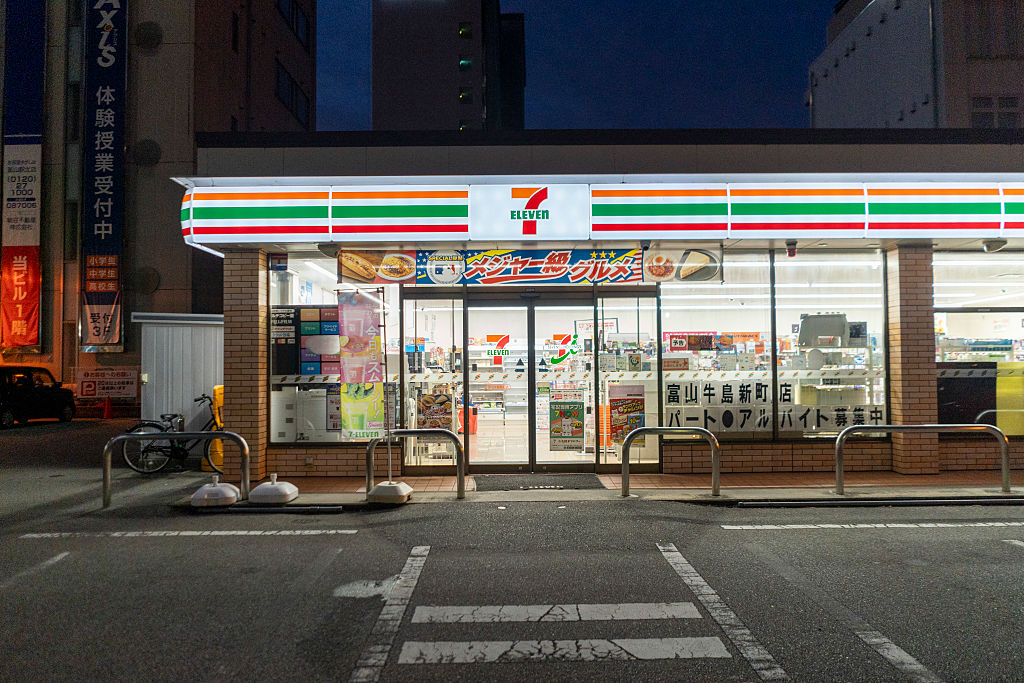
Japanese cities can disappoint. Visitors stroll around hoping to be awe-struck by the dreamy spectacle of clip-clopping Geisha in their wooden geita, or barreling sumo wrestlers, or high-stockinged ninja girls (à la Kill Bill), and all against a Blade Runner backdrop, only to be confronted with mostly unremitting blandness. The constants are these: concrete, plastic, more concrete, more plastic, endless construction (one crappy shopping complex or mansion block replacing another), confusion, and noise. It can all seem dizzyingly homogenous.
The defining feature of the Japanese city these days is the ubiquitous convenience store or “konbini,” the scaled-down supermarkets/post offices/banks/…whatever the customer requires it to be. There are 7500 in Tokyo alone (one for every 1800 people) and 56,000 in the whole country, with some regional variation but three dominant chains: 7-11, Lawson, and Family Mart. Konbini are everywhere, and unlike every other business in Japan, branches never seem to close, though new ones are constantly springing up.
I hate konbini; they are soulless, ‘non-places’
Normally, konbini are too bland, too boring, too familiar to be worth consideration or comment, but the recent death of the “visionary” businessman Toshifumi Suzuki at the age of 93, has focused minds here on the konbini’s cultural and societal role. For it was Suzuki who introduced and refined the concept from its original home in the US (where a form of the convenience store had existed since the 1920s) and made it palatable for Japanese tastes. While not exactly a household name, Suzuki had arguably more influence on Japanese households than almost anyone else in the last 50 years.
It all began on a business trip in the early 70s when Suzuki noticed the success of the 7-11 convenience stores and decided it might work in his native Japan. He faced widespread ridicule, the idea of one-stop shop mini markets in a country used to speciality family-owned (“mama papa”) stores seemed well… un-Japanese. It was assumed the venture would fail.
But Suzuki got the money together, as well as government backing (24-hour general stores were seen as a lifeline to remote communities). He opened his first franchise in 1974 in Toyosu, Tokyo, with the very first customer purchasing an 800-yen umbrella (roughly the same price today, by the way). And the rest is history, an endless expansion of an endlessly evolving phenomenon. A key moment was when the parasite consumed the host: Suzuki’s company bought the American parent and formed Seven & I holdings in 2005.
Why did it work? In a not very surprising word – convenience, but not just for the customer, but also for the retailer. The hitherto standard but tortuously complicated Japanese distribution system had forced shop owners to keep prices high, but the konbini model allowed for a much closer relationship with distributors and a smoother product flow. And contrary to the expectations of many, customers decided they liked the idea.
Slowly, imperceptibly, konbini grew, not so much in size, but in product offer. A breakthrough was the stocking of onigiri (rice balls), a Japanese staple imbued with almost magical import that was previously assumed only to be producible at home. To see them on shop shelves seemed like a miracle.
Soon, hot comfort food became available, including fried chicken, steamed buns, and, for the intrepid “oden” which is radish, fish cakes or tofu swimming (often for quite some time) in a dashi broth.
Services were next: ATMs were installed, as were photocopiers; concert tickets could be bought; bills could be settled and digital wallets topped up. All the fussy, tangly little tasks that used to take hours and trips to several locations could now be managed in one location.
Today’s konbini are in a state of permanent flux. By applying the Japanese kaizan (continuous improvement) corporate model, more common in engineering, and utilizing real-time customer data to feed into product selection, Suzuki enabled the shops to progress constantly and yet remain, eerily, the same (the look and the atmosphere never change much).
3000 products are stocked with 100 new items a month, yet somehow it never feels any different. It’s a bit like riding the Shinkansen (bullet train), so smooth, so clean, so seamless that you don’t appear to be moving at all.
What’s not to like? Quite a lot, actually. Full disclosure: I hate konbini; they are soulless, “non-places” (to reference Marc Auge’s theory of locations devoid of any identity or cultural resonance). Yes, you can buy sea urchin-flavoured potato chips and pay your water and sewage bill but no joy, pleasure, or anything resembling a genuine human emotion appears capable of survival inside a konbini. This was brought home to me on one of my very first days in Japan, when I foolishly attempted to practice my Japanese with a woman stacking shelves. She looked up in alarm and fled to the stockroom. Chatting to shop staff in Japan is tricky at the best of times, but in a konbini, unthinkable.
It seems I am not alone in my unease. This dark side was explored by Sayaka Murata in her best-selling 2016 novel Convenience Store Woman. The novel describes the life of a social misfit who finds in the pristine rules-based environment of the konbini with its manual service (literally true, there is a manual and a script for employees) a roadmap for life that frees her from any vestige of a natural, human existence.
The Convenience Store Women’s descent into near madness reaches its peak when she becomes exasperated as her colleagues gossip about her possibly having a boyfriend (she doesn’t) when they should be attending to the serious business of discounting the chicken sticks, as the manual and the strict timetable demand.
Significantly, Convenience Store Woman is unmarried and childless (in contrast to the spotless environment of the store, she finds the idea of sex “ghastly”), for Suzuki’s import has arguably contributed to the declining birthrate that has put Japan’s very future in jeopardy. In a 2024 interview, Suzuki admitted that though his own wife had never worked, and thus had the liberty to go on lengthy shopping trips, most two-income couples would struggle to survive without the convenience of the convenience store.
The onward march of the konbini would appear to be unstoppable. With Japan saturated (almost, historic Nara prefecture has tried to keep konbini out), the next stage appears to be the rest of Asia. That seems to be the reason that konbini in Japan have a very high percentage of non-Japanese staff (Chinese, Koreans, Vietnamese) or even why they have staff at all. Yes, the wages are low, and immigrants are less choosy about what jobs they take, but having staff from neighboring South East Asian countries learn the way of the konbini in Japan may pay dividends when they return home and form a ready-made workforce for international expansion.
And after Asia, why not the world? How ironic it would be if Toshifumi Suzuki’s American import, were to return home one day in its streamlined Japanese iteration to function far better than it ever worked on its home turf.






Comments