Life

I gave up drinking. Don’t call me teetotal

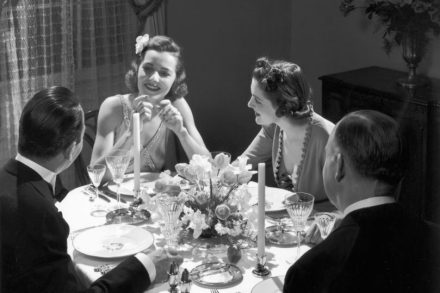
I hate teetotallers. The pitying looks they give you with their cold, unclouded eyes. Those patronising, bored smiles they smile, as though they are indulgently listening to the table-talk of children. Their uncouth early departures from the dinner table and tactless talk of early starts. Teetotallers are as bad as people who insist on whipping out their phones to film fellow guests when they’re dancing. They’re buzz-killing squares who should learn to live a little.   And yet … I have, despite my worse judgment, recently mounted the wagon. In my heart, I remain a devoted drinker. In my mind, I continue to see myself as the Falstaffian life of the party.

Why DC loves to hate Partiful

If you’re under 50, you may have noticed that Partiful has quietly annexed the American social calendar over the past year or two. The event-planning app, founded by former Palantir employees, began as another Silicon Valley toy, but it didn’t stay regional for long. Its loud dashboard aesthetic spread quickly through the Bay Area and then achieved escape velocity in Washington, DC. I wouldn’t be surprised if the strong cultural current between tech and defense is what created near-perfect conditions for a social revival in nerd world. While I understand a bit of snobbery over the aesthetics, I’ve been surprised by the constant performative disdain I’ve observed accompanying its rise. Everywhere I go, I hear people say they “hate” Partiful.

partiful

The Dr. Strangelove taxonomy of DC types

I tweeted the other day that my social life in Trump’s DC is just getting dinner or drinks with a different Dr. Strangelove character every week. It sounds like an exaggeration, but it’s not. Not really. Every week brings its own apocalypse – and the cast of characters responds accordingly. Find here a taxonomy of DC types: Dr. Strangelove (The theorist) The end of the world approaches and only the strong will survive it. Hands trembling slightly from too much caffeine and suppressed grandeur, he (it’s always a he) declares his grand theory of the world in so many words. Women, of course, will be spared. Perhaps you, too, will be counted among the lucky ones. Oh, you’re over 30? If you just read a little more Spengler. Learned a little more about semiconductors.

dr strangelove
trader joe's

How Trader Joe’s became a way of life

A young woman recently approached me as I stood outside Trader Joe’s on the corner of 93rd Street and Columbus Avenue in Manhattan. “Excuse me,” she said, “I’m visiting from the UK and I’m just wondering if there’s anything worth seeing around here.” This is not an unusual occurrence. It’s always tourist season in New York. People come for the cherry blossoms in Central Park, for the magic of the Rockefeller Center Christmas tree and for the vague hope of running into Timothée Chalamet at a downtown brunch place. They even come in the sweltering heat of summer when I, personally, would rather be anywhere else – ideally somewhere without the pungent smell of hot garbage and misplaced ambition.

The tyranny of the mass-intellectual

In the classical world the question of whether virtue can be taught, or is rather acquired by interior inclination and moral development, was the subject of intense debate by the best Grecian and Roman philosophers. None ever succeeded, however, in agreeing an answer. Progressive education along narrow lines is, for liberals, the source of all legitimate moral authority Since the second half of the 20th century, academics and intellectuals have seemed to believe that they have answered the question definitively and to their own satisfaction. Virtue, they have decided, can indeed be taught, and liberal democratic education is doing it, in public and private schools and universities alike throughout the western world.

education
gossip

Gossip is good for you… so I’m told

The late Pope Francis hated gossip. In his Christmas message to his Vatican advisors last year, he warned that it is “an evil that destroys social life.” It wasn’t the first time he’d attacked rumor-spreading. He once compared gossips to terrorists because “he or she throws a bomb and leaves.” His condemnations are of particular concern for me because I was recently accused of being a “notorious gossip.” I vehemently reject the charge, but if it were true, at least I’d be following a proud journalistic tradition. In fact, if it were not for gossip, this very magazine might not exist. The original Spectator’s founders, Joseph Addison and Richard Steele, filled the 1711 incarnation by hovering around coffee-houses, picking up gossip for stories.

Polite society is a thing of the past

In 1908, the iconoclast writer Lytton Strachey – the bad boy of the Bloomsbury set – pointed a long finger at a stain on artist Vanessa Bell’s dress and asked, “Semen?” Later, Bell’s sister Virginia Woolf wrote: “With that one word all barriers of reticence and reserve went down… It was, I think, a great advance in civilization.” Americans tend to think that the English are sexually repressed and too refined and cultured for such talk I was recently in a bar in Bloomsbury – one that actually serves a “Virginia Woolf hamburger” – when talk among the young women at my table turned to men they knew who were, how should I put this, well-endowed. Of course, I’ve heard such talk before, but not in a long time and not in such anatomical detail.

talk

Thoughts on moving houses

“A house for sale is not a home,” says Wendell Berry, which is perhaps why we have delayed putting our home up for sale as we slowly move, box by box, the five short – long? – miles down the road to the house my grandfather built in 1938. We are moving from Chapel Street to Bank Street, which I trust does not indicate a moral demotion from my lofty spiritual perch to the world of grubby materialism. I know for certain it does not augur riches. We are holding off on selling our Chapel Street home till we’ve cleared it out and are fully moved into Bank, though I nurture a ridiculous hope that before then I might unearth a rusted coffee can filled with 19th-century gold pieces that will enable us to keep both.

moving

The problem of the progressive middle class

A month or two ago, Rod Liddle had the audacity to write in The Spectator that the besetting problem of modern civilization is the middle class, while implying that something ought to done about it. Reading the article, I was reminded of an entry made by Harold Nicolson in his diary early in 1939 where he observes, à propos the homogenization of the modern world, “Even revolution is becoming bourgeois.

middle

The Erie Canal at 200

I’ve got a mule, her name is Sal              Fifteen miles on the Erie Canal               She’s a good old worker and a good old pal              Fifteen miles on the Erie Canal I’ve a pal named Sal – he’s no mule, alas – but it’s only a 15-mile trip for me, too, up Route 98 to the Erie Canal, which turns 200 years old this October 26. I while away the occasional summer morn sitting by its banks, editing or writing or reading, coffee washing the donuts down my maw. I love the old canal town of Albion (where perfidy has no place!), its tumbledown Main Street blessed by the silver-domed Orleans County Courthouse. The Upstate New York folklorist Carl Carmer grew up here, as did the sleeping car magnate George Pullman.

Erie

The rise of millionaires, valet parking and facelifts in Palm Beach

The two favored topics of conversation in Palm Beach are money and the place itself, so the latest survey by Henley & Partners, a specialist service which advises wealthy clients where to live, is doubly welcome. It shows that Palm Beach County is among the top five fastest-growing “wealth hubs” in the world, outpacing even Dubai and Silicon Valley. This latest report shows that Palm Beach County cities (that is, Palm Beach, the island off the mainland, and West Palm Beach, on the mainland, separated only by three drawbridges) experienced a 112 percent increase in millionaire residents between 2014 and 2024.

Palm
baseball

How Major League Baseball lost its soul

I highly recommend Homestand, Will Bardenwerper’s new book contrasting the community-enhancing qualities of grass-roots baseball with the soulless corporate product that Major League Baseball has become – and it’s not just because I am a central character therein. The book is at once a beautiful portrait of bleacher-level society and a scathingly effective indictment of the automatons who are destroying the American game. Will spent the summer of 2022 in and around Dwyer Stadium, home of the Batavia Muckdogs, an independent team of college ballplayers. This amateur ball club was the feisty successor to professional teams that had graced our fair city since 1939.

painting

The sad decline of painting

What hope is there for artists following the sale last year of the robot Ai-Da’s portrait of Alan Turing, entitled “A.I. God,” for $1 million? Someone has perhaps paid over the odds for a 3D print with a few marks added by a robotic arm and a few more by studio assistants to areas of the canvas Ai-Da couldn’t reach. Innovation wins. In the 1970s, the walls of art-school degree shows were studded with plaster casts of students’ genitals. By the 1980s, students were discouraged from attempting realist painting, but messy gray abstract works were still acceptable. Then it was found objects and piles of stuff. One young studio assistant I knew in the 2000s had a tutor at art school who’d gained top marks in his degree by filming himself pouring a glass of milk over his head.

Why I won’t date younger women

I recently got some good news I’d like to share: I’m thirty-six years old. Yes, I know I’m chronologically seventy — but a blood and urine test I had reveals that I’m biologically thirty-six. (Your chronological age is the number of years you’ve lived; your biological age is how old your cells are.) Dr. Alka Patel, a brilliant British longevity expert tells me that she has never seen such a big gap between chronological and biological age as mine. So, what does this mean? It means I will probably live to a ripe old age, free of any related diseases. But to me it means that while, on the outside, I might look like an old white guy with a wobbly chin, sad eyes and the scar tissue of one too many failed romances — inside, I’m a vigorous and virile thirty-six-year-old man.

younger

The controversy of Daylight Savings Time

Batavia, New York I bear no ill will against golfers — I triple-bogey easy holes and miss gimme putts with the worst of them — but President Trump’s demand that we eliminate Daylight Saving Time (DST) is a double eagle out of the blue, especially as Trump had earlier advocated a move to year-round DST. Although Benjamin Franklin is often credited as its progenitor, the real father of Daylight Saving Time, according to Michael Downing, author of Spring Forward, was the golfing British architect William Willett, who deplored “the waste of daylight.” The British Royal Astronomer dismissed Willett’s idea with the counterproposal that “between the months of October and March the thermometer should be put up ten degrees.

daylight

Bryan Johnson and the meme-ing of life

In fifth grade my class read Tuck Everlasting, by Natalie Babbitt, the story of a ten- year-old girl who stumbles on a family of immortals, the Tucks, who impress upon her that eternal life is unnatural and actually a curse. The novel had a profound effect on me. I became obsessed with the book and with the relationship of life to death. One passage in particular has haunted me for decades. “You can’t have living without dying. So you can’t call it living, what we got,” the patriarch, Angus Tuck, says. “We just are, we just be, like rocks beside the road.” I’ve been thinking about this book a lot since I became aware of the tech entrepreneur Bryan Johnson.

words

Are we still doing phrasing?

Grandma McMorris seldom curses, so when she said, “never let a son of a bitch know he’s a son of a bitch,” I knew she was quoting her father, Pop Pop. My grandfather oozed apothegms, nuggets of wisdom that are now only found on refrigerator magnets, motivational posters and throw pillows: the Silent Generation’s forerunner to the meme. Mom was giving me work advice. It’s only been two months, but I no longer remember who the son of a bitch that I called a son of a bitch was, let alone why I called him that. The particulars vanished as soon as my mother spoke, the work crisis overtaken by a personal one. It was a barbecue, probably. Or perhaps a s’mores night at the firepit. A birthday party for one of her sisters? “Dad, when can I have a cigarette?

reference

With reference to

"You spend your life waiting for a moment that just don't come," sang Bruce Springsteen many moments ago. But sometimes it comes and catches you off guard. Perhaps once a decade you are gifted a sentence begging completion or a question inviting the perfect answer, and if you don’t spit out the mot juste you spend the rest of the day cursing on the staircase, pained by a bad case of l’esprit de l’escalier. (And that about exhausts my C-minus college French.) You never know when or wherefrom these pitches are coming. I doubt that even Oscar Wilde could hit much above .500 in this league. I’m probably closer to Cornel Wilde, but I have driven a few into the gaps. Let me explain. Last spring I was toting a garden-shop tray that my wife was filling with plants.

Road-tripping with Wittgenstein

North Carolina The ancients used the sun and moon to measure time, but modern man has a more exact instrument at his disposal: the odometer. It has ticked up a thousand-plus miles, a sure sign the 2024 holiday season has just ended. The children are all struggling in the backseat — against one another, their own bladders and the nylon straps the Car Seat Cartel has foisted upon them — and are thus unable to see the dash’s mileage ticker, as well as the incriminating orange “service reminder” messages your wife is pretending to ignore. When you read aloud the “Welcome to North Carolina” sign, your most intelligent child says, “Are we still in the United States?

Wittgenstein
years

On embracing the winter years

Batavia, New York I sit in hospice at the bedside of my beloved Aunt Jane — who never let us use the honorific, as “Aunt” made the perennially youthful Jane feel old — and the jukebox in my mind plays its saddest song: “Who Knows Where the Time Goes?” by Fairport Convention. Jane, who is eighty-nine and till a few weeks ago looked twenty-five years younger, was my hip and happening aunt of the 1960s who lived in Buffalo and dated pro athletes and bopped along to WKBW’s Top 40. She taught my brother and me to write letters, which is why I still have an autographed photo of Minnesota Vikings kicker Fred Cox, and my brother has his signed picture of Rams quarterback Roman Gabriel.