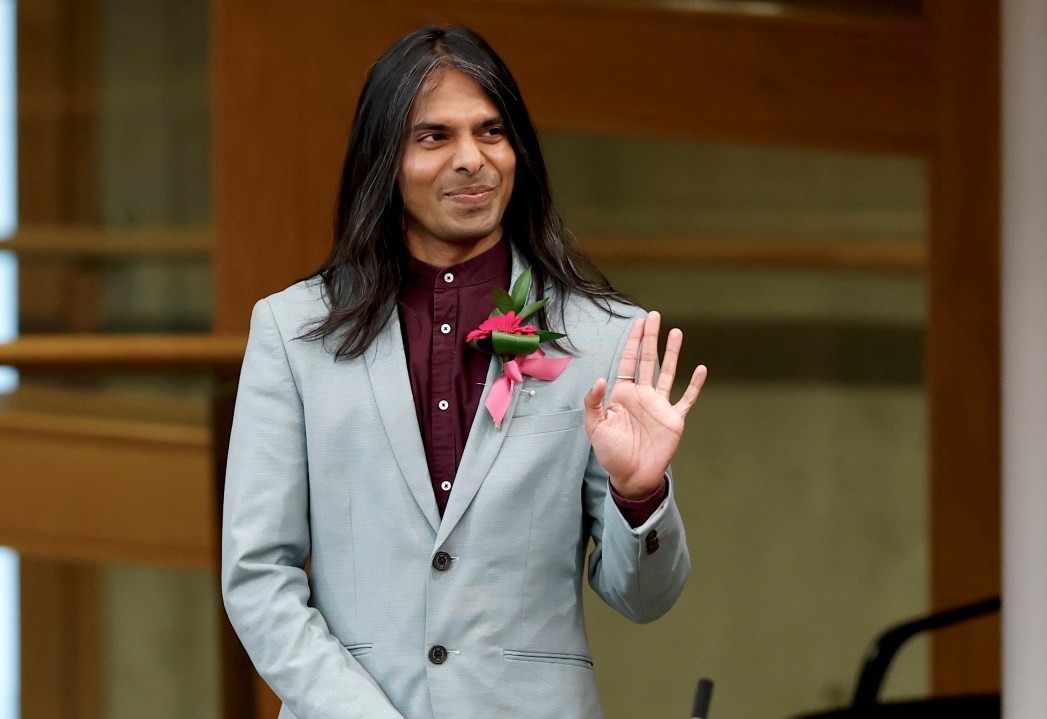
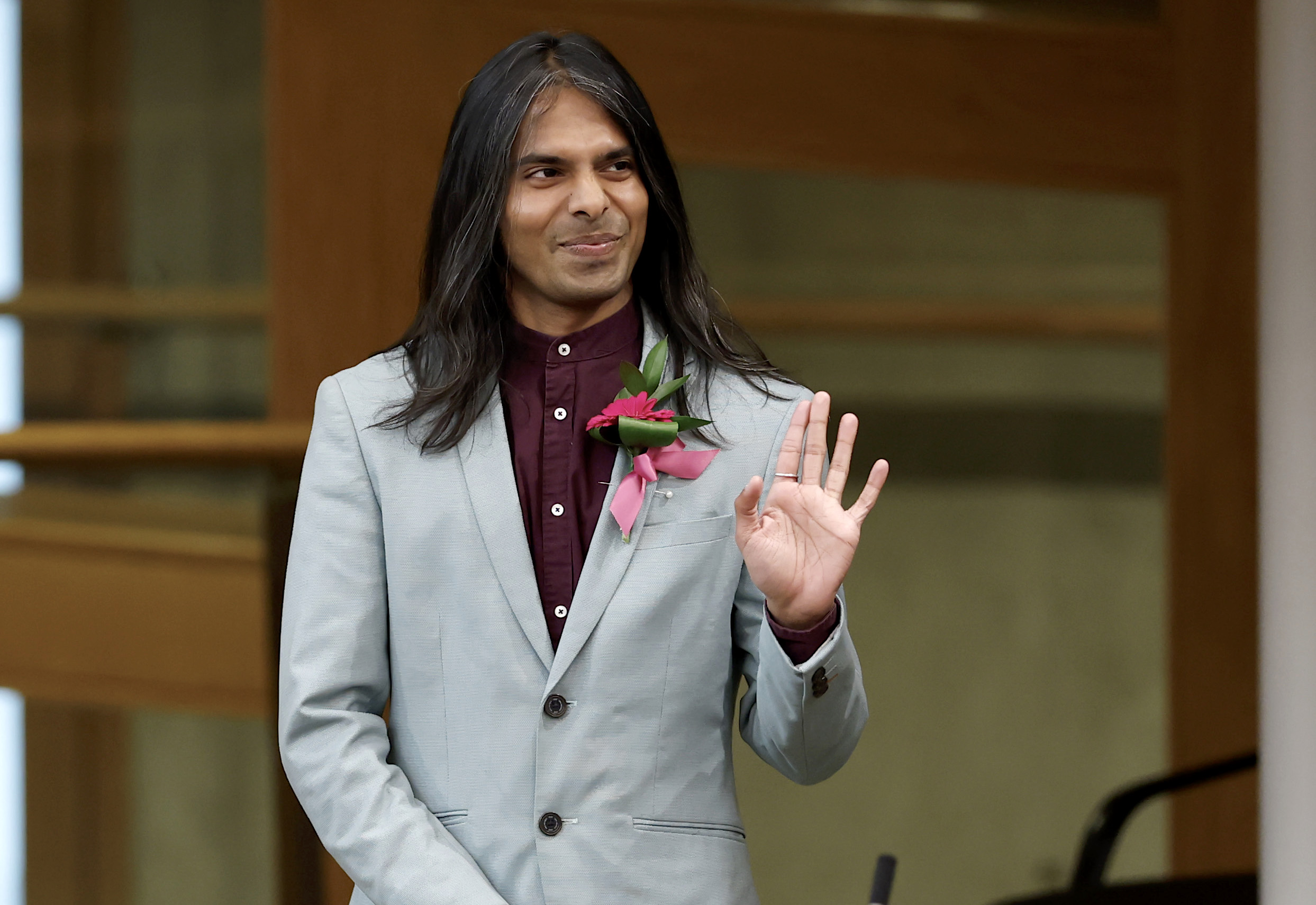
In an age full of nepobaby second-generation politicians posing as ‘outsiders’, new Green Party MSP ‘Q Manivannan’ is the real thing. Indeed, the St Andrew’s postgraduate is so much of an outsider that he doesn’t even hold British citizenship or permanent residency, and is unable to take up paid employment as a condition of his student visa. ‘Q’ was allowed to stand for office last month because the Scottish government – the Wuhan Lab of terrible ideas in UK politics – recently changed the rules allowing foreigners with only limited leave to remain to compete in elections. Although Manivannan faced a probe into his visa, the powers-that-be ruled that being a politician wasn’t a real job. This prevented possibly the funniest outcome of all – the new member of the Scottish Parliament representing his constituents in Edinburgh and Lothians East remotely from Tamil Nadu.

A ‘transgender Tamil immigrant’, ‘Q’ – born Srivatsan Manivannan – identifies as non-binary and describes himself as ‘passionate about more caring politics rooted in the working class, the queer, and the solidary’. Currently engaged in a research project called ‘Archiving and (Re)imagining Caregiving as Peacebuilding in Third World Social Movements’, at the time of his election he was also crowdfunding £2,000 to pay for his visa, apparently too impoverished to pay for it himself.
The more I read about Manivannan, the more he comes to resemble a Sokal-like hoax designed to test the limits of what progressives will accept if it wins them social approval. Always smiling for the camera, Q seems to have a cheerful demeanour and hugely adds to gross national gaiety; he will make a fine footnote in the history of modern Britain, as some future Gibbon explains how the world’s foremost imperial power found itself giggling into the sea. He certainly has reason to be cheerful; the £77,000-a-year salary of an MSP compares favourably with the average Indian annual wage of £2,500, or indeed the typical earnings of a graduate in Britain doing a PhD in peace studies, which can’t be that much more.
Perhaps it’s a failure of imagination on my part, but I find it hard to understand the mindset of someone who moves to a foreign country and, before even becoming a citizen, decides that they have the right to set its laws. Of course, as a billion Indians might say in response, you chaps do have some form on this matter yourselves.
What makes the situation somewhat galling is that the Scottish Greens are in favour of independence. Professor Peter Sarris put it well when he wrote: ‘Call me old fashioned, but I do feel it somewhat out of order for someone to come to my country as a guest on a student visa, and then set about trying to break it up? A bit like allowing a stranger to come round for tea and then sitting back as they decide to smash the crockery’.
Since British taxpayers, via the Scottish Social Science Graduate School, funded Q’s PhD, we might regard this as ingratitude, but many countries would view such behaviour as actual subversion. In Singapore, where I just visited, the authorities take a very dim view of non-citizens getting involved in politics. Even displaying foreign flags is mostly prohibited, and agitating on behalf of one of the world’s various ethnic squabbles will have you deported as a troublemaker. The Singaporeans consider us utterly mad for tolerating the presence of foreign-born radicals in Britain, but they famously do not welcome outsider involvement of any kind.
Lee Kuan Yew famously said in a 1971 speech that ‘I am not interested in advice from Asian emigres on what should be in Singapore. Their advice is worse than useless. They have no sense of shame, or they would stay and help their own countries progress and their fellow countrymen live less wretched lives. Instead, they flee to greener pastures and give us advice.’
On another occasion Lee explained his thinking like so:
If you are an authority on Greek literature but a non-citizen, then you would be wise to leave the question of whether or not Malay should be the only official language to those who are citizens. The best thing is to stick to your subject. Now if you are an authority on economics and your research shows that a certain type of industry cannot be successfully established in Singapore, then by all means propound the results of your research and your conclusion thereon, even if it should conflict with a pet scheme of the minister in charge of industrial development. And if you are an economist of repute the minister would be well to read your exposition of the subject.
In that spirit we should welcome Q Manivannan’s expertise on (Re)imagining Caregiving as Peacebuilding in Third World Social Movements, while leaving all other issues to those who are citizens.
Of course, while visiting the city-state has probably not been a good influence on whatever lingering liberalism may remain within me, Britain is not Singapore and never has been. Foreign nationals are welcome to have their say and sometimes an outsider does indeed have a better view of where the country has fallen behind, especially when it involves sacred topics. Britain has historically been among the more open political cultures, and we had Indian-born MPs in the 19th century; indeed, you could go further back than that to the foundation of the House of Commons by a Frenchman.
Yet Indians could be parliamentarians in the reign of Victoria because they were imperial subjects; the empire is long gone, and yet something of that empire mindset still lives on among Britain’s elite. We still, bizarrely, allow Commonwealth voting, whereby foreigners are allowed to take part in our democracy purely because their countries were once invaded by Britain. Many of ours rulers still see their job as serving humanity in general rather than the British people. MPs, diplomats and even ministers feel no embarrassment about displays of dual loyalty; with this in mind, it seems like hardly a stretch to allow non-citizens to make our laws. Yet there are limits.
The Singaporeans value social harmony, which is best served by a clear distinction between naturalised citizens and resident foreigners; the latter enjoy the full protection of the law, but they have no right to take part in the country’s political affairs, for the simple reason that they are not invested in the country. As with so many areas, here they seem to have a less naive understanding of human nature and incentives than their former colonial masters. They are also more forward-looking.
Our elites equate ‘open’ with high status and modernity, but it is actually the British-style approach which has become antiquated with hyper-globalisation. At its most acute the risk of hostile foreign interference grows stronger with freer movement, better technology and economic integration, most notably in the case of states like Russia and China. While the Singaporeans have always been acutely aware of the risk of political infiltration from communist China, Britain’s rulers seem blindly unaware of the dangers.
True to the script, one of the first things Edinburgh’s new representative did after election was to push for Scottish taxpayers to fund reparations for Palestine
State interference is not the only risk, however; perhaps more of a problem is the rise of the Global South Aristocracy, members of ruling elites from non-western countries who help to polarise and radicalise the political systems of the states they move to. Talking the language of social justice and equality, they promote a form of identity politics which raises their own prestige, and which is often comically opposed to their ancestors’ record of oppression and slavery. What distinguishes the Global South Aristocracy from the exiles and refugees of the past is that their ire is mostly directed at their new homes, rather than injustices in their homelands. These are the ‘emigres’ whom Lee despised, and the incentives to build careers in richer states are far more immense now than in his time.
While Q claimed to have ‘grown up starving’ in India and that as a ‘queer Tamil immigrant’ he would be a voice for the ‘working class and marginalised’, it turns out, inevitably, that he went to a private school. As the Sunday Times reported, ‘Manivannan comes from an upper middle-class household in Chennai, one of India’s wealthiest, most cosmopolitan cities.’ Although his party want to ban private schooling, ‘Manivannan attended both private high school and university, and went on to run a subsidiary of an Indian business that coaches the children of the super-rich to access the world’s elite institutions.’ I could give you that advice for free: just call yourself ‘they’ and waffle on about gender identity. Every western progressive will swoon at your every word. They might even elect you.
The tale is too farcical to be enraging, too much of a right-wing fever dream, too obvious and predictable. True to the script, one of the first things Edinburgh’s new representative did after election was to push for Scottish taxpayers to fund reparations for Palestine. Of course they did.
This piece originally appeared on Ed West’s The Wrong Side of History.



Comments