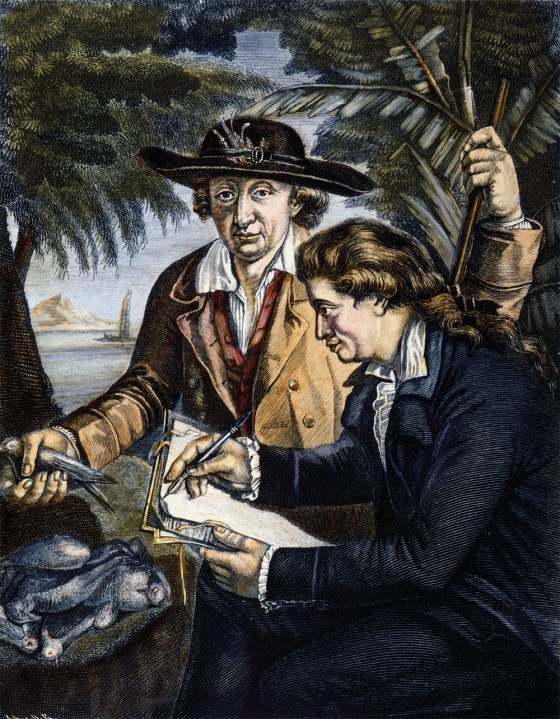
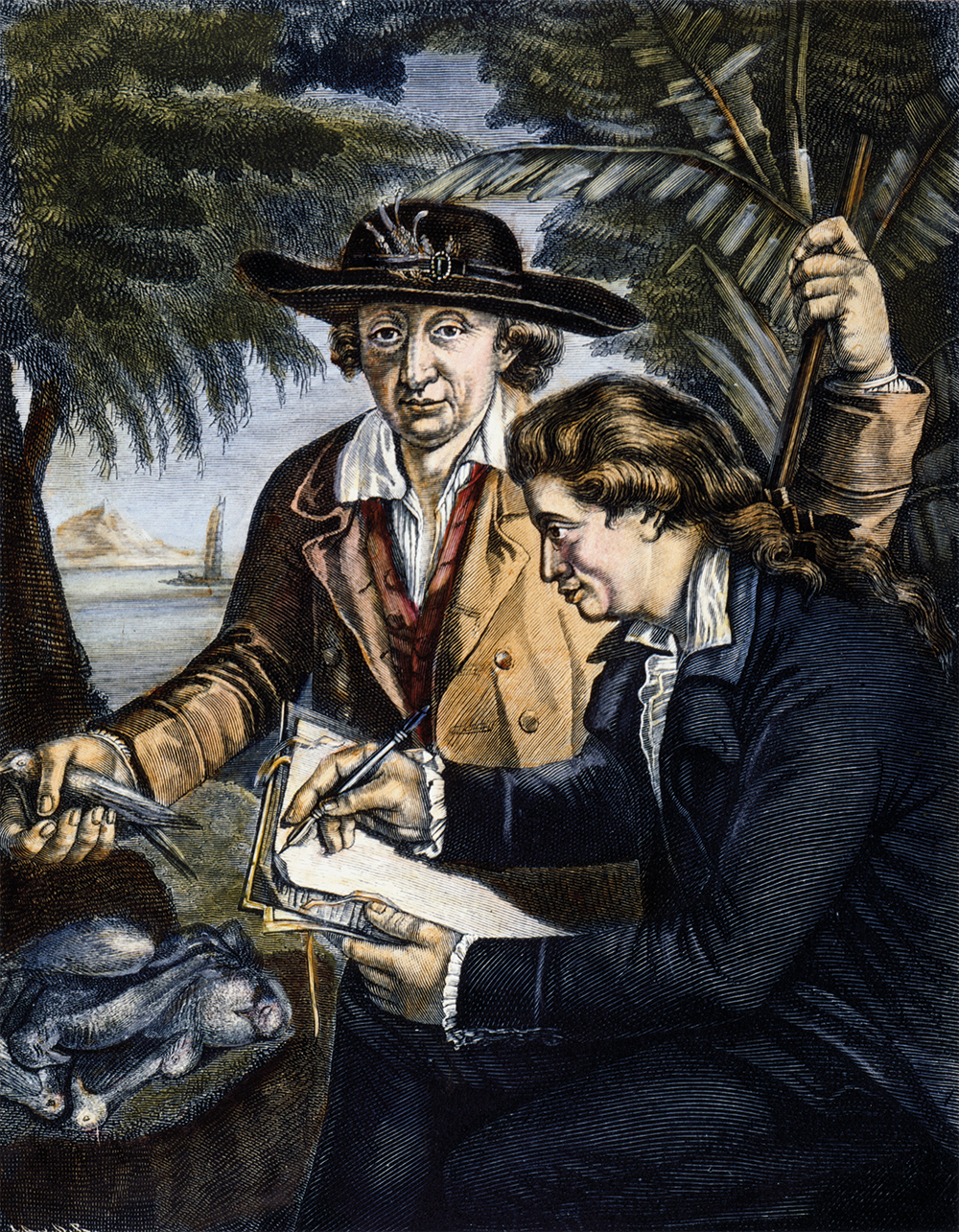
George Forster (1754-94), the German-Polish polymath, was in every sense a late Enlightenment prodigy. He was just ten years old when he accompanied his father, Johann Reinhold, on a scientific expedition to Russia and still in his teens when he sailed with him on Captain Cook’s epic three-year voyage to Antarctica and the Pacific islands. The ensuing book, A Voyage Round the World (1777), largely written by George, became a classic. It established him as one of the most significant naturalists and travel writers of the age, leading to him being elected a Fellow of the Royal Society aged just 22. He was also a very young polyglot, having learnt German, French, English and Russian by the age of 12. (He later added Dutch, Italian, Spanish, Portuguese and Swedish, as well as Latin.) Andrea Wulf draws on Forster’s publications and personal archives to reconstruct the trajectory of this remarkable, compellingly humane, figure.
On board Cook’s HMS Resolution, Forster encountered new civilisations and breathtaking scenery – from the huge icebergs and flocks of penguins in the Antarctic, to Easter Island’s giant statues, to the lush vegetation of New Zealand and Tahiti. He studied the islanders he met closely, captivated by their music and admiring of their dress and jewellery, but at times disoriented by their religious rituals and political customs. He approached different civilisations sensitively, without assuming – as was the norm – that European ways were superior.
He was also aware that expeditions such as his often resulted in violence against indigenous populations, and he deplored a number of acts perpetrated by Cook and his crew. The book opens powerfully with a description of one such brutal encounter. Forster believed that local peoples should not be coerced into accepting foreign domination, and he lamented the fact that journeys of discovery were often ‘fatal to the nations they visit’. He was thus an early critic of colonialism.
The late 1770s and 1780s saw his political ideas develop in an increasingly radical direction. His enthusiasm for the American Revolution was further strengthened when he met Benjamin Franklin during a visit to Paris in 1777. In line with Diderot and Abbé Raynal, Forster condemned the barbarity of Atlantic slavery – imposed on African peoples so that western societies could ‘enjoy a few delicacies, such as sugar and coffee’. In the process, he questioned the growing belief in racial hierarchy. He challenged Kant’s views about the inferiority of black people, finding that all humans were essentially the same in terms of instincts, biological development and morality.
This democratic way of thinking was further nourished by Forster’s involvement with freemasonry, then a major instrument in the diffusion of egalitarian ideas among the bourgeoisie. He also joined the Rosicrucians, a mystical fraternity and masonic offshoot, which celebrated the unity of God in nature. When the French Revolution erupted, he rallied enthusiastically to its cause. He soon became a fervent Jacobin, and, in 1792, served as the vice-president of a short-lived republic established by the advancing revolutionary army in the electorate of Mainz.
Forster cut off his ponytail to show his ardent commitment to republicanism and threw all his support behind the new political order. He promoted democratic elections and a free press, celebrating the people as ‘daring champions of freedom and equality’ while railing against monarchs as ‘the scum of the human race’. But, disillusioned by the Terror, which he witnessed close up, and denounced as a traitor by German royalists, he died in Paris after a rheumatic illness, aged 39. Yet he had remained loyal to the French democratic cause and understood that without the Jacobins’ steely determination, the Revolution would have been crushed by reactionary forces. Sadly, he narrowly missed witnessing the Convention’s abolition of slavery.
Despite the recognition Forster received throughout Europe, his life was full of challenges, not least personal. His Lutheran pastor father was jealous and overbearing, and his relationship with his wife, Therese Heyne, broke down. His financial position was often insecure, forcing him to take translation work and even more dreary jobs as a language instructor. (He started teaching when he was 13). But one of his most admirable qualities was his determination to think for himself. Ahead of his time in many respects, he was suspicious of grand theories about human nature, preferring to arrive at his own conclusions through reflection, observation and intuition. We find him writing in 1777 about human rights, more than a decade before the outbreak of the French Revolution.
Some of his insights were extremely prescient. With the help of Hitihiti, a young Polynesian who joined the Resolution and to whom he became close, Forster studied the languages, religious customs and agricultural techniques of the peoples of the South Pacific. He worked out that they all shared a common ancestry – a conclusion since confirmed by advances in DNA.
Equally original were his views about the divinely ordained force of Nature, which he constructed through his reading of Enlightenment thinkers (there are strong echoes of Rousseau here) and his encounters with pantheistic cultures. The link between his naturalism and his radicalism was further reinforced through his masonic affiliations, where the notion of the ‘Great Architect of the Universe’ plays a central role. This was a typical example of the way his mind worked, drawing together elements from eclectic intellectual and cultural sources to forge a general synthesis.
He was a very young polyglot, having learnt German, French, English and Russian by the age of 12
Forster also speaks to the fractures of the present. He personified the cosmopolitan ideal – not the limp version championed by Kant, which turned out to be compatible with Prussian despotism and racial prejudice, but a genuine universality, based on sympathy and respect for different cultures and ways of being. His universalism was also intellectual. When he lamented that the pursuit of knowledge in his time had fallen into ‘meaningless drivel’ as a result of its obsession with classification, abstraction and specialisation, he could have been commenting on today’s social sciences, where a similar tendency to focus on minutiae increasingly detracts from engagement with larger existential questions.
Forster’s uncompromising democratic spirit was grounded in his conviction that human beings were entitled to equal rights. He thought that freedom should be constitutionally enshrined for all – not just those favoured by birth, fortune or membership of the right club. He also believed that those blessed with knowledge had a duty to contribute to a better world. The way he engaged with the French Revolution was, in this sense, exemplary, driven by an appreciation of the need to stand up for humanity in moments of crisis. ‘One is either for absolute freedom or absolute tyranny,’ he declared. ‘There is nothing in between.’





Comments