HS2 has never had the attention it needs and the scrutiny its scale demands. This is Britain’s largest infrastructure project, dwarfing the Channel Tunnel by a factor of around ten in terms of the cost and yet it has been allowed to bumble along as if it were the construction a little branch line to a Suffolk village.
Ministers come and go, civil servants stick their heads in the sand and the media gets bored with the story apart from covering protestors digging themselves under Euston or living in trees.
Now there is a brief focus on the scheme with the ‘reset’ which has been 18 months in gestation but I suspect that the project, which is costing taxpayers £7 billion every year, will again retreat back to the shadows. It shouldn’t this is a national scandal and disgrace and deserves far more attention than it gets.
This is a national scandal and disgrace and deserves far more attention than it gets
Despite having covered this story since the construction of the line was first announced in 2009, the ‘reset’ revealed this week by Heidi Alexander tests my credulity. I think it helps to set out the estimated cost in real numbers, as a ‘billion’ is still a nebulous concept. So Alexander announced the likely costs would be £102,700,000,000. Actually, my sources inside the scheme say that is a gross underestimate as it does not include the rolling stock, the depots and various other associated costs. Let’s call it £110,000,000,000.
But even taking Ms Alexander’s figure that is, give or take a few bob, £1,500 for every person in the country. For a 135-mile line that duplicates two other railways between London and Birmingham. Robert Stephenson who built the first one in the 1830s would be appalled.

Then there is the timeline. We are now told the line will not open until 2036 at the earliest, a mere ten years after the initial date. Probably that is being optimistic since she gave a range of dates stretching to 2039. That’s because Mark Wild, the new CEO, is a cautious fellow who, when in 2019 given the task of finishing Crossrail which had fallen behind schedule, refused to be committed to any precise completion date until very near its eventual opening in May 2022.
That project, which is now the very successful Elizabeth Line, was much criticised for being three and a half years late and at £19 billion, a mere 30 per cent above budget. How Wild would love to be in that situation. HS2 is currently set to cost at least three times its original estimate. And remember that estimate of £32.7 billion – admittedly at 2011 prices – was for the whole Y shaped HS2 to Leeds and Manchester, not the truncated version which I have dubbed the Acton to Aston shuttle, connecting Old Oak Common, five rather inaccessible miles by road from central London, with Birmingham Curzon Street, a mile away from the city’s main station, New Street.
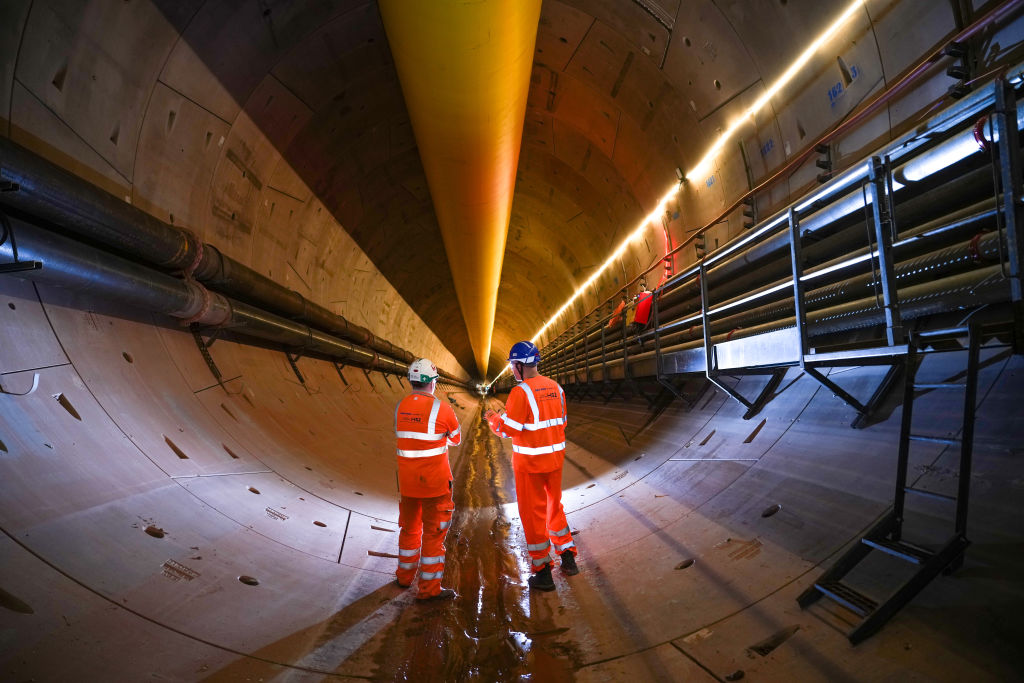
Euston will not be reached, Alexander admitted, until the mid 2040s, although the tunnel boring machines are on their way there from Old Oak Common and due to emerge in a year’s time. As for the connection with Manchester, that simply ain’t going to happen and Leeds is an even more distant dream.
Alexander’s statement was accompanied by the publication of a very revealing assessment of the governance of the project by Sir Stephen Lovegrove who focused on the role of the civil service and of HS2 Ltd the company created to manage the project. His analysis uncovers a series of failings by both the board and the Department for Transport’s civil servants, in particular over the soaring costs of the project. The board, far from scrutinising why costs had soared, instead, according to Lovegrove, proselytised for the scheme: ‘the Board focused more on advocacy for high‑speed rail and maintaining visible progress on the programme rather than on rigorous delivery within the cost envelope’. As for the auditors, HS2 relied on the Government’s Internal Audit Agency (GIAA) which not only failed to provide Lovegrove with a full list of audits it had carried out but did not have the requisite skills to cope with such a large project which was, as he puts it, ‘beyond the capabilities of the GIAA to address’.
Given all this, and the well-rehearsed arguments about a scheme that had no clear remit, suffered from politically-motivated changes resulting in a ten mile tunnel under the Chiltern hills, and received insufficient scrutiny, it is still impossible to understand how come it needs another ten years and some £40-50 billion more to be spent on it. Ever those figures are vague estimates rather than real commitments.
Surely it should be possible to tell us when the damn thing will be finished and how much it will cost. Mark Wild has taken 18 months to produce his reset, which was expected to be issued last December, and still we do not have this level of detail.
Of course, the cheapest and quickest way to finish the project would be to do it quickly. But here I suspect the malign role of the Treasury is involved. The Treasury, rather understandably, does not trust the railways but worse does not really believe in them – seeing rail not as a vital part of the nation’s infrastructure but rather a bottomless money pit. This hostility means there is a lack of trust that ironically results in extra costs because of scrutiny of every detail but no overall assessment of the long-term overall costs.
Ms Alexander was quick to blame the previous Tory administration for the overspend and delay, and there is some truth in that. In Sally Gimson’s excellent book on the HS2 debacle published last year, she highlights the fact that only one of the many rail and transport ministers during their various administrations, Andrew Stephenson, took a concerted and detailed interest in the project. The rest just seemed to agree to the huge sums being spent without scrutiny or questioning why costs were soaring.
However, one could also ask why it has taken 18 months to issue this reset and why Keir Starmer has shown no interest in the project despite its budget of £7 billion per year and the fact that a key part of it, the terminus at Euston Station is in his constituency. Last summer I met him at a social gathering and bearded him about Euston, informing him that my contacts there said that Labour was haemorrhaging votes over the chaos around the station. He responded to my warning with a dismissive ‘it’s all in hand’, something I knew was not true and, indeed, remains so since no plan for the new Euston station exists. Two proposed plans have been rejected as too expensive.
We need to hear from Starmer about what is going to happen at Euston and how he intends to improve the management of this out of control project. Otherwise Labour will have to share part of the blame for its failings.
Christian Wolmar’s book on high speed railways across the world, Fasts Track, will be published on July 23





Comments