
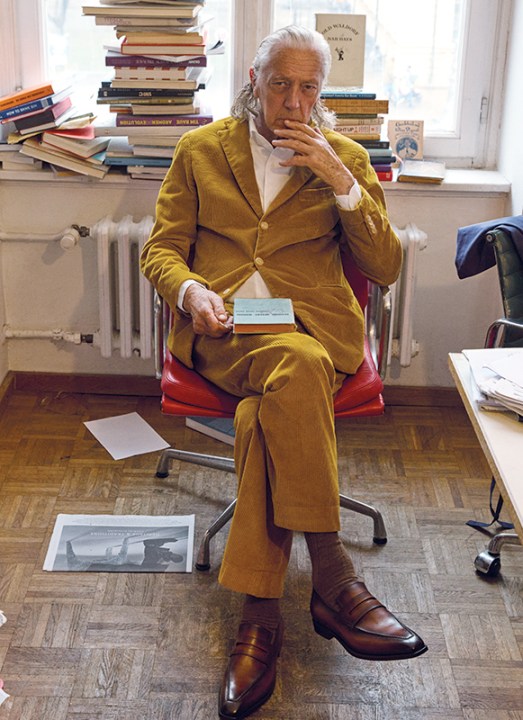
The story goes that, in 1962, Andy Warhol went into the Berluti store in Paris asking for some shoes to be made for him. The place, a family-run business founded in 1895, was well-known for its elegant footwear, and the young Olga Berluti was given the task of dealing with this new customer.
Warhol’s sketch of what he was looking for was a guide, and Olga made a pair of leather loafers. But when the artist came to collect them, she confessed that one had a scar on it where the hide had been marked, possibly by the cow catching on some barbed wire. According to the brand legend, Olga apparently said that the blemish was the result of a “subversive cow,” and Warhol stated: “From now on, I only want shoes made from the hides of subversive cows.”
Of course, though the classics endure, there is always room for innovation
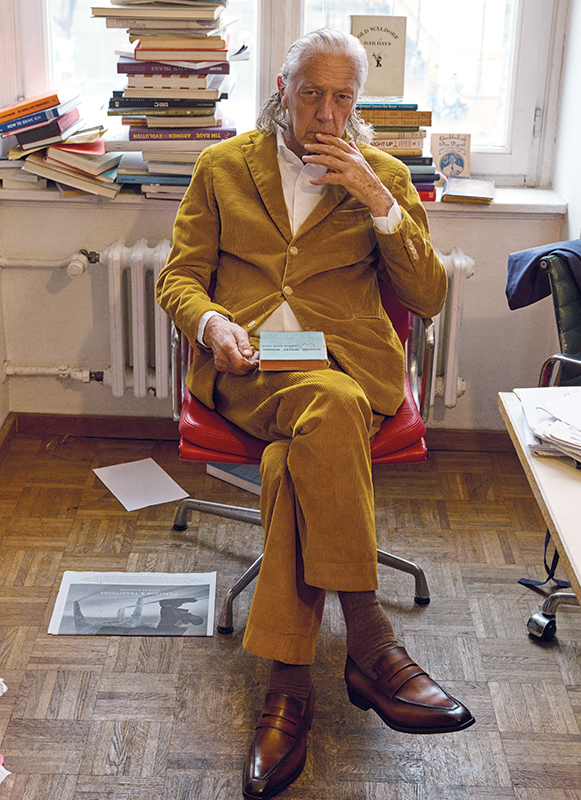
Whether that’s what actually happened, we’ll never know, of course, but it’s true that the first shoes Olga ever made were inspired by the famous artist, and the Andy loafer is today an established classic. One of its fans is Charles Schumann, the well-dressed bartender behind the famous American Bar in Munich. Schumann, whose book The American Bar: The Artistry of Mixing Drinks has become an essential text for those interested in mixology, is a Berluti fan and in many ways conforms perfectly to the brand’s imagined customer profile: elegant, idiosyncratically stylish, a connoisseur, and a cultured individual with a global outlook.
He follows in the well-shod footsteps of not only Warhol, but also other stylish men like Francois Truffaut, Jean Cocteau, the Duke of Windsor, Pierre Cardin, and Yves Saint Laurent, all of whom wore Berluti shoes. In more recent times we can add to this list actors Omar Sy, Timothée Chalamet, and Rupert Everett, as well as chef Mory Sacko and musician Alex Turner.
Time was when Olga Berluti might have invited the whole lot to join the Swann Club, a group she created in 1992 and named after Marcel Proust’s À la recherche du temps perdu character Charles Swann. The activities of this organization consisted of social gatherings of Berluti wearers, at which conversation was mixed with a ritual of polishing shoes, occasionally with ice-cold champagne.
The Swann Club no longer exists, although there is talk of reviving it. And should this happen, surely Charles Schumann would be top candidate for manning the bar. He learned his craft in bars and clubs in the south of France before returning to his native Germany to work in the legendary Harry’s New York Bar in Munich in 1973. Nearly a decade later, in 1982, he opened Schumann’s American Bar in Maximilianstrasse. The bar has since moved to Odeonsplatz under the name Schumann’s Bar am Hofgarten, and the proprietor can occasionally be spotted sitting in the garden cutting spuds for his signature roast potatoes, which he says only he can make. His secret in all things would appear to be down to great ingredients and keeping things simple– a philosophy that matches Berluti’s own.
“Our cuisine? The way I like to eat: five or six dishes, pasta, risotto, a good steak, a fresh salad,” he says. “Schumann’s is not a classic restaurant, even though people like to come for lunch or dinner. I always say we are more like a sophisticated canteen, at one of Munich’s most beautiful locations, the Hofgarten. A bar? From midnight on.”
Upstairs, the space also houses Les Fleurs du Mal. Schumann describes it as “A cocktail bar like I have always wanted… One table, nine meters long, crafted from a single tree. You can take a seat and personally discuss the drinks with the barman – just like at a bespoke tailor.”
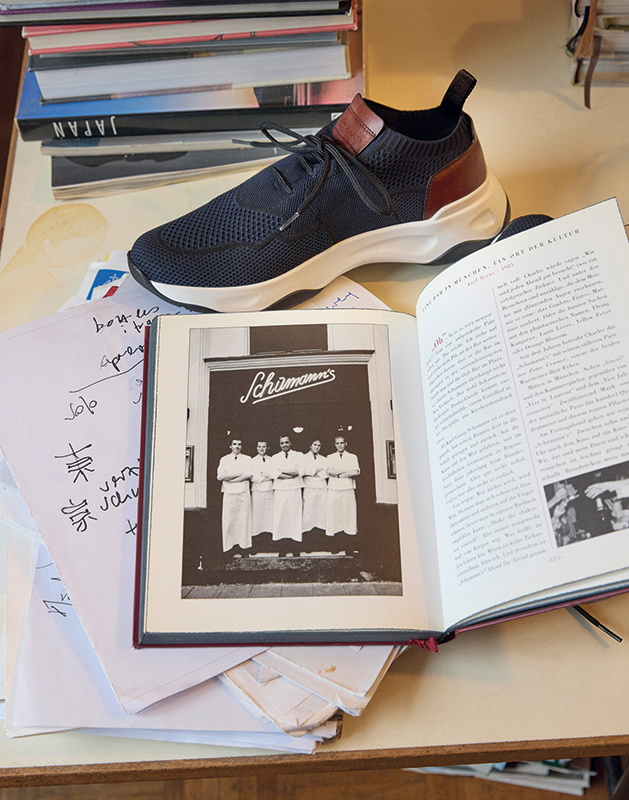
Of course, though the classics endure, there is always room for innovation. And just as Charles has created several new serves, like the swimming pool (in 1979 when at Harry’s Bar – rum, vodka, coconut cream, blue curaçao) and the pepe (tequila, cachaça, grapefruit juice, Rose’s lime juice, triple sec), so too Berluti has developed new footwear. One notable model is the very 21st-century Shadow sneaker. Launched in 2019, this has just evolved to its second generation, featuring a new acetate sole, light and flexible, that improves comfort. The upper is knitted, employing more than 375,000 stitches, which also adds to the effortless feel of the shoe. And there is a choice of materials for different looks and weathers – nylon, linen, and cashmere. Patinated leather details reference the house style, which sees hides treated with hand-painted coloring.
Between his Andy loafers and Shadow sneakers, Schumann now has a choice of Berluti shoes to suit mood, outfit, and climate. And presumably champagne to polish them with.




Comments