
The original The Thomas Crown Affair overflows with automotive eye candy. There’s an evocative promotional image of Steve McQueen with a dark blue Rolls-Royce Silver Shadow two-door (later known as the Corniche), and rarer still is his character’s Ferrari 275 GTB/4 NART Spyder. Exactly the sort of thing a millionaire playboy thief (or indeed movie star) would drive in 1968.
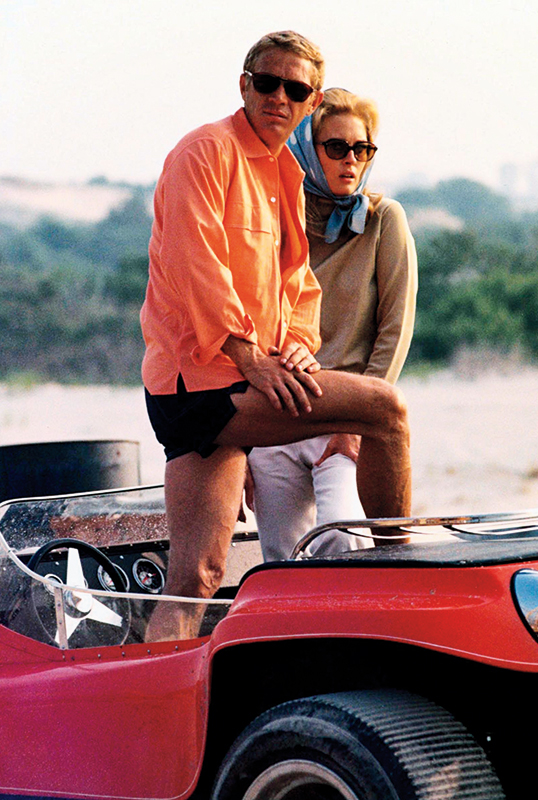
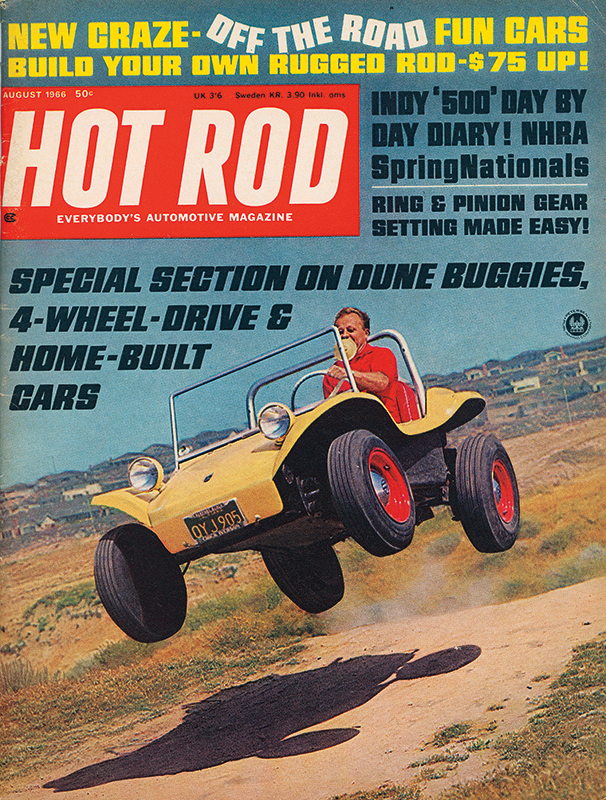
But neither is actually the film’s most famous car. McQueen, a man who likely had issues with impulse control but also the means to indulge it, was perusing the August 1966 issue of Hot Rod magazine when he realized its cover star was something he needed in his life. This was a… well, what was it, exactly? It looked like a beach buggy.
McQueen invariably got involved in Thomas Crown’s pre-production. The film’s screenplay outlined a scene in which his character and the insurance agent investigating him (played by Faye Dunaway) razz around a beach in a Jeep. McQueen insisted on casting the buggy, albeit one that was modified according to his exacting specifications. It had been dreamed up by a Californian surfer called Bruce Meyers.
He enlisted the help of an east coast vehicle shop called Con-Ferr whose co-owner Pete Condos worked with him to personalize the car. A slimline speedboat-style windscreen, centrally mounted headlights with fairings, and rear luggage rack were all added. “Mag” wheels were cast and wrapped in Firestone competition rubber. Out went the thrummy air-cooled VW engine, replaced by a bigger six-cylinder unit sourced from a Chevrolet Corvair. Not that you can hear it on the film, whose sound editors evidently preferred a V8 snarl.
As the Californian counterculture became world-famous, so the Manx was a visual symbol of those heady days
Roll forward almost 60 years and I’ve wedged myself into the original Crown car, in a doomed bid to summon up McQueen-level nonchalance. We’re leading a parade of 80 Manxes around the Goodwood racing circuit, which makes for a memorable sight. Cars are often anthropomorphized, and this one has so much personality it could have been designed by those geniuses at Pixar.
Despite its zippy pop-cultural kudos – Elvis drove one, in the opening scene of 1968’s Live a Little, Love a Little – the story of the OG beach buggy and its creator deserves more light.
California in the late ’40s and early ’50s found itself at an unusual juncture in American culture. There was post-war relief and optimism, but the black-and-white world was yet to turn Technicolor. Hot rodding soon became popular, a pastime that saw young drivers chopping and slamming mostly pre-war Fords and racing them up and down the “strip.” Bruce Meyers loved it, but he was also entranced by improvised dune buggies. Many of these were Jeep-based specials, and they were fun to chuck around – if a little bulky.
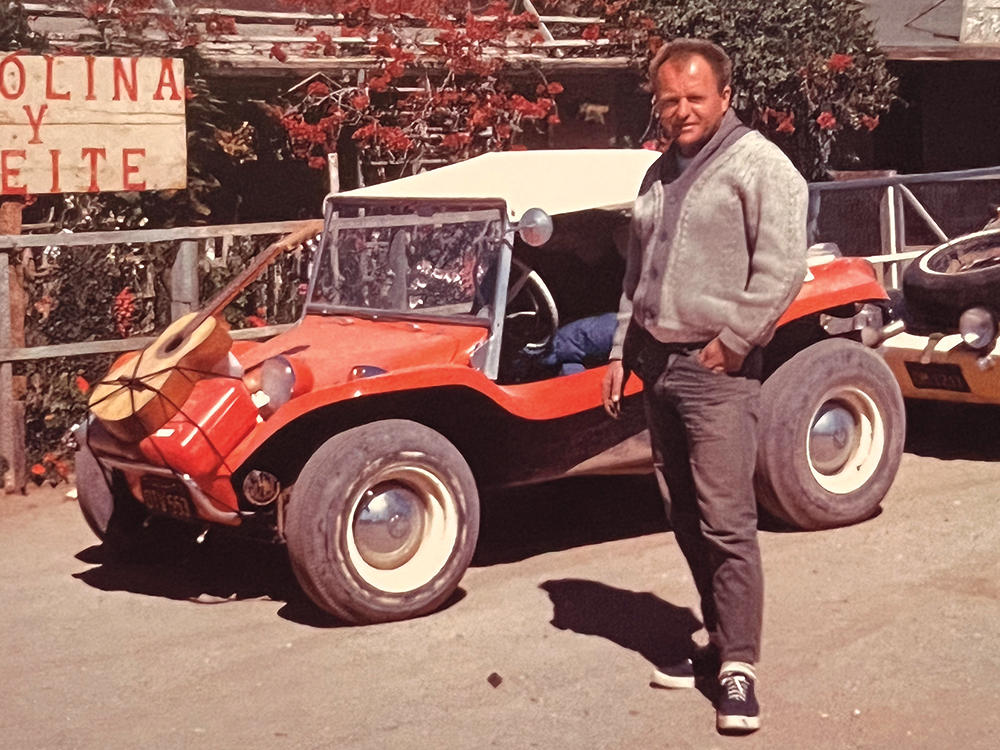
Bruce had the answer. Having returned from navy service and a spell in Tahiti, he’d taken a job at Jensen Marine where he’d fabricated tools for the company’s fiberglass boats, while also designing his own. He also became aware of a company called EMPI (European Motor Products Inc.), an aftermarket car parts and accessories business in Riverside set up by a guy called Joe Vittone. It had concocted a sheet metal, four-seat buggy called the Sportster, a neat idea rather crudely executed. (EMPI would go on to become a big noise in the influential SoCal air-cooled Volkswagen drag racing subculture.)
Following 18 months’ experimentation, Meyers’ “beach buggy” prototype looked immediately and innately right. He nicknamed it Old Red, but formally called it the Manx, because its stubby tail reminded him of the famous cat. “People would walk in and say, ‘what a neat looking toy’,” he remembered. “I just hung my hat on my wanting something I liked the look of and hoping the rest of the world feels the same way. I guess that’s what happened.”
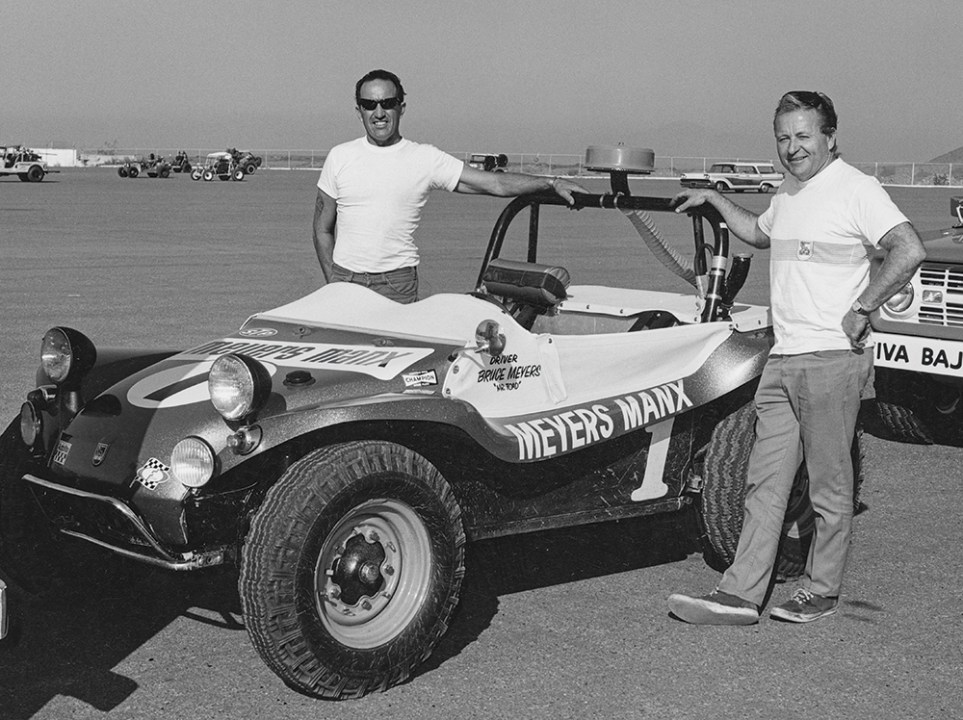
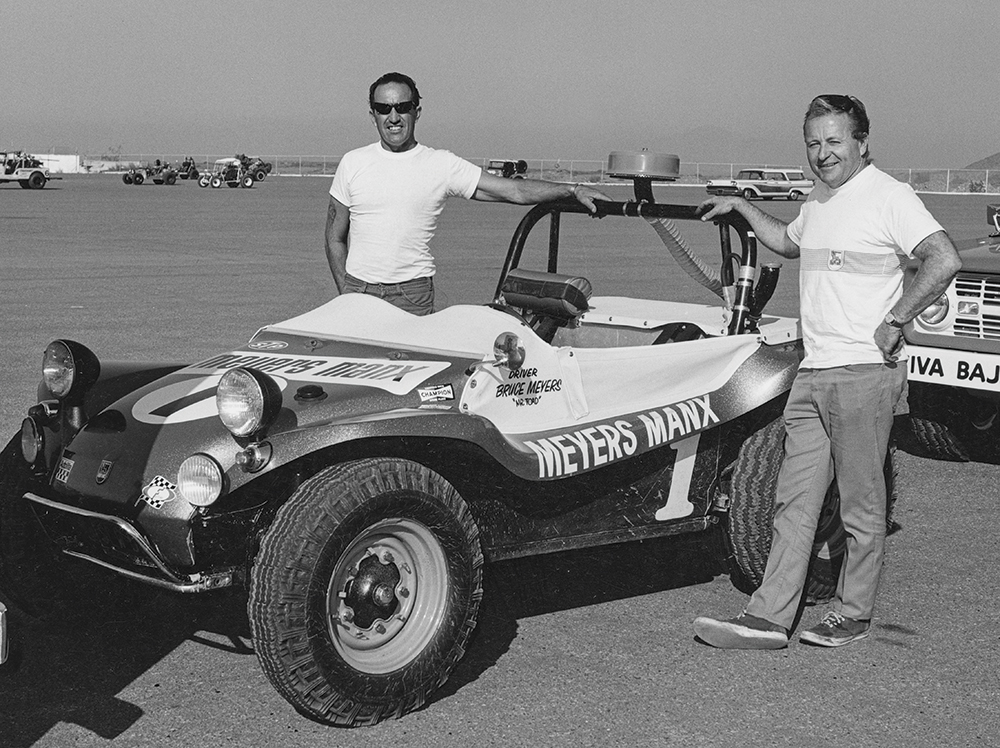
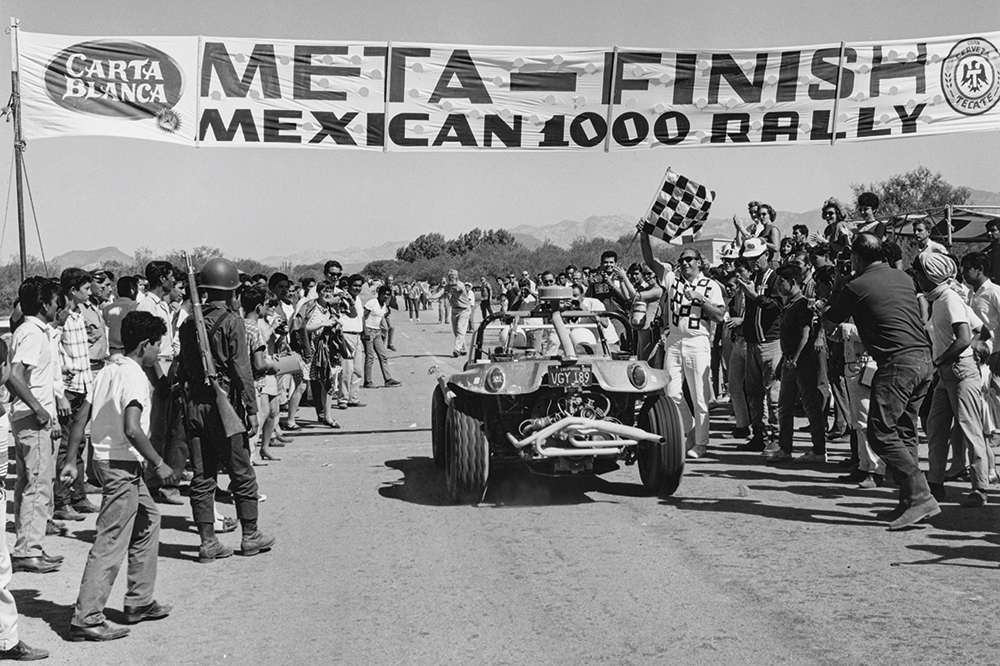
Then the car went what might be called “viral.” There was that cover of Hot Rod magazine. It took top honors in its class in that year’s Pikes Peak Hill Climb, a celebrated test of machine and driver in Colorado. A year later, Meyers and his friend Ted Mangels decided to tackle the daunting Baja run in Old Red, from Tijuana to La Paz in Mexico, completing the 952.7-mile route in 34 hours and 45 minutes (and inspiring the launch of the official Mexican 1000). It was a new record and an amazing achievement for a homebrew off-roader of minimal provenance, enough to make the cover of Car and Driver magazine. The Meyers Manx was a phenomenon, and in off-road racing the latest competitive sensation.
Bruce, though, struggled to satisfy demand for the Manx, and also hurt himself racing a new version of the car, the Tow’d, in the 1968 Mexican 1000. But an even bigger challenge loomed. As the Californian counterculture became world-famous, so the Manx was a visual symbol of those heady days. Its simplicity was key to its appeal, but it also presented grifters and copycats with an open goal. Meyers reckoned that up to 70 companies were ripping off his idea, but a costly lawsuit for copyright infringement saw a judge rule that the Manx had been in “public use” for a year before Bruce had filed for a patent (back in ’65). Meyers made around 5,200 Manxes, a drop in the ocean of buggies that had flooded the market. Frustrated and financially imperiled, B.F. Meyers & Co. ceased trading in 1971. “It took 10 years before I could hear the words ‘dune buggy’ and not get furious,” Meyers told Car and Driver in 2006.
Now the story is into its third act. Venture capitalist Phillip Sarofim grew up driving the Manx, among others. A committed car guy, Sarofim came to prominence in high-end automotive circles when he restored a famously outré one-off Aston Martin, called the Bulldog. He also owns a pair of Ruf Porsches, a Lancia 037, and bought the legendary Stratos Zero when celebrated Italian coachbuilder Bertone was forced to sell off some of the family silver. These are serious bona fides. His company, Trousdale Ventures, has interests in various areas, including tech, aerospace, and energy. Buying a beach buggy company is a bit of stretch, but they’re not planning to fatten and then flip it. “The key for us is to be custodians for a highly significant heritage brand. But to be clear, it’s definitely not a plaything,” Sarofim’s business partner, Michael Potiker, tells me.
The new Manx’s concept and design reimagining are in safe hands. Freeman Thomas is an industry veteran with Porsche, Volkswagen, DaimlerChrysler, and Ford on his résumé. During his time at VW, he helped formulate the emerging retro trend, which reached its apotheosis in the 1990s Audi TT. Thomas had actually known Bruce since inviting him to VW’s Californian design outpost back in the ’90s. He later met Phillip Sarofim at Pebble Beach and recalled seeing an original Meyers Manx in the Santa Monica mountains, and knew that Sarofim owned a Manxter. An idea took shape. Sarofim asked Thomas to call Meyers and a deal was soon worked out. “You were the only guys I wanted to sell to,” Bruce Meyers told them. He passed the baton onto the new team just three months before his death on February 19, 2021, aged 94. “We got some time with Bruce before he passed, which was great,” Potiker says. “He was charismatic, like a pirate.”
‘It reminded me of a Series II Land Rover; it’s classless and appeals to everyone from farmers to bankers’
Thomas was aware of the design challenge. “It was a continuous problem-solving process. We asked ourselves, should it be the same size, should we scale it up?” he tells me. “We went through that process digitally. I brought a digital modeler in from Ford. We’d work on it during the day, take screen shots and I’d sketch over them on my iPad. We kept it the same size, though the wheelbase is 50mm longer. The most challenging bit was the rear end, because the original had the engine on display there. So I kept sketching until I came up with the cladding surround, the grille, and the smile.”
The company is headquartered at a facility in Costa Mesa, Orange County, and the legacy business is ticking over nicely, the “remastered” car resonating with racers and high rollers alike. Kits are available for those who want to build their own, with rack and pinion steering, high-quality gel-coat paint finishes, and high-end shocks with remote reservoirs on the menu. There’s also a version powered by a radial engine, similar to the sort you’d find on a historic piston-powered aircraft with the cylinders arranged in a circle around the crankshaft. In standard form, it produces around 120bhp, but supercharging is a possibility. Slung out between the rear wheels underneath that familiar Manx body, this is a slam-dunk in a world that’s become fixated with analogue. Equally dramatic is the LFG, a version of the buggy co-developed with UK Porsche specialist, Tuthill, which goes the full McQueen and then some: carbon fiber body, 4WD with front, center, and rear limited-slip diffs, a lightweight Inconel exhaust, and emotive BFGoodrich tires.
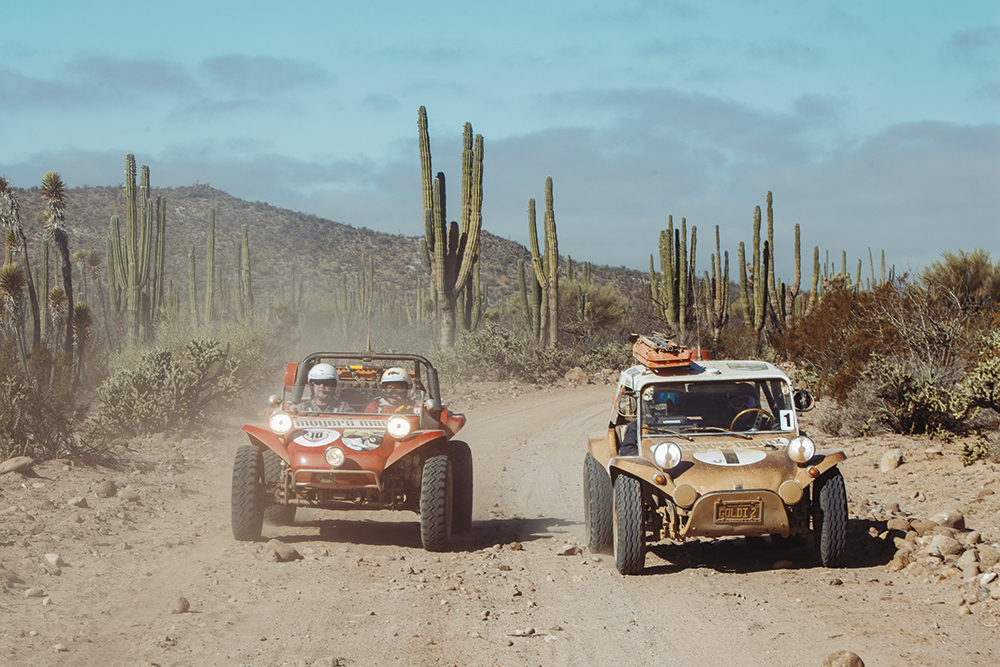
Meanwhile, the Manx 2.0, a dual motor EV with a 40kWh battery, continues gestating. Its powertrain is a sealed unit that can be submerged in three feet of water, with the hard- and software being developed in-house by a team of 15 engineers. The car uses an aluminum tub, will have a thermo-formed body, and sits on double-wishbone suspension. Bruce Meyers himself saw the potential in electric, having created a prototype in 2014. He liked the idea of a silent powertrain, all the better to experience nature as you traveled through it. The company is tech-agnostic: electric and combustion co-exist, with the emphasis above all on experience and adventure.
“I kind of watched from the sidelines and I was like, ‘I don’t know about this,’” Potiker admits of the Manx comeback. “Then I drove one in San Diego and got the thumbs-up from everyone and it ended up being valet-parked in the prime spot outside the best hotel in La Jolla. It reminded me of a Series II Land Rover; it’s classless and appeals to everyone from farmers to bankers. Phil had great foresight, and the brand opportunity is big, too. We’ve got serious about apparel and the lifestyle side, as well. We want to create an incredibly robust business; it’s not a passion project. Passion projects, especially in automotive, can be viewed as an environment where a significant loss is OK. That’s not what’s going on here. The Tuthill LFG car demonstrates the experience aspect of it. We want people to have adventures – like Bruce did, in fact.”
Steve McQueen would surely have approved.





Comments