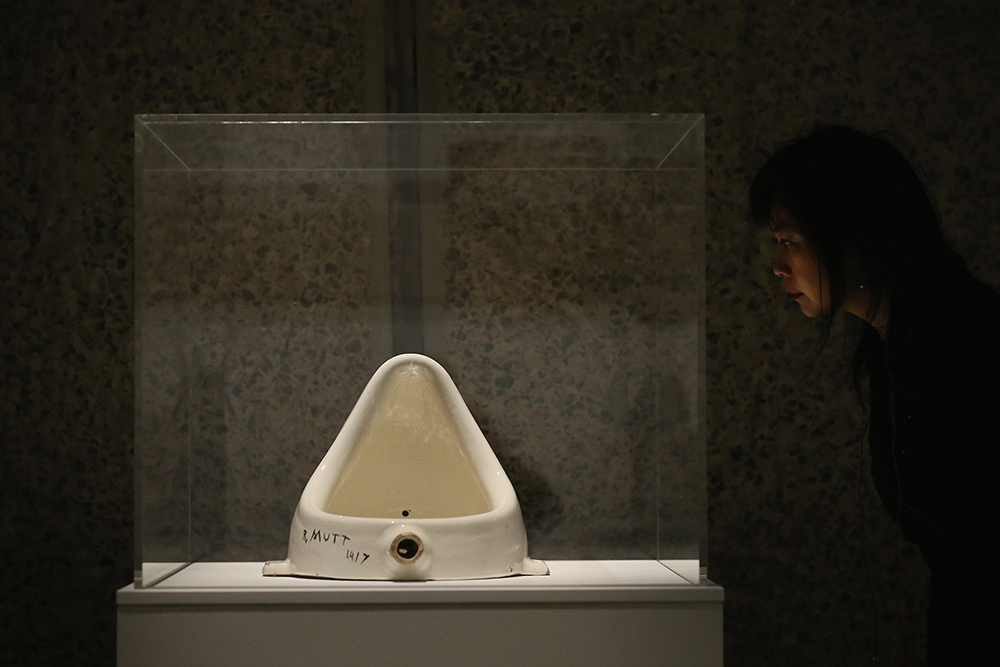
This slim volume has only one fault. It has no illustrations. So you’ll have to do some Googling or visit the current Duchamp exhibition at MoMA (until 22 August) if you want to know what ‘The Bride Stripped Bare by Her Bachelors, Even’ looks like. Otherwise it’s perfect – wittily written and packed with many fascinating characters besides the ever intriguing Marcel Duchamp.
He didn’t actually arrive in New York until 1915, but when he did he found himself already famous. His ‘Nude Descending a Staircase, No. 2’ had been included in the 1913 International Exhibition of Modern Art, alongside works by Picasso, Van Gogh, Gauguin, Matisse and Braque, and completely stole the show. Duchamp didn’t even know the painting was being exhibited. He was still in Paris studying to be a librarian. He’d previously submitted it to the Salon des Independants in Paris but they’d asked him to change the title and he whisked it away in a huff. He decided to qualify as a librarian because ‘I wanted a nice quiet job. I was through with the world of the artists.’
But when he sailed to New York to escape the war, he found himself welcomed as the Nude-Descending-a-Staircase Man. He gave dozens of press interviews and put out provocative statements:
If only America would realise that the art of Europe is finished – dead – and that America is the country of the art of the future. Look at the skyscrapers! Has Europe anything to show more beautiful than these?
He acquired a great patron in Walter Arensberg and made good friends with Man Ray, Florine Stettheimer (whom Andy Warhol called his favourite artist) and the heiress Beatrice Wood, who recalled:
Marcel at 27 had the charm of an angel who spoke slang. He was frail, with a delicately chiselled face and penetrating blue eyes that saw all. When he smiled, the heavens opened. But when his face was still it was as blank as a death mask.
Women queued up to sleep with him, but he preferred the less attractive ones because, he said, they made love better than beautiful ones.
Collectors clamoured for more paintings, but he was obsessed with his ‘readymades’, of which the most celebrated remains ‘Fountain’. It was a urinal he reputedly bought from a plumbing suppliers and signed ‘R. Mutt 1917’. He submitted it to the Society of Independent Artists, which was supposed to show any artist who paid $5 in annual dues and a $1 entry fee. So ‘Fountain’ was duly entered – and rejected. Duchamp had it photographed by Alfred Stieglitz and that was the last anyone saw of it. The original no longer exists. Nevertheless, it has often been recreated for Duchamp exhibitions.
John Strausbaugh floats the interesting theory that ‘Fountain’ was not actually the work of Duchamp at all but of Baroness Elsa von Freytag-Loringhoven. She was a well known German eccentric, ‘unhampered by sanity’, who turned up in New York in 1913, aged 39. She worked as a life model at the Art Students League and looked extraordinary: ‘Her lips were painted black, her face powder was yellow. She wore the top of a coal scuttle for a hat.’ She lusted after Duchamp and wrote him a poem – ‘Marcel, Marcel, I love you like hell, Marcel’ – but he would have none of her because she stank like a skunk. But they were good friends, so it is significant that Duchamp wrote to his sister the day after the Independent Artists’ exhibition opened: ‘One of my female friends under a masculine pseudonym, Richard Mutt, sent in a porcelain urinal as a sculpture.’ And also that he did not claim ‘Fountain’ as his own until 1934, after the Baroness died.
The work he slaved over from 1915 to 1923 was the ‘large glass’ he titled ‘The Bride Stripped Bare by Her Bachelors, Even’. He showed it at the Brooklyn Museum International Exhibition of Modern Art in 1926 but it fell rather flat and some reviewers didn’t even mention it. Duchamp was bitter: ‘Nobody cared for it, nobody saw it or even knew about it.’ Moreover, its two glass panels were subsequently shattered in shipment. But he cared enough to spend two months piecing them together and encasing them in more sheets of protective glass. The critic John Golding said that, with the fractures, the work ‘acquired the character of some giant icon, battered and venerable before its time’.
Aged 35, Duchamp said that he was through with art and would concentrate on becoming a chess champion. In fact he remained involved in art, both as a dealer for Brancusi and as a mentor to Peggy Guggenheim, who wrote in her memoir: ‘Marcel was a handsome Norman and looked like a crusader… Every woman in Paris wanted to sleep with him.’ He was also secretly working on the ‘Étant Donnés’, which Strausbaugh calls ‘his last great – and greatly baffling – work of art’. It is a sort of ‘What the Butler Saw’ assemblage, still in situ at the Philadelphia Museum of Art, which has to be viewed through two peepholes and reveals a naked woman spreadeagled on a bed of twigs and branches with woods and a waterfall in the background. Jasper Johns thought it ‘the strangest work of art any museum has ever had in it’.
But Duchamp was dead of a heart attack by the time it was unveiled in 1969. The Village Voice obituary pronounced him ‘the most influential artist of our time… A mainspring, a wellspring, a genius’. And his importance has, if anything, increased since. Last year Jeff Koons declared that ‘Duchamp is as relevant today as in his own time’ and Ai Weiwei said: ‘Marcel Duchamp’s influence remains profound – not only today but well into the future.’ Strausbaugh’s brisk little book is an ideal introduction.
Comments