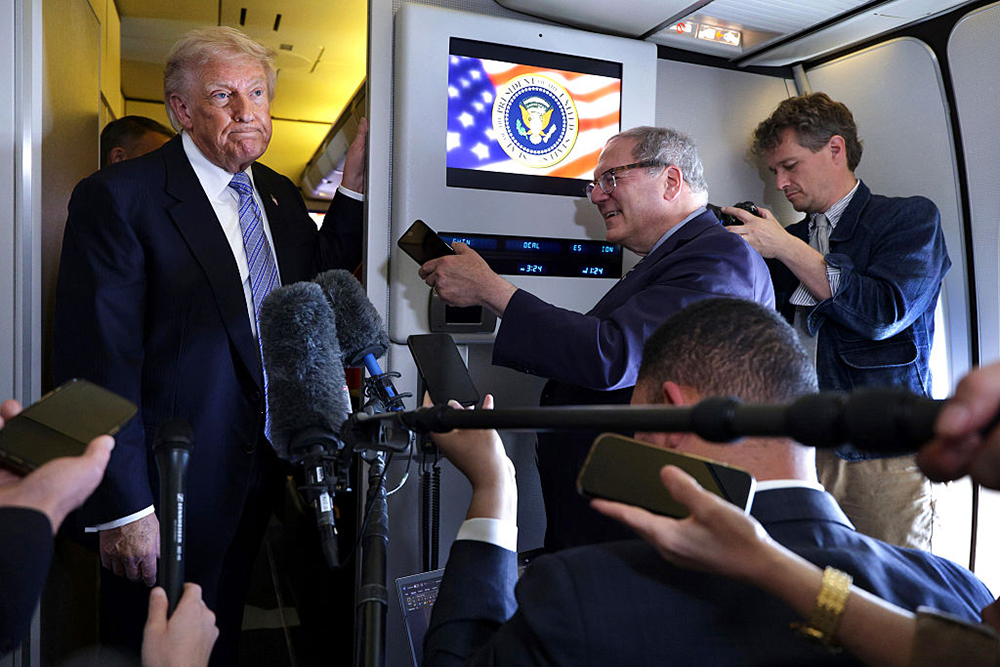



Donald Trump has had a career-long love-hate relationship with the press. On one hand, he popularized the phrase “fake news” and branded the press “the enemy of the people.” On the other, the President takes phone calls from virtually every reporter with his personal cell and is fixated on cable news and his print media coverage. Trump views journalists as friends, foes and foils, or some combination of the three. But if a story catches him at the wrong moment, the author could find themselves on the receiving end of a Trump-SLAPP.
A Strategic Lawsuit Against Public Participation, or SLAPP, is a lawsuit filed with a tactical intent besides disproving a damaging story in a court of law. Usually the suit demands an attention-seekingly large sum in damages. “I wish that every article describing a lawsuit would note that the sums demanded are purely for the benefit of headline writers and should always be read in a Dr. Evil voice,” is how the New Yorker’s lawyer Fabio Bertoni puts it.
‘Trump’s natural instinct is to be litigious. It’s the bare-knuckle New York real-estate, fist-fight mentality’
The complainant may wish to undermine the integrity of the offending reporter or outlet. Or they could file a SLAPP as a means of intimidating other outlets from pursuing negative stories. Unlike a bona fide libel suit, the end-goal of a SLAPP isn’t necessarily a jury or judicial ruling in favor of the plaintiff, though an out-of-court settlement can also be considered a win. “The complaints are framed as wild PR screeds against the press generally, and against the reporters or news organization that’s being sued,” David Korzenik, a veteran media lawyer, tells me. “They include all kinds of allegations that have nothing to do with the specific libel claim that they’re trying to bring. They get immediate press coverage which echoes all the extraneous stuff that’s tossed in to discredit the initial story.”
In his second term as president, Donald Trump has been particularly SLAPP-happy. He is seeking $10 billion from the BBC for a Panorama documentary that cut a section of his January 6, 2021 speech – or, per the wording of the suit, “intentionally, maliciously and deceptively” doctored his words. Trump wanted another $10 billion from the Wall Street Journal after the newspaper published the signed cartoon he reportedly supplied for Jeffrey Epstein’s 50th birthday book. “These attempts by powerful people to shut reporting down, with the use of injunctions and SLAPPs threats via lawfare, were something that I thought I’d be escaping when I came over here,” says Emma Tucker, the British editor-in-chief of the Journal. “I was excited about the fact that America has a much freer environment for reporting. What’s really worrying is the gradual import of what I got used to in Britain over here.”
At a recent conference, Tucker described what it was like to face a SLAPP suit. “Everybody gets tied up,” she said. “The lawyers are busy. The reporters working on the story, instead of working on the story, they’re having to deal with the lawyers. It’s also the case that the stories that used to get dismissed by courts no longer get dismissed.”
Journalists must also contend with how a SLAPP suit causes trouble for their outlet’s owner. ABC made a $15 million donation to Trump’s presidential library to settle a defamation suit the President brought against George Stephanopoulos after the anchor wrongly stated that Trump had been found civilly liable for raping E. Jean Carroll. (The term “sexual abuse” would have been more precise – and Trump continued to appeal the civil court’s ruling.) CBS donated $16 million to the library to settle the President’s suit against 60 Minutes. Trump alleged the program’s interview with 2024 rival Kamala Harris had been edited to “tip the scales” of the election in her favor. CBS said Trump’s case was “completely without merit” – then settled regardless, at around the time its parent company Paramount needed regulatory approval for its merger with Skydance.
Other figures in Trump’s orbit have also eagerly deployed the SLAPP. First Lady Melania Trump threatened the author Michael Wolff with a $1 billion suit after he claimed her relationship with Jeffrey Epstein was closer than previously reported: he countered with his own lawsuit against her. FBI Director Kash Patel filed a $250 million suit against the Atlantic for publishing a piece claiming his colleagues had raised concerns about his drinking. Patel’s response to the reporter’s request for comment was notably brazen: “Print it, all false, I’ll see you in court – bring your checkbook.” And Trump Media and Technology Group sued the owners of the Guardian and Variety for their reports on the Southern District of New York’s money-laundering probe into its financing. Hugo Lowell wrote the Guardian story that led to the TMTG suit. “I believe that they filed that suit because it angered Trump personally and moved their share price into bargain-basement territory,” he tells me. “The suit was an attempt to discredit the story, even though it later turned out to be absolutely correct.”
How can the press fight back against such high-stakes, vexatious and frivolous lawsuits? “Many states have anti-SLAPP laws,” Korzenik says. “Some of them are quite strong, as in New York, and some of them are really quite feeble. Some judges are uncertain about how to apply them because they’re new.” A series of recent cases has clarified that New York’s anti-SLAPP law is applicable in federal court. “You keep advancing the claims, sometimes in hostile judicial settings, other times in more favorable ones, and you can improve the law,” Korzenik says. “That’s exactly what happened with different litigants getting the New York anti-SLAPP over that federal hurdle.”
Usually an outlet will file a stand-off motion to dismiss as soon as they receive a SLAPP – but those motions can take around two years to reach a judge. Korzenik thinks the press could be more aggressive, sooner. “Do the standoff motion and also immediately get third-party discovery and subpoenas out, and start to expose the problems in the plaintiff’s factual case, not just their pleadings,” he suggests.
Trump’s track record of sending frivolous legal letters stretches back decades. “It’s the bare-knuckle New York real estate, fist-fight mentality,” Lowell says. “His natural instinct is to be litigious.” Korzenik used to represent Spy magazine in the 1990s: “We wrote about him all the time and he threatened us all the time, sometimes through lawyers. I still have some of his letters. If you’re not intimidated by him, he disappears. If you’re intimidated by him, like some of the law firms that caved, he’s back on your ass again.”






Comments