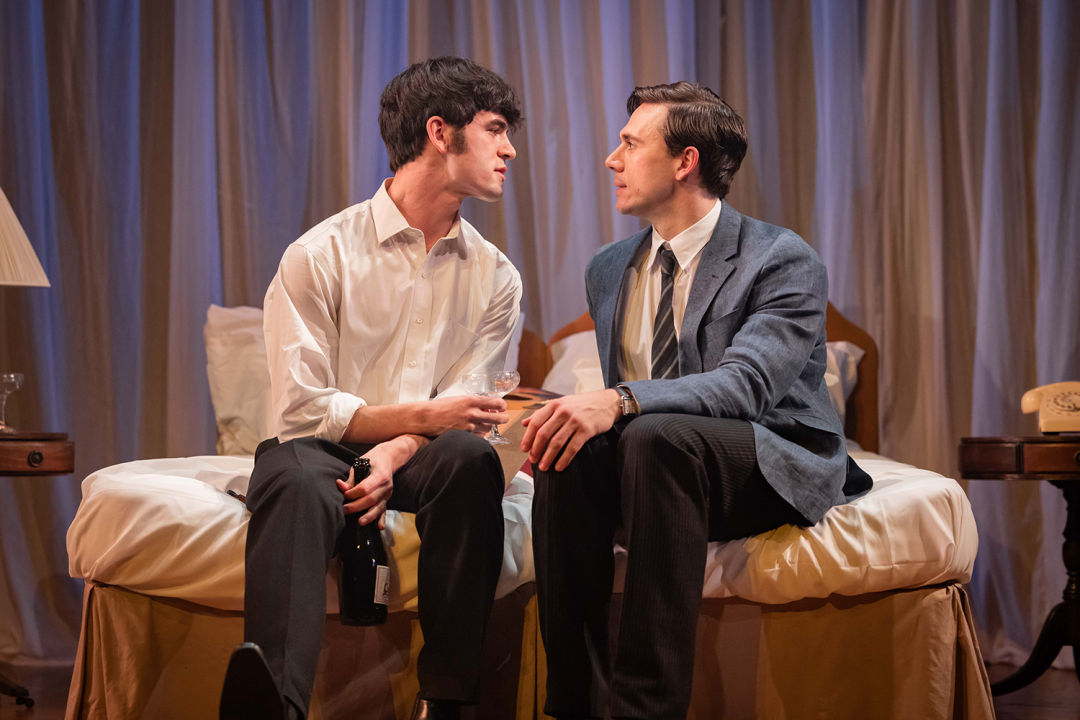


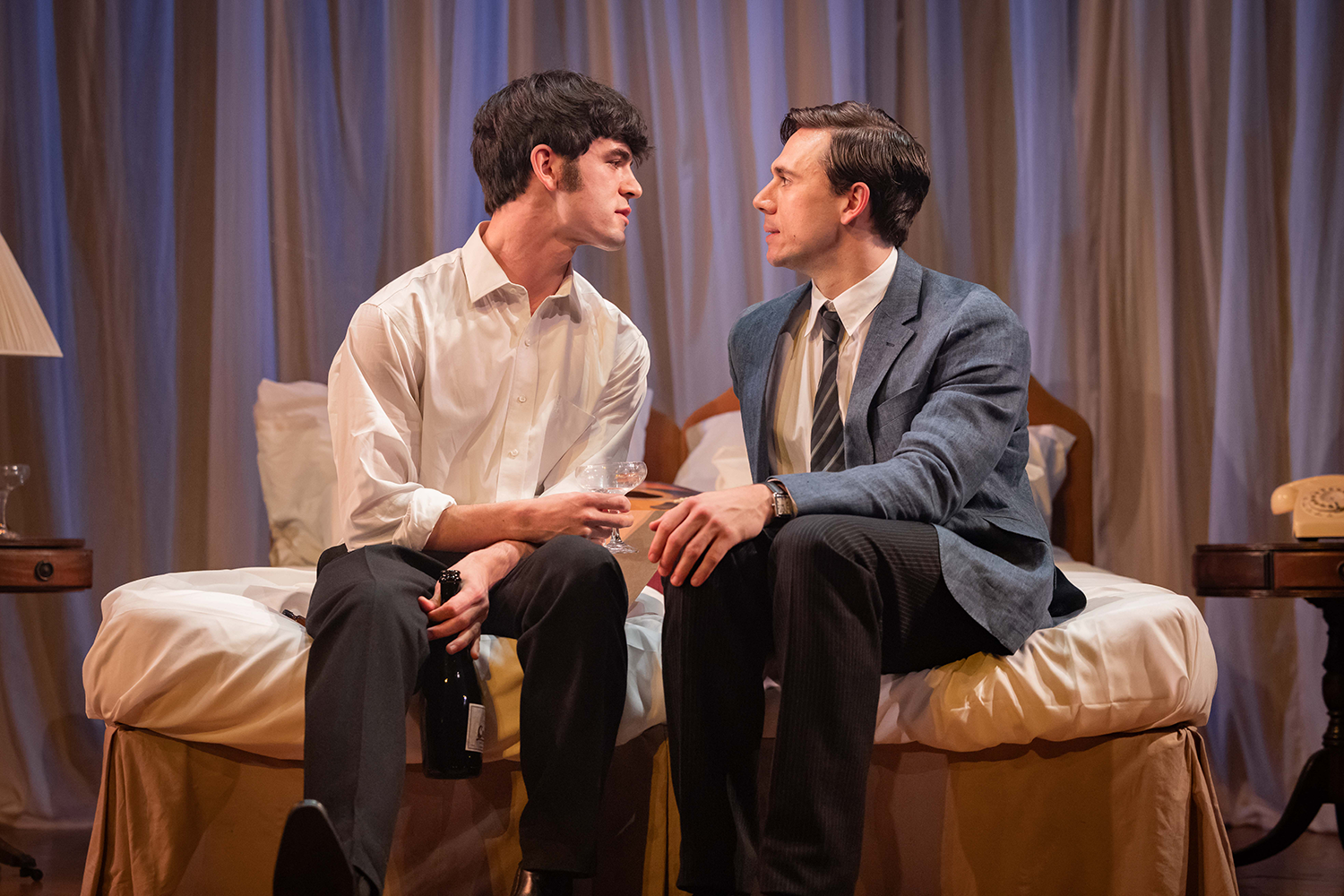
Please Please Me is a play about Brian Epstein whose brief and troubled life remains relatively unknown. Tom Wright’s linear script opens with the teenage Epstein enjoying secret affairs with teddy boys while working at his dad’s record shop on Merseyside. When he spotted the Beatles at the Cavern, he was smitten by their homoerotic energy rather than their music or their potential for making tons of cash. He put them in suits to soften their image while encouraging their talent for witty backchat. ‘A little pinch of naughty but family friendly,’ was his branding message. But he lacked artistic vision and he cut a lousy deal to sell plastic Beatles dolls which cost the band a fortune and angered Paul McCartney. We don’t hear enough about these personality clashes because the show is very nearly a Beatle-free zone. Their music isn’t featured and Lennon is the only band member we meet.
What an odd creation. A Beatles show without the love
The story focuses on Epstein’s hopeless love life and his infatuation with Lennon who bullied him over his sexuality and his racial heritage. When Epstein was commissioned to write an autobiography, Lennon suggested the title Queer Jew. He seems to have wallowed in Lennon’s jibes and they had a brief affair, according to this play, at a hotel in Torremolinos while Cynthia was at home in England nursing the newborn Julian. Lennon offers a long list of pretexts for sleeping with Epstein: pity, physical curiosity, a disregard for social convention, a wish to explore the power dynamics of gay relationships. The surfeit of motives sounds a little strained. How many reasons does a man need? Later, they had a second tryst which Lennon explained more simply: ‘I wanted to prove I didn’t enjoy it.’
As Epstein became richer his life got sadder. He suppressed his Merseyside brogue and affected a pretentious Home Counties accent which made him sound like a rotter from an Ealing comedy. In America, he continued his doomed pursuit of happiness by boozing all day, popping pills, trying LSD, and hiring rent boys with a taste for rough sex.
The emotional atmosphere of the play is sour, crude and alienating. Too many scenes end with characters screaming and swearing at each other. When Epstein hit rock bottom, he tried to reinvent himself as a straight man by offering himself to Cilla Black who turned him down. Eleanor Worthington-Cox captures Cilla’s effusive charm brilliantly and she can sing as well. Her warm and melodious voice easily surpasses the original. (Cilla sang like an air-raid siren.) Worthington-Cox puts in a double shift as Lennon’s fearsome Aunt Mimi and as the glamorous but irascible Cynthia who struts around the stage in a blonde wig and a chic sun hat.

There’s a lot of fun and joy in this story but the play can’t find it because Epstein is the saddest and least interesting figure in the entire Beatles saga. Calam Lynch plays him as a pitiful washed-up loser whose character is unlikely to appeal to mainstream theatre audiences. Noah Ritter bears a strong resemblance to Lennon and his vocal impersonation is excellent. But the script concentrates on Lennon’s mean, thuggish side and ignores his mischievous lyrical talent and his political dreams. What an odd creation. A Beatles show without the love.
Flush is a hectic play set in the most crowded ladies’ loo in clubland. The set features three lavatory stalls where the characters vomit and urinate while exchanging gossip and sharing toots of cocaine. Off-stage dramas spill into the restroom. Fisticuffs erupt between members of a hen party. A group of office workers search for a shy American colleague who locks herself in a cubicle and sends forlorn messages home. A gang of underage girls discuss how to meet boys while avoiding the gaze of an older female who threatens to call their parents.
This is a witty, frenetic, good-natured drama that wants to cram far too much into too small a space. Four actresses play 15 characters and they keep sprinting off stage to change their costumes and wigs. The realistic dialogue contrasts adolescent girls with their older counterparts. The youngsters are fixated with cosmetic enhancements that they don’t need while the mature women are still fretting over nicknames they acquired years ago in school. Setting the drama in a lavatory is a neat idea, in theory, but it limits the show’s freedom to breathe and to take its time. No central character emerges from the tangled mass of inter-related stories. Ultimately, the loo itself is the dominant personality and it serves as a shelter, a make-up salon, a parliament and a place of safety for the mad, the weird, the lonely and the weary.
This is an impressive debut by April Hope Miller who deserves to emerge from the little girls’ room and into a domestic setting.






Comments