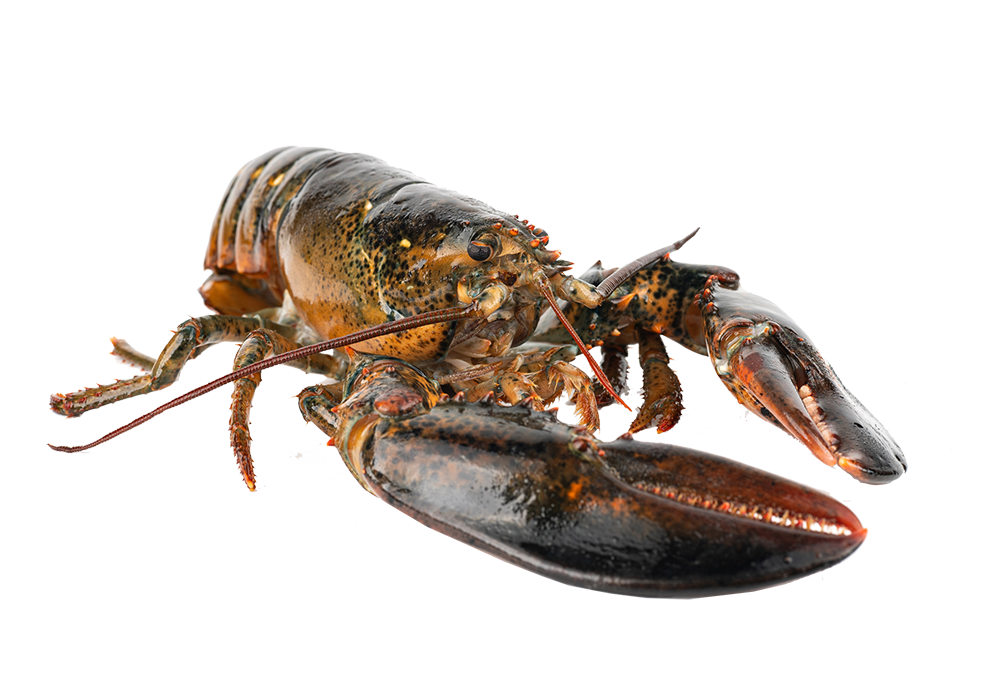



She was doing a postgrad course in a town by the sea, and a strange thing happened to us one afternoon. On the quayside we saw lobsters being sold from a trestle table. Only one of them remained and I squinted at it, close up. The sharp oval claws, like holsters, had been bound in elastic bands to stop them nipping customers. It seemed a small-minded precaution. These imposing pincers were cumbersome and useless on dry land. But in the sea, with the water’s buoyancy to give them mobility, they would be swift and lethal weapons. Yet the lobster-catcher had neutralized them with a pair of turquoise bands. What for? The beast was already defeated, plucked from its natural habitat by a giant human being, and yet the victor was fearful of the tiniest nip from his prisoner’s claws.
We carried the lobster back to her kitchen in a plastic bag. We hadn’t thought about how to cook it. It was a fascinating creature, dark brown with tiny spots of color on its bony outer skeleton, a thing of incalculable antiquity. Ten million years old? Or 350 million years? It looked strangely modern with its jointed limbs and sunken central base and those slow, lumbering pincers. It might have been a demolition machine or an extractor for grabbing ore from the side of a mountain. The color puzzled me.
“Aren’t lobsters orange?”
“After you cook them,” she said.
It was still alive, twitching and groping blindly on the draining board, unaware that its end was nigh. We might have spared it by walking to the beach, launching it into the shallows and buying some jacket potatoes for supper. Instead we carried on discussing its death. I’ve killed fish and chickens before, and it’s easy enough. You smash them on the head with a tool. Then you wait. If the first smash doesn’t kill them, you smash them on the head again. I couldn’t do that with a lobster. It didn’t have a head.

“Boil it,” she said, filling a saucepan from the tap. An unspoken dilemma arose. Boil it gradually or throw it into scalding water? Either method was horribly cruel. A slow, creeping death in a pool of liquid that rose to a furious heat? Or a lethal plunge into a bubbling cauldron?
“Let’s put it back in the sea,” I said grandly, knowing that this sentimental absurdity would be overruled.
Then a stroke of luck. It had died on the draining board while we were chatting about its execution. I picked up the cold, fabulous monster and lowered it into the saucepan. She turned up the heat and we got ready to eat it. I poured two glasses of wine. Then it started to move. The warmth had triggered an escape reflex. It was thrashing and jerking against the saucepan. It pushed its claw downwards, as a sort of elbow, or lever, and heaved itself halfway up the side of the metal prison. It fell back again. A pause. More heat triggered another attempt. This time it nearly succeeded in pole-vaulting out of the pan.
We exchanged a glance. Then we looked at the desperate captive trying to flip itself free of our deadly trap. This third effort – clumsy and doomed – gave us the same thought. Spare this innocent beast. Let it go. But we’d damaged it so badly it couldn’t survive in the sea. Besides, we still needed supper. So we carried on boiling it to death. I covered the pan with a lid so we could at least pretend we weren’t killing a defenseless animal.
CLACK.
The lid moved. A desperate bony claw kicked at the cover and shifted it clear.
CLACK CLACK.
The lid came off and landed noisily on the floor. The jailbreak was back on. I picked up the lid and plonked it on the pan again. I weighed it down with a chopping board.
CLACK CLACK.
It was still hammering, still determined to get out. CLACK CLACK CLACK. God. It was horrible.
CLACK CLACK CLACK.
We looked at each other, embarrassed by this extended death scene. We giggled too. There was something funny and tragically absurd, in the thump-thump of the ancient sea monster as its life came to an end in a saucepan on a stove in a cottage by the sea.
CLACK CLACK CLACK.
“Oh God.”
“Let’s go.”
We retreated guiltily into the sitting-room. I closed the door.
CLACK CLACK CLACK.
Still audible.
“How long’s it going to last?”
We stood there, waiting until the last clacks had ceased. In the kitchen we looked at the thing we’d killed. It was bright orange. We served it with lemon juice and a green salad. We needed the heaviest weapons in the kitchen to pierce its bony, plated armor. I don’t recall the taste. Nutty I think. Lobster is another dish I’ll never eat again.
But I felt a powerful new connection with her the day the lobster died. We’d set out to gratify a basic need – hunger – and we’d cooperated in destroying an animal in order to sate ourselves. It felt like creation in reverse. And I sensed – or imagined – that this willingness to kill together had given rise to a contrary wish. A desire to engender life. We became parents-to-be that day, in spirit at least. Twenty months later, our son was born.



Comments