There’s a question I’ve started being asked at work. Given I’m a psychiatrist, it isn’t one I’d ever expected to hear: ‘Do I have cancer?’ A young woman with anxiety wants to know whether the lump on her neck is sinister; she has been watching a great deal of TikTok. A man in his late thirties, in for a routine review, mentions in passing that his sister has been referred for a colonoscopy and wonders whether he should be too. At a dinner party a few weeks ago, a friend leant across halfway through her low-alcohol natural wine and asked me, in a small voice, whether it was true her generation was getting cancer in their thirties.
Yes, I said, perhaps a little too bluntly. She looked rather panicked for the rest of her evening. But it is true, although not quite in the way some in the media have framed it. The current panic is about a ‘Gen Z cancer crisis’, which is, broadly speaking, nonsense. The data says something different yet just as worrying. The generations being hit hardest are, in fact, the very ones now phoning me up in a panic. They are millennials and Gen X: people in their thirties and forties. The generations, in other words, who have done absolutely everything they were told to do. Gen Z, who are even more abstemious than millennials, may yet end up the worst affected of the lot. But cancer in your twenties remains rare, so we won’t know for a decade or two.
Gen Z, even more abstemious than millennials, may yet end up the worst affected of the lot
In 2024, researchers at the American Cancer Society published findings in the Lancet Public Health journal that ought to give my dinner party friend pause. Among 23.6 million patients, incidence rates of 17 of 34 cancer types (including breast, pancreatic, gastric, colorectal, kidney and uterine) were climbing through successive generations, each cohort doing worse than the one before.
Some of the figures are gobsmacking. Someone born in 1990 is twice as likely to develop colon cancer and four times as likely to develop rectal cancer as someone born in 1950. Bowel cancer is now the leading cause of cancer death in men under 50 in the US. In Britain the trajectory is the same. Globally, early-onset cancer (anything diagnosed before 50) has been climbing by between 1 and 2 per cent a year for two decades.
Now you might think we’re simply catching more cancers than we used to, thanks to improved screening, greater public awareness and so on. But the studies have been controlled for screening intensity and the rises persist. What’s more, the cancers picked up in younger people are, on average, more aggressive, more advanced at presentation and harder to treat.
And here is where it gets awkward, because these are the generations who think they’ve done everything right. They drink less than their parents drank. They smoke considerably less than anyone over 50. They have signed up to the wellness gospel with the kind of zeal that used to be reserved for religion. They run half-marathons, do yoga, monitor their sleep cycle, count their steps, journal their feelings, swallow their omega-3s, drink their oat milk lattes, and have done more therapy between them than the entire population of post-war Britain. They have turned up their noses at the boomer pint-and-Marlboro tradition.

So why are they the ones who are dying, statistically speaking? Nobody knows for certain. But there is a depressingly plausible suspect, and that suspect is what they have been putting in their mouths. Last November, clinicians at Massachusetts General Hospital published a paper in JAMA Oncology that looked at women under 50. Those eating around ten servings of ultra-processed food a day had a markedly increased risk of developing bowel polyps, the precursor to colorectal cancer, compared with those eating around three.
Their work is part of the wider Prospect programme, a Cancer Grand Challenges initiative founded by Cancer Research UK and the National Cancer Institute, which is hypothesising that early-life exposure to ultra-processed food is the dominant driver of the early-onset bowel cancer surge. Closer to home, an analysis of UK Biobank data by Imperial College, published in 2023, found a clear association between higher intake of ultra-processed food and both cancer risk and cancer mortality in British adults.
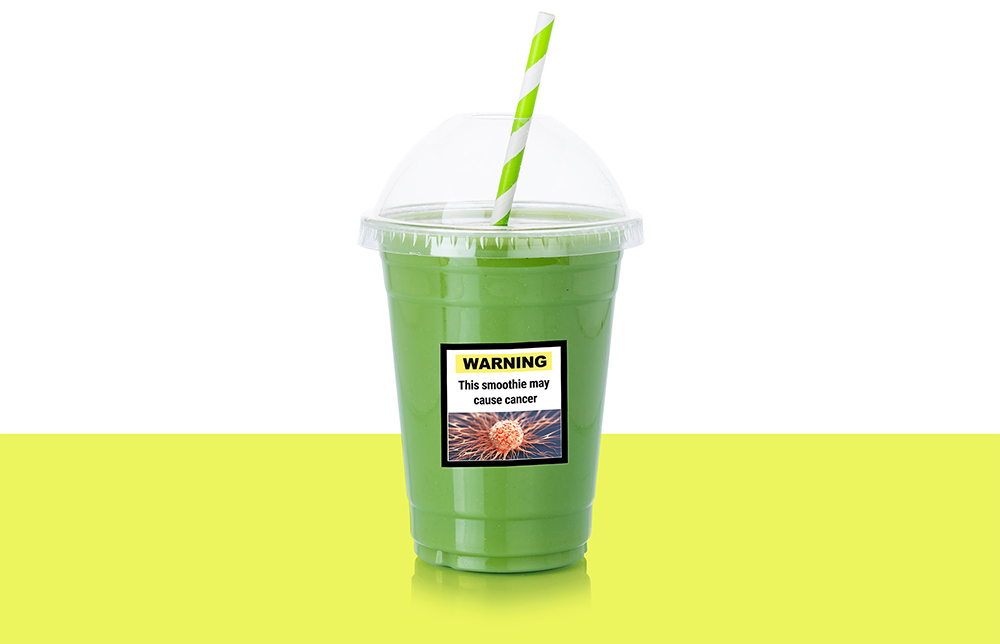
The irony here is bitter. Ultra-processed food is the very thing hiding behind the wellness branding. The protein bar with 18 ingredients on the packet, displayed lovingly in the gym café. The ‘high-fibre’ breakfast cereal with the additive-to-actual-food ratio of a Soviet cosmonaut’s meal pouch. The cold-pressed smoothie that is largely sugar dressed up as virtue. The plant-based ready meal whose ingredients list runs to a second column. The meat-free sausage, the protein powders, the ‘naturally flavoured’ everything. These are the staples of a generation that prides itself on its health, and many of them are precisely the foods now most strongly implicated in early-onset cancer.
Of course, it isn’t only food. Obesity rates in the younger generations are significantly higher than they were at the same age in their parents and grandparents, and obesity is implicated in around a dozen different cancers; the metabolic syndrome it produces is a generally hospitable environment for tumour growth. Sedentariness is part of it, which is what desk jobs and screens do to a body. The gut microbiome may also be disrupted, possibly from early antibiotic exposure, lower rates of breastfeeding, and the rise of caesarean delivery. And there’s emerging interest in what scientists rather grandly call ‘the exposome’, the total cocktail of environmental chemicals, microplastics, endocrine disruptors and other novelties to which the post-1970 generations have been exposed since gestation. None of this is settled, but the picture is consistent: the body of someone born after about 1965 has been swimming in a different chemical and metabolic broth from infancy onwards than the body of someone born before. And the result is turning up in the cancer wards.
Which brings me to what I’m supposed to say to my patients, though it isn’t always what I do say. The message neither the patient nor the wellness industry wants to hear is this: the older generation, with their lamb chops and their gin and tonics and their roast on Sundays, were probably not eating a worse diet than the one young people are currently shovelling down in the name of clean living. They cooked from raw ingredients. They ate variedly and seasonally, because they had no choice. They ate butter rather than spreads, real bread rather than the engineered, gluten-free loaves that arrive shrink-wrapped, and they didn’t snack between meals.
You are more likely to get cancer than your grandmother, and the wellness industry isn’t going to save you
Yes, they smoked, and plenty of them died of it. But the ones who didn’t went on to live rather long, well-functioning lives. The picture of the boomer as nutritionally feckless next to their kombucha-drinking children is not accurate.
I’m not, by the way, suggesting we go back to the cigarette and the cocktail. There is no virtuous past to return to, and a generation that smoked was always going to pay for it in the lung clinic. What I am suggesting is that the new puritanism, with its supplement subscriptions and its whey-protein piety, is not the answer it claims to be. In many cases it is the very thing making the problem worse. The wellness industry has sold an entire generation a story about its own virtue, and the cancer registries are the receipt.
So what do I tell my patients? Eat actual food. Cook it. Move about. Don’t get fat. Worry rather less about the things your hippie aunt warns you against and rather more about the fact that days go past and home-cooked food doesn’t pass your lips, yet you kid yourself you’re being ‘healthy’. And try to remember that the news, as ever, is both worse and better than it’s made out. No, you almost certainly don’t have cancer now. But you are more likely to get it than your grandmother was, and the wellness industry isn’t going to save you.




Comments