


Many of us, if told we must live by foraging in the wild, would quickly go toes up – from fear, not malnourishment, like the birds in Ol’ Paul the Mighty Logger, who saw snowy white popcorn bits flurrying through the air as the giant Bunyan munched, figured winter was back, and promptly froze to death.
But there’s no need to die of fear at the idea of picking spring greens. True, we love our washed and bagged “spring mixes” of baby lettuce and we tremble at the thought of dandelion greens plucked from the meadow by our own inexpert hands, uncurated by the all-wise authorities of the food industry. But vegetables do, after all, grow out of the ground, and were edible before refrigeration and produce regulatory boards existed.
Vegetables do, after all, grow out of the ground and were edible before refrigeration existed
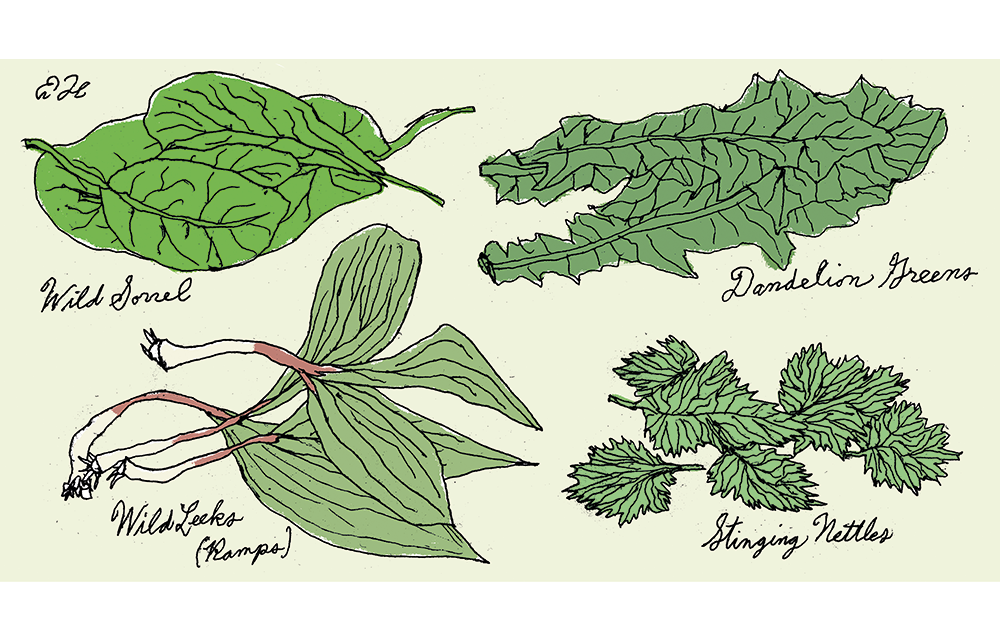
Lots of people recognize wild leeks – also called ramps – the brilliant green patches springing up on the leaf-covered floors of hardwood forests from Québec down to Georgia and across to Minnesota. Easily spotted as the first green thing to appear in the woods come spring, they like shade and damp. They are close relatives of garlic and they smell like it; they’re known in Richwood, West Virginia, as “little stinkers.” Richwood will hold its 87th ramps festival, known locally as the Feast of the Ramson, this month. (Ramsons are a European name for ramps.) In Richwood, they fry them in bacon fat, but they also pickle the bulbs and make ramp jelly and ramp salsa.
Wild leeks are only in season for about three weeks, and are considered quite a delicacy by chefs. In Québec, they’re so sought-after that a law had to be enacted to prevent foragers from harvesting them to sell: you can pick them for personal consumption, but anyone caught with more than 50 bulbs can be fined $500. And with their pungent smell, even the greenest of police officers can sniff out offenders.

Of course, the law promptly brought about a thriving black market, complete with hockey bags stuffed with thousands of bulbs, camouflaged police staking out poachers in the patch and cruisers sailing in victoriously, lights blazing, to block thieves’ getaway cars. Québec chefs at one time spoke of needing “connections” to be able to offer the prized vegetable two or three nights a year, jealous of restaurateurs in other regions where a legal supply is so easy to come by.
Those who find the wild leek too lively on the palate may find sorrel, another early spring delight, more to their taste. It emerges quickly after the snow is gone in the north; morally speaking, the plant is tough as nails, able to endure all manner of environmental rigors – but the new leaves it unfolds are tender and lemony, good in soup, with fish, and in pasta.
Somehow nearly everyone has heard that dandelion greens are edible. This is technically the case, but if you’ve ever, in a fit of homesteading spirit, tried one, you know just how bitter they are. “If you can’t beat them, eat them,” was botanist James A. Duke’s helpful advice to gardeners, but that’s easier said than done. The very first leaves of the season, plucked well before the flowers come, are supposed to be milder. But the truth is, even then, they taste awful.
Wild food expert Dr. John Kallas wondered about this as a student. He tried dandelion leaves at every stage in an effort to understand why they were once a popular salad ingredient. But try as he might, he couldn’t see the appeal. Knowing that many senior farmers in a rural Michigan community had grown up eating dandelion salad, he decided to carry out a research project. At first he asked if they found dandelion greens bitter. No, was the quasi-universal reply; they were delicious.
Kallas found this response very puzzling; every leaf he’d ever tried was extremely bitter. “Had all these farmers been replaced by alien pod people? What was I missing here?” he wondered. Then he realized he was asking the wrong question. Instead, he started asking how they prepared their dandelion greens – and discovered the secret ingredient: bacon.
It turns out that bacon really does make everything better. Way back when, dandelion aficionados started by frying up a batch of bacon. They poured the hot fat all over the greens, causing them to wilt. Then they chopped up the rashers along with a couple of hardboiled eggs, and tossed them in. They added salt and sometimes vinegar and voilà. With so many different flavors going on, and with the bitterness of the greens reduced by the wilting process, and masked in bacon fat for good measure, our great-grandparents wouldn’t have thought of the salad as particularly bitter – only balanced.
Nettles are very good for you, with scads of protein and calcium, not to mention half the alphabet in vitamins
Young stinging nettles, surprisingly, are another spring treat and a superfood to boot. Fans say there is no need to be stung while engaging with these potentially delightful greens, as long as you wear gloves when gathering them. As soon as the nettles are dried or cooked in any way, their stings disappear and they become quite domesticated. They’re very good for you, with scads of protein and calcium, not to mention half the alphabet in vitamins, and they’re delicious – no, really – in soup and tea. (Even without bacon! Though you might like to have some on the side, just to be safe.)
Mixologists among us may like to try making a “Stinger in the Rye,” a recipe composed by Ellen Zachos, who blogs at the Backyard Forager. First you make a nettle cordial, which begins by steeping very strong nettle tea for 24 hours. You bring a quart of this tea to a boil with ginger (she suggests wild ginger rhizomes but a few slices of ginger root would do) and half a cup of agave nectar.
Once it boils, you remove it from the heat and add a few slices of lemon, cover and leave it for another 24 hours. You strain the result, and there’s your cordial. It’s good on its own, but to make a “Stinger in the Rye,” shake two ounces of nettle cordial, two ounces of rye whiskey, and ice in a cocktail shaker, then serve. It’s springtime in a glass.






Comments