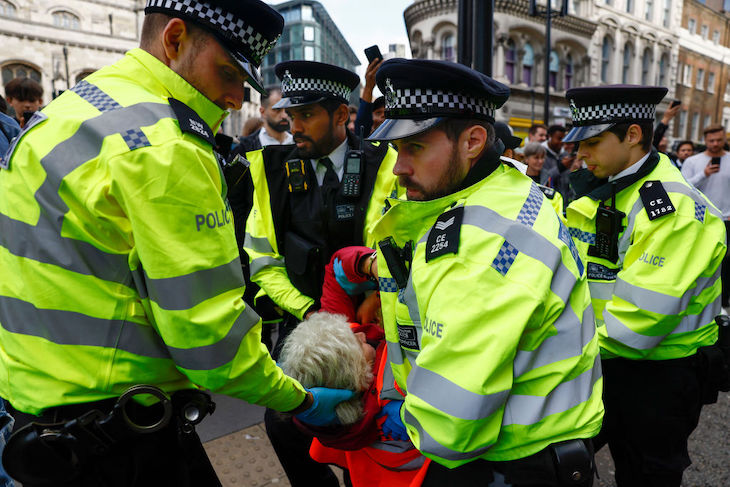
The law of public protest is in a sorry state. Lawful protest should take place within clear parameters set by the criminal law, framed in part to protect the rights of others. Instead, “protest” is too often treated as a reason to disapply the ordinary law, wrongly prioritising the liberty of “protestors” over the freedom of members of the public to go about their lawful business. While the last Parliament repeatedly failed to repair this imbalance in the criminal law, Parliament now has another opportunity to address the problem, which it should take.
Last week, the Supreme Court rejected a claim by protestors that they could only lawfully be convicted of glorifying Hamas if the prosecution could persuade the trial court that a conviction would be a proportionate interference in their ECHR rights. The judgment does not spell this out, but what the Supreme Court rejected was an attempt to extend to offences under the Terrorism Act 2000 the approach that the Court itself had pioneered in DPP v Ziegler in 2021. While the Court’s judgment last week is welcome, it does nothing to reverse the damage that Ziegler has done to the integrity of our criminal law.
Parliament has another opportunity to address this problem
What Ziegler established was that a person could only be convicted of obstructing the highway if the prosecution was able to persuade the trial court that a conviction would be a proportionate interference in his or her Convention rights of speech and assembly. In a split decision, Lord Sales and Lord Hodge partly dissenting, the Supreme Court ruled that a conviction would only be proportionate if the protest had caused “serious disruption”. This introduced an unworkable standard into the criminal law, emboldening Extinction Rebellion, Just Stop Oil, and other groups to occupy the streets and to inconvenience the public until their demands were met.

The foothold for the Supreme Court’s judgment was that section 137 of the Highways Act 1980 makes it an offence for any person “without lawful authority or excuse” to obstruct free passage along a highway. The Court used this phrase to require the prosecution to prove that a conviction would be a proportionate interference with Convention rights – that a conviction was justified all things considered – which is not a fit question for a trial court to have to answer. The role of the trial court should not be to decide, in a case when the ingredients of the offence are made out, whether, in addition, convicting the defendant would strike a fair balance between his interests and the public interest. This is an invitation for unpredictability and arbitrariness.
The Ziegler approach was soon extended to the offence of criminal damage, which also refers to a person acting “without lawful excuse”, most notably in the trial of those who toppled the statue of Edward Colston into Bristol harbour. True, the Court of Appeal thereafter limited the extent to which the approach applies in relation to criminal damage, but even in this context it still remains open to the defendant to argue that a conviction would be disproportionate and therefore unlawful – at least where the damage is minor or involves public property.
The last Parliament enacted the Police, Crime, Sentencing and Courts Act 2022 and the Public Order Act 2023, neither of which addressed Ziegler. The 2022 Act empowered the Home Secretary to amend the Public Order Act 1986 to clarify the meaning of the term “serious disruption to the life of the community”, which was not otherwise defined. The 2023 Act introduced several new public order offences, each of which included a lawful or reasonable excuse qualification, which duly imported the Ziegler approach in relation to them. Policy Exchange repeatedly warned that these measures were inadequate and recommended more targeted and robust legislation.
In addition to these two enactments, the then government belatedly attempted to address the problem by way of secondary legislation, made under authority of the 2022 Act. This was predictably, and quite rightly, quashed by the Divisional Court, which ruled that the Home Secretary was acting in excess of the powers Parliament had conferred upon her. The government’s final, faltering attempt to address the problem, the Criminal Justice Bill 2024, was cut short by the general election and would in any case, as I said at the time, have almost certainly failed.
What each of these attempts had in common was a refusal to contemplate reversing Ziegler, perhaps out of misplaced fear of confrontation with domestic or European courts. In fact, it is quite likely that senior judges would welcome Parliament reversing the judgment, which goes beyond the Strasbourg case law, and which the Supreme Court has not itself been able to correct.
Parliament now has that opportunity in the form of an amendment to the Crime and Policing Bill tabled by Lord Faulks KC and Lord Hogan-Howe, the former Commissioner of the Metropolitan Police. The amendment is drawn from a paper that Sir Stephen Laws and I published three years ago. It makes clear that a person does not have a lawful excuse, in relation to an offence that includes such a caveat, if the person’s conduct is intended to intimidate, provoke, inconvenience or otherwise harm members of the public – or is designed to influence the government or public opinion by subjecting a person or their property to a risk of loss or damage.
This is an invitation for unpredictability and arbitrariness
In the Committee Stage of the Bill, last month, Lord Pannick KC argued that the amendment was unnecessary because the Supreme Court had already cast doubt, in another case, on the Ziegler approach. But neither that judgment nor last week’s judgment could reverse Ziegler, either in relation to the offence of obstructing the highway or any other similar offence, including the many offences created by the 2023 Act. Parliament cannot responsibly leave the law in this state of disarray. The Faulks et al amendment would make clear that Parliament is unwilling to tolerate protest constituting an excuse for conduct that aims to harm others in order to force them to accept the protestors’ demands. The amendment would not criminalise conduct where inconvenience to members of the public is an unintended side effect, as it would be for example in relation to a march or an assembly, which are sharply different to blocking roads.
Amending the Bill in this way would reverse the Ziegler approach, which has only ever been possible because of the Human Rights Act 1998. The amended Bill would specify that Parliament has itself decided what is necessary for the protection of the rights of others. Parliament can restore the criminal law as it was understood until 2021 without repudiating the 1998 Act or calling into question the UK’s membership of the ECHR. In acting in this way, Parliament would be exercising its responsibility to correct a wayward judgment, making clear, as the Supreme Court said in relation to the Terrorism Act last week, that it is not for the trial court to decide on proportionality.





Comments