
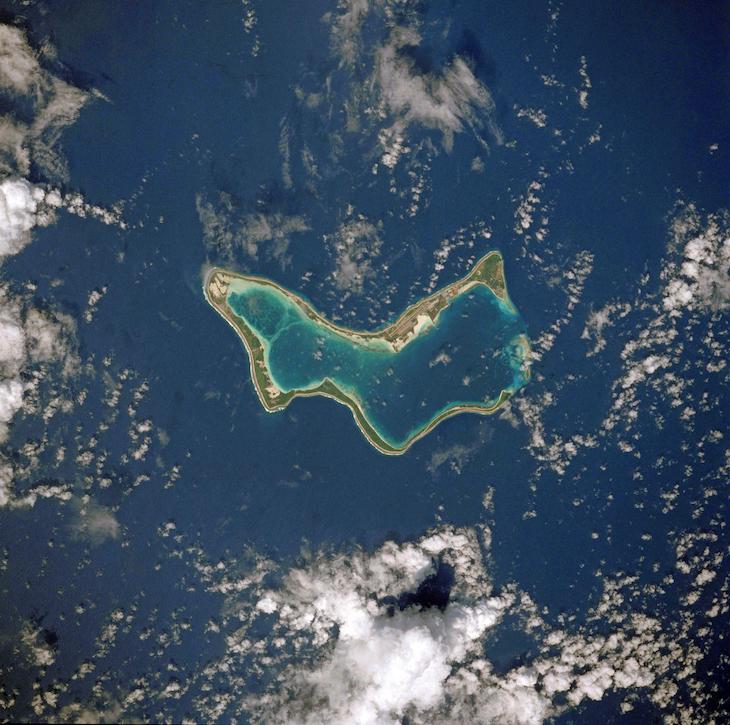
The policy that seems closest to the government’s heart – the surrender of the Chagos Islands to Mauritius – is in real trouble. The treaty with Mauritius, signed in May last year, cannot be ratified unless parliament enacts legislation. But the Diego Garcia Military Base and British Indian Ocean Territory Bill has run out of time in the Lords and, the Times reports, the government does not intend to include legislation for ratification in the King’s Speech next month.
This is a change of plan, not a change of heart. The government has accepted that for the time being the second condition on ratifying the treaty – securing US consent – cannot be satisfied. American support is a political requirement because our alliance with the US remains the cornerstone of our national defence, and the Diego Garcia military base is a joint UK-US military facility. It is also a legal requirement because the terms of the 1966 UK-US treaty require the UK to maintain sovereignty over the Chagos Islands, thus enabling the base to operate. Unless and until the US agrees to amend that treaty, the UK cannot lawfully surrender the islands.
For the government, this is only a tactical defeat. It remains committed to ratifying the treaty, surrendering sovereignty over the Chagos Islands in return for continued access to Diego Garcia and an obligation to make substantial annual payments. What the government intends to do now, it seems, is to work on the Americans, hoping that President Trump will once again change his mind, as he has done twice this year already. At that point, the government would bring legislation back before parliament and no doubt attempt to ram it through as rapidly as possible.
If this is the government’s strategy, it is a poor one. The Iran war has made vividly clear the military importance of Diego Garcia, which was in the end used for ‘defensive’ strikes on Iran and has in turn been targeted by Iranian missiles. It has also soured the relationship between President Trump and Sir Keir Starmer, with our government’s initial refusal to allow Diego Garcia, and other UK bases, to be used by US forces outraging Trump. Perhaps in a few months’ time all will be forgiven and forgotten, but for the foreseeable future it would seem very unlikely that the US government is going to consent to the transfer of sovereignty.
For Mauritius, an indefinite delay in ratification may be a disaster. It was counting on sizeable annual payments from the UK. It may also have been hoping to exploit the pristine waters of the archipelago, discussing opportunities for fishing with the EU, for example. How can it respond to the UK’s delay in ratifying the treaty? It has been reported that they may sue for compensation, perhaps claiming the annual payments that the UK has agreed to make after ratification. But as the treaty has not been ratified, the obligation to pay does not arise. No tribunal in the world has jurisdiction to order the UK to pay compensation.
The government has repeatedly warned that unless the UK agrees terms of surrender, Mauritius will frustrate the operation of the Diego Garcia military base, resuming its campaign of lawfare. In a series of Policy Exchange papers, beginning in October 2023, my colleagues and I have shown that the UK is not required, as a matter of international law, to surrender the islands and cannot be forced to do so. While the International Court of Justice (ICJ) issued an advisory opinion in 2019, it had no jurisdiction to decide the dispute between the UK and Mauritius. Unless the government were mad enough to choose to consent to ICJ jurisdiction, Mauritius cannot possibly secure a judgment from that court requiring the UK to surrender the archipelago.
The greater risk is that Mauritius may attempt to frustrate the operation of the joint US-UK military facility by applying to the International Tribunal of the Law of the Sea (ITLOS), leveraging the ICJ’s 2019 advisory opinion into (provisional) rulings that the waters are Mauritian, which would complicate the UK’s capacity to exclude Mauritian and other vessels. Were such rulings to be procured, this would be a gross abuse of international law by Mauritius and by ITLOS.
Parliamentarians should press the government to abandon its policy altogether
The government seems to assume that the UK could not resist such abusive legal proceedings and would have no option but to comply should the abuse take place. Neither assumption is well founded. State consent to international adjudication is fundamental to international law. The UK cannot responsibly accept the circumvention of this rule, which is precisely what would take place if the UK were to accept that it must comply with a ruling by ITLOS in these circumstances.
Unfortunately, the government may well agree with Mauritius that the UK is in the wrong. Speaking in October 2024, shortly after the UK reached an agreement in principle with Mauritius, Lord Hermer KC, the Attorney General, referred to the return of the Chagos Islands to Mauritius as an illustration of the new government’s commitment to the international rule of law, a statement which, like several others made by senior members of the government, itself risked damaging the UK’s legal position. Relatedly, the Attorney General’s new legal risk guidelines, published later that month, required government lawyers to ask what a court would decide even if no court had jurisdiction. The Attorney General’s advice may well be that the UK has no legal right to the Islands. If this is the government’s understanding, that would certainly help explain the unseemly haste with which it reached an agreement with Mauritius in October 2024, which may have been a cackhanded attempt to lock in the agreement before the American and Mauritian elections. This is not elegant statecraft.
The government generally and Starmer personally have devoted an immense amount of political and diplomatic capital, not to mention parliamentary time, to ratifying this treaty. Ministers will no doubt have persuaded themselves, or been persuaded, that this is necessary for national security. The better view is that the UK has no legal, moral or political obligation to surrender the Chagos Islands, which would be to hand over a priceless strategic asset, degrading UK-US defence interests, and paying handsomely for the privilege, while also risking an environmental catastrophe.
It is good news that the government recognises that it cannot ratify the treaty in the immediate future. But this is a pause, not an end. Parliamentarians should press the government to abandon its policy altogether, telling Mauritius that the UK no longer intends to be a party to this treaty, to work with the US to secure our joint interests, and to consult the Chagossians, many of whom have been firmly opposed to the termination of British sovereignty. And parliamentarians also need to be ready for any future attempt to bring back legislation to enable ratification.





Comments