If you read books for a living, the calling probably started with a moment of utter entrancement: a novel you couldn’t bear to set down; a few unforgettable days, as Bleak House, Earthly Powers, The Woman in White or Titus Groan worked its unsuspected magic on its millionth reader. Such books are rarer these days, but they do still happen, and Francis Spufford’s Nonesuch is an absolute corker. Randall Jarrell once wistfully imagined a novel that would ‘bear up under the weight of hundreds of thousands of readers a plot that higher critics could call crude and that bewitched families could pad over in house slippers’. Nonesuch does the trick, and I won’t be the only reader whom it keeps up until 3 a.m.
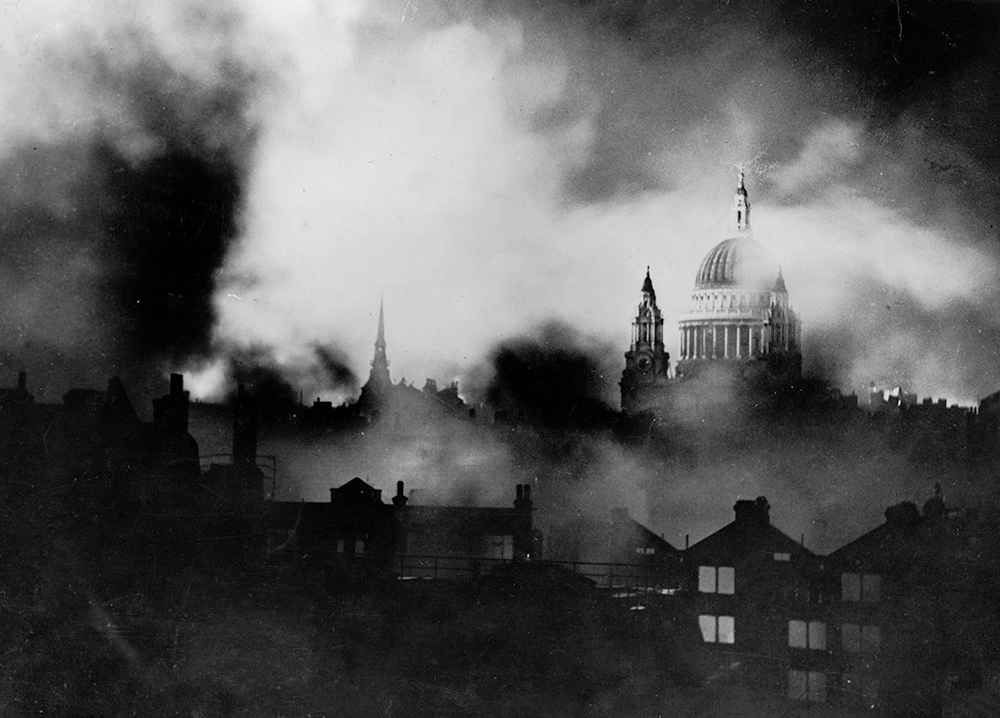
It’s a novel of immense confidence. It has no fear of lurid scenarios, of gruesome spectacles and bloody terrors; of satisfying villains, cliffhangers and hair-raising sentences. (‘Stay where I put you, you disgusting creature, unless you want me to attend to your other eye.’) Over the past 60 years or so, since the English first read Alejo Carpentier and Gabriel Garcia Marquez, we’ve developed a taste for novels that combine history with fantastic events. Nonesuch, set during the London Blitz, but incorporating angels, black magic, parallel universes and incorporeal paths into the past, is a brilliantly effective contribution.

We assume that the innovation came from South American novelists, translated in the 1950s and 1960s, but Spufford, an intensely English novelist, may make us think twice. In the splendid opening chapter, a City secretary recites a magic spell and the huge statue outside her office window turns its head and, with a voice ‘like a glacier grinding on a cliff’, asks what she wants. That, I think, is a homage to the greatest of Portuguese novels, A Year in the Death of Ricardo Reis by José Saramago. But for the most part, Spufford’s rich inventiveness is rooted in what he knows and loves best: the sumptuous tradition of English fantasy.
His novels have rightly gained a substantial readership, but he is in the curious position of being best known for a novel hardly anyone has read. Passionately keen on C.S. Lewis’s Narnia books, an obsession memorably explored in his memoir of a bookish childhood, Spufford went to the lengths of writing an entire new novel about Narnia and Aslan. But Lewis, who died in 1963, is still in copyright, and the Lewis estate, as was its perfect right, declined permission for the book to be published. Everyone who has had the luck of reading The Stone Table has spoken with awe of its authenticity and intelligent engagement. I don’t know what odds William Hill would offer, but I would say you could clean up in eight years’ time by naming the bestselling book in the UK in January 2034, when Lewis comes out of copyright.
Nonesuch is a highly inventive homage to another Oxford writer of theological terror and fantasy, Charles Williams. His last novel, All Hallows’ Eve, is also set during the Blitz, and its opening gambit, with two young women, uneasy and enforced allies, wandering the newly unreal London streets – they are actually dead – seems behind Nonesuch’s most haunting scenes. Williams may also have inspired some of the demonic figures, worlds of secret society and ritual and the presence of the divine. From these suggestions, Spufford has made something entirely his own.
There are angels, black magic, parallel universes and incorporeal paths into the past
A young woman, Iris Hawkins, is working in a stockbroker’s firm on the brink of the outbreak of war in 1939. She is estranged from her family, and, though highly able, is limited by her sex and class from achieving her potential. By the standards of her time she is atrociously promiscuous. One night she goes on a double date with a rather hopeless man; she walks out from the restaurant with his friend’s date, a sculptor called Eleanor. At the party in Chelsea they end up at, they meet a poisonous fascist called Lalage and an innocent called Geoff.
Geoff is a brilliantly clever scientist and also a virgin, and Iris goes home with him to take care of that. Home is with his widowed father, and stuffed to the brim with papers, manuscripts and mysterious totems. There is something in the street outside the house; a figure that is not quite human, faceless, watching and guarding, who has noticed Iris and is going to destroy her if it can. That presence is one of ‘a lowly and numerous category of aerial spirits… proletariat of the angelic species’, summoned up and instructed by the secret Order of which Geoff’s father is the unwilling archivist. Among the other members of the secret Order is Lalage – it is one of Spufford’s most playful touches that her name, far from confirming her commitment to secrecy, actually means ‘babbler’. She’s a holy terror. ‘And now there might be a homicidal blonde with magic powers in the picture.’
The hurtling, madcap, thrilling plot should be left to unfold itself. Enough to say that the fascists have found an esoteric spell to travel back and erase the path that led to war, while leaving Hitler free to govern Germany. At one point, Iris travels in mid air across the City, through the terrifying barrage of the Blitz, on crystal pathways summoned by magical commands. It is simply thrilling, and so are the precise, extraordinary accounts of the often bad-tempered angels – a voice ‘like a desert wind in a test tube’, a furious whorl of intense blue light.
At the heart of the book, however, is something entirely serious. Spufford has in his other novels explored lives that might have occurred in quite different ways. Light Perpetual constructed the postwar fortunes of a group of people who in reality were killed as children by a bomb in the war. Essentially Nonesuch concerns the life Iris wants to lead, and which, we are convinced until the very end, she will indeed enjoy once the war is over. Her desire is not of her time, but it is heroic:
I want to condescend to every toffee-nosed public school boy who condescended to my dad. I want to buy the mortgage on Lall’s place in the country and turf her out of it. I want to be a tycoon. I want a yellow Rolls-Royce and a fur coat. I want to be a Rothschild, a Rockefeller, a J.P. Morgan – and when I am, I want everyone to know that I’m also Iris Hawkins from Watford.
She is allowed an exhilarating argument with John Maynard Keynes at Eleanor’s dinner table, and perhaps would be one of those, 30 years later, who rudely shattered the cabals and closed castes ruling the country.
Well, we are ruled once more by a caste of lawyers with the same degree of contempt and the same skill at exclusion evident in Iris’s time and place. Iris is granted a glimpse of the London of the future, a blend of what we now know, and what a different present might contain:
A cathedral standing where St Paul’s should, but with a black and ramshackle tower instead of a dome; a structure all in glass like an impossibly tall spearhead with a broken tip; men with iron collars chained together digging in a ditch.
That light touch of engagement with our realities surely gives Spufford’s novel a cogent standing of moral judgment and ethical seriousness. The fabulous degree of spectacle and impossibilities can be pursued because of that solidity. Nonesuch has a keen and convincing sense of how the noblest aspirations can be foiled by those who think of themselves as well-intentioned; foiled both in ways stolid and familiar, and through means conjured by the novelist’s dreaming. This novel deserves to be a colossal success.




Comments