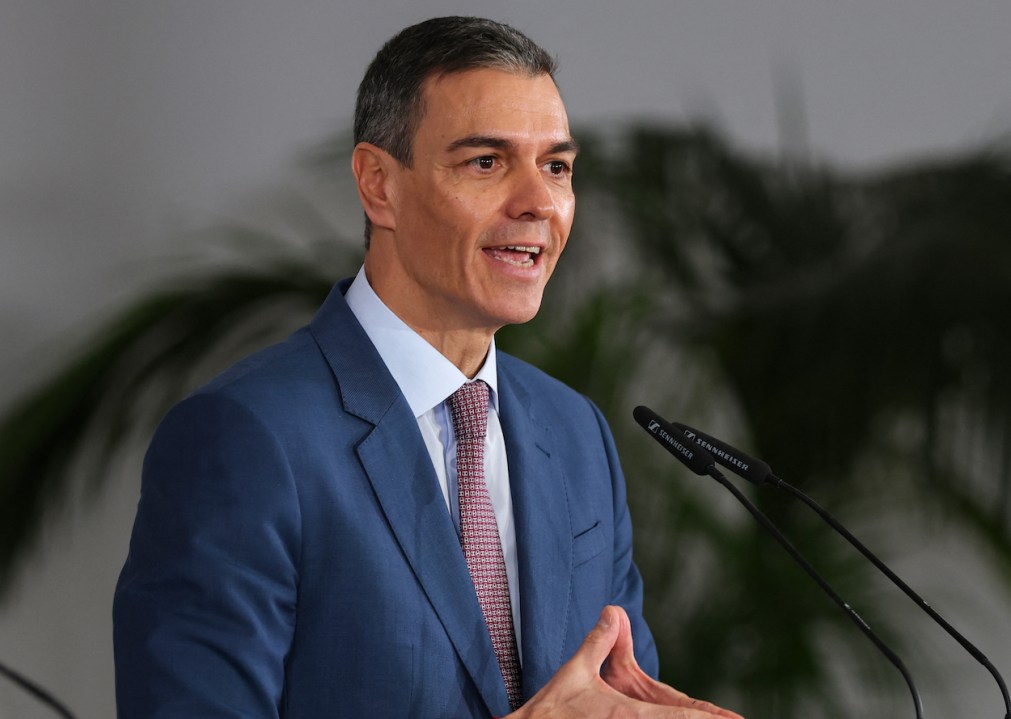
Spain’s Socialist prime minister Pedro Sánchez is proposing a ban on under-16s using social media, following the example set by Australia last year. Speaking at the World Government Summit in Dubai earlier this week, Sánchez said: “Today our children are exposed to a space they were never meant to navigate alone… We will protect [them] from the digital Wild West.”
The Spanish premier’s announcement comes at a time when several other European nations are also attempting to combat the harmful effects of social media on children. France’s ban on under-15s using social media is expected to become law later this year, while Greece, Portugal and Denmark have signaled their intention to enact similar legislation.
Sánchez’s ban is part of a legislative package that includes a proposal to hold social media executives personally responsible for illegal content on their sites, and new measures to track disinformation, hate speech and child pornography. The Spanish premier has also signaled his willingness to work with the public prosecutor to investigate TikTok, Instagram and Elon Musk’s AI Chatbot Grok for alleged illegal content.
Musk, whose social media platform X was fined €120 million ($140 million) by the European Union in December for failure to comply with transparency legislation, is furious. “Dirty Sánchez is a tyrant and traitor to the people of Spain,” he thundered on X. Grok is also under investigation by Britain’s communications regulator Ofcom and the EU Commission over the alleged generation of nude images of real people. If found to have violated the EU Digital Services Act, X could be fined 6 percent of its annual turnover.
This is not the first time that Sánchez and Musk have clashed. In January 2025, the Spanish premier joined other leftist European leaders in claiming that tech billionaires are trying to “overthrow democracy” by using social media to “divide and manipulate” (politicians, of course, are never guilty of division or manipulation). Sánchez has also said, somewhat ludicrously, that “the international far-right movement… is being led by the richest man on the planet, [and] is openly attacking our institutions, inciting hatred and openly calling for people to support the heirs of Nazism in Germany” – an apparent reference to Musk’s endorsement of Alternative für Deutschland.
Sánchez was wrong to attack Musk for broadcasting his political views on X. Expressing support for the European right, even (whisper it) the “far-right” is not a crime. Nor is not being an astute political commentator: social media would suddenly go very quiet if people were prohibited from saying stupid things.
But Spain’s PM is on the right side of this battle. His social media ban deserves credit for attempting to keep children out of a murky, under-regulated space in which they are prone to grooming, cyber-bullying and explicit content. Social media’s more benign aspects – online interaction, following news, sharing photos – can be enjoyed elsewhere, in safer environments.
Last year, Australia became the first country in the world to ban under-16s from using social media platforms such as TikTok, X, Facebook, Snapchat and Threads. A study commissioned by the Australian government found that 96 percent of children aged between 10 and 15 had used social media, 71 percent of whom had seen content associated with harm. Over half of them had experienced cyber-bullying and 24 percent had been victims of online sexual harassment. Social media companies can be fined $32 million for violating Australia’s new legislation, but children and parents won’t be punished. Meta, the company that owns Facebook, Threads and Instagram, blocked over half a million Australia-based accounts in the first few days of the ban.
Teething problems are inevitable
Skeptics are expressing doubts about the effectiveness of such bans, especially of the age verification systems required to enforce them. But given that this legislation is in its infancy, teething problems are inevitable. Hopefully, their proliferation will force social media companies to improve their vigilance and security technology. Many laws are ineffective at best, harmful at worst; this one is ineffective at worst, extremely beneficial at best.
The proposed scope of Spain’s ban, though, leaves room for misapplication. Announcing it in Dubai, Sánchez also said: “We will investigate platforms whose algorithms amplify disinformation in exchange for profit… Spreading hate must come at a cost – a legal cost, as well as an economic and ethical cost.” Providing that doesn’t include a ban on tech billionaires – or anyone else – splurging half-baked political opinions on X, Spain’s social media ban will have a positive impact on society. Protection, not suppression, is the aim.

Comments