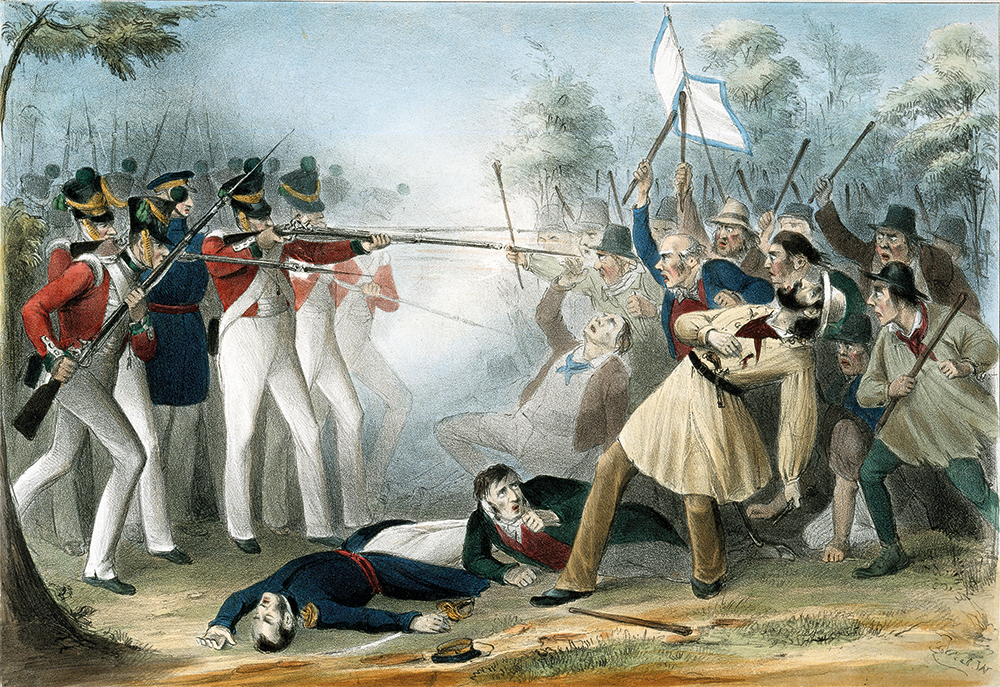
When was the last battle fought on English soil? The traditional answer, still sanctioned by Wikipedia, is Sedgemoor, in 1685, when the Duke of Monmouth’s rebellion was defeated and more than 1,000 combatants were killed. But there are other candidates, such as the Jacobite encounters at Preston and Clifton Moor in 1715 and 1745, reminders that English history didn’t end in everlasting peaceful compromise with the Glorious Revolution of 1688. The subject of Ian Breckon’s book was killed at yet another last battle, at Bossenden Wood in Kent, in 1838.
It wasn’t a pitched battle like Sedgemoor, and only 11 people died, nine on the day and two later of their wounds. But both sides were armed, and one at least was a regular force, a detachment of the 45th Foot (Nottinghamshire Regiment), only recently returned from Burma and India, though the latest recruits had joined from Ireland, having travelled to Kent for seasonal work.
The group these soldiers confronted, however, were homegrown insurgents, not colonial ones. They were led by a Cornishman, John Nicholls Tom, but that was not the name he went under. Tom claimed to be Sir William Courtenay, the rightful heir to the Earldom of Devon. (There was a real Sir William, but he was overseas.) In the previous weeks, he had also claimed to be the Messiah.
The story Breckon tells begins in carnival spirit as Tom arrives in Canterbury in 1832, where he initially adopts yet another persona, that of Count Moses Rothschild, attracting attention by his flamboyant dress and manner and apparent generosity. After taking up the identity of Sir William Courtenay, he then stands twice for parliament in Kent, proving a popular turn at the hustings, but losing on both occasions.
Tom/Courtenay presented himself as a military hero, a Knight of Malta and a friend of the poor, who attacked the unpopular church tithes and appeared to support further parliamentary reform, which had expanded the scope of the electorate by only a few per cent in the recently passed Reform Act.
This fact of 19th-century politics, now that Tom was pretending to be an aristocrat from a venerable landed dynasty, was the greatest obstacle to his chances of being elected. It’s difficult to be an electorally successful populist when the people don’t have the vote. It was only after the elections, as Tom continued his political agitation, publishing a journal and making public appearances, that suggestions that he was an imposter began to surface. He was eventually hoist by his own petard after volunteering false evidence in a smuggling case, and was convicted of perjury. Initially sentenced to imprisonment and transportation, after a petition and a medical examination he was sent instead to Kent County Lunatic Asylum.
He presented himself as a military hero and a friend of the poor, who supported parliamentary reform
By this point, Breckon’s story, which we have known from the beginning will end in tragedy, has taken a decidedly dark turn. In the asylum Tom was visited by his wife and her brother-in-law, who revealed the patient’s real identity – as a Truro maltster who had gone missing on a business trip, appearing to lose his mind as he clothed himself in a new persona. But Tom refused to recognise them. He stuck to the fiction that he was Courtenay, and began to make religious pronouncements, though, from the record kept by the asylum superintendent, he was not yet claiming divine status. Tom still had supporters on the outside from his political campaigns who began agitating for his release, as did his wife, despite his repudiation. Given the sequence of events that followed, it was unfortunate that the asylum superintendent was of the opinion that Tom ‘would harm no one’.
The campaign succeeded at the beginning of Queen Victoria’s reign; but Tom continued to reject his wife, and so was released into the care of a follower in the Kent countryside, a yeoman farmer who was only gradually disabused about the state of Tom’s mind and the threat he posed. By that time, it was too late. Tom, following the playbook of so many cult leaders before and since, gathered a ragtag collection of the downtrodden and disaffected, convincing them that he alone could answer their needs and that he would use supernatural powers to do so. Soon enough, his provocations descended into violence. Once he had shot dead a man who had a warrant for his arrest, the machinery of state creaked ponderously but inexorably into gear and the bloody denouement of Bossenden Wood was the conclusion.
The tale has been told before, but Breckon’s version brings to it the storytelling skills of a historical novelist, while adhering closely to his carefully assembled and sifted sources. Tom/Courtenay was a cause célèbre before he turned violent, appearing as a character in the work of the most popular novelist of the day, Harrison Ainsworth. Breckon notices, too, that the story of Bossenden Wood was reported as Oliver Twist was being published, and he draws attention to the new world of the workhouse and those who feared it as recruits for Tom. He might also have mentioned that Dickens was at work at the same time on Barnaby Rudge, his novel inspired by the murderous consequences of another populist and religious fundamentalist (and a genuine aristocrat), Lord George Gordon.
Historians have interpreted Tom’s rising in the context of the poor laws, of rural disaffection (E.P. Thompson called it the ‘last peasants’ revolt’) and religious discord. Breckon brings all this in, and adds the suggestion that Tom represents a type familiar today, a millenarian prophet proposing simple solutions to a confused populace. Perhaps; but he is best recalled as a very particular case on the cusp of modernity, when who you were was as difficult to establish as what your real state of mind was. Breckon mentions other impostors of the age. More deluded than the Tichborne Claimant and more dangerous than Princess Caraboo, Tom was a mercifully rare example in British history of a cult leader who drew enough of a following to make him a genuine threat to others.




Comments