


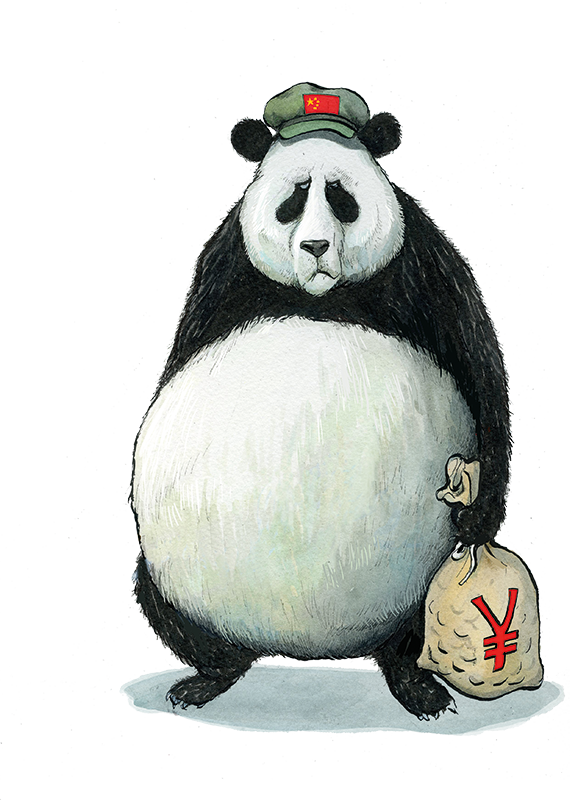
Roedean is now known as ‘Beijing High’. Cheltenham Ladies’ College is ‘Hong Kong College’. In the country’s most elite boarding schools, pupils say that they are one of just a handful of English children. Others note that Chinese has become the dominant language in hallways and dormitories.
Many English parents can no longer afford a boarding school education for their children. And the pressure of recently introduced VAT on fees, as well as above-inflation rises year on year, means the number able to cough up will dwindle further. By contrast, China and Hong Kong’s growing economy and cultural obsession with education provides a surfeit of parents with the cash needed to secure the educational prospects of their children.
More than 30 independent schools and their brands have been snapped up by Beijing investors
There are 11,000 Chinese pupils at British independent schools. At Harrow, 28 per cent arrive from overseas, climbing to 40 per cent at Roedean. The parenting forum Mums-net is awash with complaints that the ‘inter-national’ make-up of English public schools has ‘diluted’ the cultural value of the education one might expect at these institutions.
None of this is a coincidence. Admissions teams have made every effort to attract eastern money. Harrow, among others, has appointed designated agents through ‘Academic Asia’ and the ‘UK Boarding Schools Admissions Service’ to simplify overseas applications and recruit from Hong Kong and China. Chinese applicants to Shrewsbury School, named independent school of the year in 2020, can contact an official representative on WeChat – a Chinese–only instant messaging, social media and payment app that operates under ChineseCommunist party oversight.
The classroom demographic isn’t the only thing changing at these schools. Over the past decade, more than 30 independent schools and their brands have been purchased by Chinese investors. KSI Education, a company which invests in British private schools and is bankrolled by China First Capital, has already bought Kingsley School in Devon, Heathfield Knoll in Worcestershire and Greene’s College in Oxford. It is bargain-hunting: snapping up smaller boarding schools struggling after the pandemic and in a political climate hostile to paid-for education.

Post-investment, these schools often benefit from major infrastructure projects – a new computing centre or music lab – which helps sell them to a Chinese audience. Just a month after Malvern St James, a girls’ school in Worcestershire, was purchased by Galaxy Global Education Group (another China–backed company building up a portfolio of independent schools), it was announced that they would be taking boys from September. Explaining the decision, the headmaster noted that ‘the overseas international boarding market’ exhibits a ‘preference towards co-education’. China has little to no culture of single-sex education. Historically, affluent families send their sons abroad for education rather than their daughters, and have a strong preference for placing siblings in the same school, which significantly reduces the appeal of all-girls’ boarding.
In Norfolk, Thetford Grammar School, recently brought under Chinese ownership, is similarly focused on the overseas model. According to the Independent Schools Inspectorate report, its boarding house for senior students accommodates pupils who are ‘almost all from overseas’.
China is still not deemed by the UK government to be an enhanced threat to national security. Consequently, there have been few efforts to hamper a gradual Beijing takeover of our oldest educational institutions.
Some in government fear that we’re witnessing ‘ideological warfare’, as China attempts to raise children who will ‘grow up and be helpful to the Communist party’, but there is little legislation limiting foreign investment in schools. Indeed, the Education Secretary Bridget Phillipson’s continued efforts to cripple independent schools is playing into the hands of Chinese investors uninterested in catering for the UK market. As overtaxed parents remove their children, the schools start to struggle, which lowers the price of influence for Chinese investors.
Labour is aware of this. Phil Brickell, an MP on the foreign affairs committee, claims that our ‘world-leading education system is an obvious target for influence’ and ‘should be protected accordingly’. Venture Education, a Beijing-based market intelligence consultancy, has admitted that Chinese capital is being used to ‘buy distressed schools and either try to fill them with Chinese students or use the brand in China’.
Would these schools be prepared to hold talks from those who support Taiwanese independence?
In some cases, British schools are doing China’s work for them. Realising the market value of their brand in the East, many of our public schools have set up Chinese schools under their name.
British independent schools now operate 115 overseas campuses, 44 of which are in China. In Beijing, Shanghai and Suzhou students can attend ‘Dulwich College International’, run in partnership with the UK school. Wellington College and Harrow have sold their name and crest to education companies operating a series of licensed schools across China (the English school does provide some governance). Thousands of Chinese students at these institutions subsidise struggling financial operations in Britain. Just a few years after founding overseas counterparts, many institutions find that profits in China vastly outstrip the money they make back home.
However, this arrangement requires more than simply carrying over the curriculum to China. The liberalism taught at many of our schools isn’t popular with the CCP. Chinese schools are not autonomous. They operate under national and provincial regulations. All foreign-run schools must be in partnership with a Chinese entity, which will have a CCP-appointed liaison or supervisor.
While schools can offer western IGCSE and IB (International Baccalaureate) programmes, they also must teach Chinese history (as deemed correct by the government) and the Chinese national curriculum (for all Chinese pupils), and avoid political education. China’s sovereignty over Taiwan and Tibet, for example, must be accepted as fact by the English public schools wishing to operate in the country.
For some, this relationship has proven untenable. Westminster School, which had planned to build six new schools in China before 2028, cancelled the arrangement in response to new rules preventing private schools from using foreign curriculums and textbooks. Westminster took the decision after building a school in Chengdu for 2,000 pupils – a project that could have brought in far more money than its London campus.
In response to the cancellation, the former security minister Tom Tugendhat said: ‘The sad reality is that the space for cultural exchange is narrowing in Xi’s China.’ Had it taken place, the project would have been overseen by Hong Kong Melodious Education Technology Group, with oversight from a party secretary and businessman involved in China’s Tibet administration.
While Westminster concluded that the outpost in Chengdu was incompatible with its principles, the majority of public schools pursuing the overseas model have not been so sceptical. Most are quite happy to get into bed with compulsory Chinese legal entities, allowing the government to dictate curriculum and policies through compliance officers and Chinese ownership of much of the capital involved.

Only a fool would believe that these operations don’t affect teaching at home. For many public schools, a licensing arrangement in China is their only means of staying afloat in Britain. In these cases, ongoing support of the CCP is a requirement for these schools’ survival.
Elite education in Britain now bows to a Chinese market. Would these schools be prepared to hold talks from those who support Taiwanese independence? What pressure would a teacher wishing to discuss Uighur oppression find themselves under? It is not unreasonable to assume that a head teacher who spends their time speaking on panels about how Chinese parents can access the UK independent schools market will be compromised when it comes to criticism of China’s conduct on the world stage.
And the great irony? The popularity of English boarding schools in China and Hong Kong comes from a perception of their unique British character. Parents speak of wanting their children inducted into high society – taught to play cricket, read the classics and dress for dinner. But as they increasingly find they are sending their children to a China away from China, more and more are pulling them back out or declining offers altogether – leaving space for another influx of Chinese students.
Watch the latest of Lara Brown on The Edition:



Comments