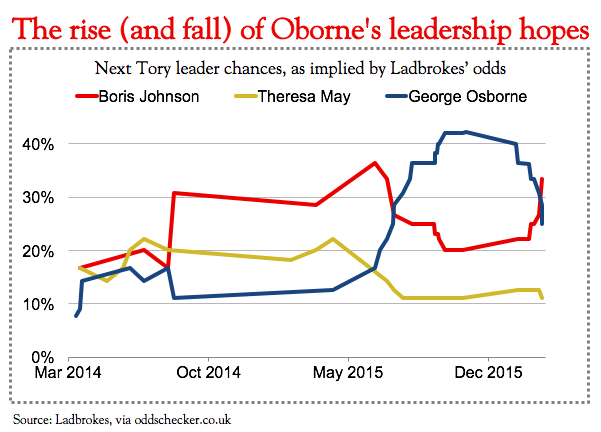
The Chancellor has today declared a ceasefire on Middle Britain: he will not go ahead with his planned pensions raid, where he was intending to erode the relief due to upper-rate taxpayers. The Timessplashes on the news, and says that “pressing ahead with the plans may well have dented his popularity within the party as a leadership battle approaches.” If this was his motive, it was not without foundation: the tax credits debacle, his Google gaffe and, most recently, his positioning himself as a EU cheerleader has not endeared him to the Tory members who will decide who succeeds David Cameron. The bookmakers show his odds plunging (below) and have today cut his odds on being sacked by Christmas to 6-1.
Osborne has recovered before (see above graph) and can recover again. But as far as Tory members are concerned, there will be another test when he delivers his eighth budget a week on Wednesday. How different will his Budget be to that which Ed Balls would have passed? Think of the policies Osborne has grave-robbed from Balls since the last election: the levy on companies to fund apprenticeships, the punishment beatings on the banks, the £9/hour minimum wage. It always used to be convention that Tory Chancellors would show restraint on the great Middle Britain stealth tax: ensnaring workers in the top rate of tax. Osborne has unleashed the stealth tax with a force that may soon come to exceed that of Gordon Brown.
Of course, as with everything Osborne does, it’s political: designed to occupy the centre ground as Labour vacates it. But his worry, now, will be that he has miscalculated: he has moved so far to the left that people wonder just how much he values Conservatism. The reason so many Tories campaigned against these ideas at the last election is not to do with tribalism: they’re bad ideas that are bad for the country. So why is Osborne championing them? I looked at this in my Daily Telegraph column yesterday.
I don’t dispute Osborne’s overall strategy. Even I argued that the Tories should jump to the left after the election – but I meant by changing their language and focus. Tory policies should be sold in terms of the way they help the poorest, boasting about the social repair of the last five years. Tory social achievements should be recognised, and then shouted from the rooftops. This is all the party should have spoken about. Michael Gove’s school reform has, as I wrote recently, started to put private schools out of business because state schools are so good. Iain Duncan Smith’s welfare reform means the FT’s data division is now flagging up a lack of workers, while the rest of Europe is worrying about a lack of jobs.
The great paradox – that progressive aims are best achieved by conservative means – needs explaining. But Osborne doesn’t seem to like explaining Conservative ideas. IDS never stops trying to explain the progressive motives of his welfare reform. And, to me, all of the evidence is there. Osborne didn’t need bad Labour policies to move to the centre: he just needed a better stab at selling the Tory ones. At times, you do wonder if Osborne has much faith in conservatism in general: if he did, why ape all of those Labour policies? Under him the government underestimated the impact of corporation tax cuts and the (Lib Dems’) raising of the tax threshold on lower-paid workers. Look at the (fairly recent) forecast for unemployment, versus the actual:-
When he eventually cut the 50p tax, he said it wouldn’t raise any money – indeed, that it would cost about £100 million (see table A2 of this pdf document). This week, it emerged that the tax from the highest paid actually surged by £8 billion. Economists will argue over precisely how much of this was due to the 50p tax cut but it’s pretty clear that we’re witnessing what John F Kennedy called the ‘paradoxical truth’ that lower rates can yield more revenue.
So why not cut the top rate to 40p? It’s fairly obvious that this would raise more revenue still, which is why Labour kept it that level for almost all of its time in power. And this is the key question: what is Osborne afraid of? Criticism from Jeremy Corbyn? The effect on a general election that lies four years away?
Osborne’s politics were formed in the Blair years, in which the confidence of a lot of Conservatives was destroyed. Hardwired into the psyche of that generation of Tories is the idea that they should hide their conservatism away: that the public just doesn’t like it. I’m more optimistic. Now that Labour’s creed has visibly imploded, and that the list of progressive Tory victories is stacking up, it’s time to try to show Conservatism in all of its dimensions. So the 2016 Budget should be a festival of Conservatism, all of it explicitly aimed at making Britain stronger, fairer and more socially cohesive.
The perception that Osborne has to fight, if he is to win the party leadership, is that he suffers from a Tory cringe, acquired during the Blair years: he thinks Conservatism is something you slip into the voters’ soup when they’re not looking. And that he is not up to the most important part of a Tory leader’s job: making the case for Conservatism and selling it to the country.
I don’t think it’s too late for Osborne: he has been written off plenty of times before and there are still formidable hurdles facing Boris Johnson, who looks like being his only real rival. While it’s almost pointless to speculation about a leadership race that lies three years into the future, conjecture about that race is very real in parliament and does shape the way policies are made now. All told, there are plenty of reason for Osborne to reconsider his leftwards lurch and come out with some proper Conservative policies in his Budget. You kinda have to ask: if not now, when?
Silicon Valley rewards founders who talk about tomorrow’s technology as if it’s already here. A founder tells investors that a machine runs a blood test…

 Of course, as with everything Osborne does, it’s political: designed to occupy the centre ground as Labour vacates it. But his worry, now, will be that he has miscalculated: he has moved so far to the left that people wonder just how much he values Conservatism. The reason so many Tories campaigned against these ideas at the last election is not to do with tribalism: they’re bad ideas that are bad for the country. So why is Osborne championing them? I looked at this in my Daily Telegraph column yesterday.
I don’t dispute Osborne’s overall strategy. Even I argued that the Tories should jump to the left after the election – but I meant by changing their language and focus. Tory policies should be sold in terms of the way they help the poorest, boasting about the social repair of the last five years. Tory social achievements should be recognised, and then shouted from the rooftops. This is all the party should have spoken about. Michael Gove’s school reform has, as I wrote recently, started to put private schools out of business because state schools are so good. Iain Duncan Smith’s welfare reform means the FT’s data division is now flagging up a lack of workers, while the rest of Europe is worrying about a lack of jobs.
Of course, as with everything Osborne does, it’s political: designed to occupy the centre ground as Labour vacates it. But his worry, now, will be that he has miscalculated: he has moved so far to the left that people wonder just how much he values Conservatism. The reason so many Tories campaigned against these ideas at the last election is not to do with tribalism: they’re bad ideas that are bad for the country. So why is Osborne championing them? I looked at this in my Daily Telegraph column yesterday.
I don’t dispute Osborne’s overall strategy. Even I argued that the Tories should jump to the left after the election – but I meant by changing their language and focus. Tory policies should be sold in terms of the way they help the poorest, boasting about the social repair of the last five years. Tory social achievements should be recognised, and then shouted from the rooftops. This is all the party should have spoken about. Michael Gove’s school reform has, as I wrote recently, started to put private schools out of business because state schools are so good. Iain Duncan Smith’s welfare reform means the FT’s data division is now flagging up a lack of workers, while the rest of Europe is worrying about a lack of jobs.
 Of course, as with everything Osborne does, it’s political: designed to occupy the centre ground as Labour vacates it. But his worry, now, will be that he has miscalculated: he has moved so far to the left that people wonder just how much he values Conservatism. The reason so many Tories campaigned against these ideas at the last election is not to do with tribalism: they’re bad ideas that are bad for the country. So why is Osborne championing them? I looked at this in my Daily Telegraph column yesterday.
I don’t dispute Osborne’s overall strategy. Even I argued that the Tories should jump to the left after the election – but I meant by changing their language and focus. Tory policies should be sold in terms of the way they help the poorest, boasting about the social repair of the last five years. Tory social achievements should be recognised, and then shouted from the rooftops. This is all the party should have spoken about. Michael Gove’s school reform has, as I wrote recently, started to put private schools out of business because state schools are so good. Iain Duncan Smith’s welfare reform means the FT’s data division is now flagging up a lack of workers, while the rest of Europe is worrying about a lack of jobs.
Of course, as with everything Osborne does, it’s political: designed to occupy the centre ground as Labour vacates it. But his worry, now, will be that he has miscalculated: he has moved so far to the left that people wonder just how much he values Conservatism. The reason so many Tories campaigned against these ideas at the last election is not to do with tribalism: they’re bad ideas that are bad for the country. So why is Osborne championing them? I looked at this in my Daily Telegraph column yesterday.
I don’t dispute Osborne’s overall strategy. Even I argued that the Tories should jump to the left after the election – but I meant by changing their language and focus. Tory policies should be sold in terms of the way they help the poorest, boasting about the social repair of the last five years. Tory social achievements should be recognised, and then shouted from the rooftops. This is all the party should have spoken about. Michael Gove’s school reform has, as I wrote recently, started to put private schools out of business because state schools are so good. Iain Duncan Smith’s welfare reform means the FT’s data division is now flagging up a lack of workers, while the rest of Europe is worrying about a lack of jobs.





Comments