The Spectator

Letters: The case for an NHS card

A new prescription Sir: It is maddening to see the British people being refused face-to-face GP appointments and subjected to a form of health rationing that should have ended decades ago (‘Dr No’, 12 June). In Australia a Labour government solved the problem in 1975 by separating payment for healthcare from provision of healthcare. The government gave everyone a Medicare card that could be presented to any accredited healthcare provider. The provider would be paid at a set rate per procedure and send the bill to the government. The result is a truly responsive healthcare system where the patient comes first, is treated with respect and courted by a competitive and creative ecosystem of public, private and third-sector providers. Supply meets demand, unlike in the UK.

Has Covid turned us into a nation of cyclists?

On this day Would 19 July make a suitable ‘freedom day’ (assuming Covid restrictions are lifted even then)? There is an ominous warning from history. In 1919, 19 July was designated ‘Peace Day’, on which victory in the Great War would be celebrated with parades and banquets, three weeks after the signing of the Treaty of Versailles. In London 20,000 service men and women marched on a seven-mile route past the temporary Cenotaph. Many demobbed servicemen felt aggrieved, however, that so much money was being spent on celebrations when many of them were out of work and still without the housing they had been promised.

How many Lilibets are there in the world?

Rare Lili Other than the new royal baby, is there anyone in the world formally called Lilibet? — There are 141 Lilibets in the US. None have been born since 1999 — when 8 were born, according to the US Social Security Administration. — Lilibet Foster, born in the US Virgin Islands in 1965, is a documentary-maker whose film Speaking in Strings, about the violinist Nadja Salerno-Sonnenberg, was nominated in the 72nd Academy Awards. — In answer to a freedom of information request in 2017, the Office for National Statistics refused to provide a full breakdown of the first names of people living in Britain. But it does publish a list of the top 100 girls’ names for recent years, which haven’t included Lilibet.

It’s time to revisit the Northern Ireland protocol

Britain has already seen two ‘Brexit days’ — when it formally left the EU on 31 January 2020 and the end of the transition period 11 months later. But given that it has taken less than six months for the Northern Ireland protocol to unravel, it’s horribly clear that our future relationship with the EU is anything but settled. The transport of sausages and other chilled meats from Britain to Northern Irish supermarkets may seem a trivial matter. But the attempt by the EU to enforce a ban on this trade demonstrates what so many people found problematic about the idea of an internal UK border down the Irish Sea. And it is surely a harbinger of battles to come.

Portrait of the week: Pub staff shortages, a baby called Lilibet and a slap in the face for Macron

Home The government pondered delaying the end of coronavirus restrictions on 21 June. But Chris Hopson, the chief executive of NHS Providers, noted that ‘vaccines have broken the chain between Covid-19 infection and high levels of hospitalisations and then mortality’. Of 126 people taken to hospital with the Indian variant of coronavirus (now designated Delta), only three had been doubly vaccinated and two thirds not vaccinated at all. By the beginning of the week, 52.5 per cent of the adult population had received two doses of vaccine; 76.6 per cent the first dose. Vaccinations were offered to anyone aged 25 or more. Of those aged 70 or more, 96.9 per cent of Jews had been doubly vaccinated; 96.2 of Christians; 95.4 of Hindus; 94.3 of Sikhs and 84.7 of Muslims.

The vaccines are a game-changer: Covid is losing its sting

It seems all but impossible to convince government scientists of the wisdom of proceeding with the final lifting of Covid restrictions on 21 June. No matter how much progress is made, officials seem to find a new reason to delay — a new variant or some similar development always pops up. The Indian variant has now become the dominant strain in Britain and our cases are rising. The question is whether that should change things. When the government’s roadmap was agreed, with 21 June as the end date, scientific advisers on the Sage committee drew up five scenarios for hospitalisations. None of them imagined that by this stage the figure would be as low as it stands now. Cases are rising — but cases are not translating into hospitalisations as they once did.

Have tennis players always been expected to give interviews?

Game, set, chat Japanese tennis player Naomi Osaka withdrew from the French Open after being fined $15,000 for failing to appear for a post-match press conference. Have players always been expected to give interviews? — Wimbledon was first televised live in 1937, the year of Fred Perry’s third and final victory against Gottfried von Cramm. A photo from 1938, when Bunny Austin was beaten by the US player Donald Budge in the final, shows that the post-match interview was already part of the coverage. Vaccine clots How many people in the UK have died from blood clots related to the AstraZeneca vaccine? Up to 27 May the Medical and Healthcare Products Regulatory Agency has recorded 332 serious cases and 58 deaths.

Portrait of the week: Boris Johnson’s wedding, bitcoin blackouts and a £140m tomato ketchup factory

Home Freelance scientists urged the government not to end coronavirus regulations on 21 June, for fear of a third wave. Fewer than 900 people remained in hospital with Covid, compared with 39,249 in January. Chris Hopson, the head of NHS Providers, said ‘very, very few’ Covid patients in hospital had received two coronavirus vaccinations, and usually had additional conditions. Heathrow got round to using a separate terminal for passengers arriving from countries with a high risk of Covid. The government considered compulsory Covid vaccination for NHS staff. The Johnson & Johnson single-dose vaccine was approved for use. By the start of the week, 47.3 per cent of the adult population had received two doses of vaccine; 74.2 per cent the first dose.

2506: Summer’s voice – solution

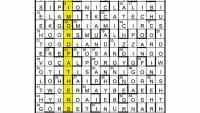
The unclued lights are ferns: RUSTY-BACK (26/5A), WALL RUE (48/7A), MAIDENHAIR (1D/11), OSMUNDA (18), BIRD’S-NEST (20/45) and POLYPODY (24). PTERIDOMANIA (diagonally from 10) could have induced this puzzle and was to be shaded. Title: cf. Adder’s-tongue.

Has No. 10 really solved the problem of Covid groupthink?

It is hard to deny the importance of the issues raised this week by Dominic Cummings. His decision to identify the many mistakes made at the start of the pandemic is not about seeking vengeance; it is a vital process to ensure that errors are identified and not repeated. A vaccine-evading variant or a new virus could come along at any time. Should this happen, ministers must be ready. Some of the world’s finest minds worked on pandemic planning, in Britain and throughout the western world. The UK was once ranked as more prepared for a new virus than any country in Europe. But the failure to provide adequate PPE equipment was the most visible sign of implosion.

Letters: The unfairness of ‘free care for all’

Taking care Sir: I agree completely with Leo McKinstry that care for parents should be paid out of their estate (‘Home economics’, 15 May). The costs of care are what people effectively work for, not for the passing on of wealth paid for by the taxpayer. My mother lived until she was 100, and was in care for almost 14 years. Although she had a property and shares, we funded her care until her cash/share balance was £15,000. After this time she was means-tested and between her pension and the rent from her flat, we were able to pay for some of the care, with the rest paid for by the local council. On her death the property was sold and the effective loan from the local authority was paid out of the proceeds of the sale.

Portrait of the week: Bashir’s reckoning, Dominic Cummings’s evidence and ‘secret’ local lockdowns

Home The BBC was engulfed in doubts after a report by Lord Dyson blamed Martin Bashir for deceiving the late Diana, Princess of Wales, before interviewing her on television in 1995 — and the BBC for failing to investigate properly. The Duke of Cambridge said: ‘It brings indescribable sadness to know that the BBC’s failures contributed significantly to her fear, paranoia and isolation that I remember from those final years with her.’ He said that had the BBC properly investigated complaints, ‘my mother would have known that she had been deceived’ before her death in 1997. The former chairman of the BBC, Lord Hall of Birkenhead, resigned as chairman of the National Gallery.

Cummings, Covid and groupthink – a cautionary tale

It is hard to deny the importance of the issues raised this week by Dominic Cummings. His decision to identify the many mistakes made at the start of the pandemic is not about seeking vengeance; it is a vital process to ensure that errors are identified and not repeated. A vaccine-evading variant or a new virus could come along at any time. Should this happen, ministers must be ready. Some of the world’s finest minds worked on pandemic planning, in Britain and throughout the western world. The UK was once ranked as more prepared for a new virus than any country in Europe. But the failure to provide adequate PPE equipment was the most visible sign of implosion.