The Spectator

Letters: The C of E’s obsession with critical race theory

From our UK edition

Christian approach Sir: Dr Michael Nazir-Ali’s criticism of our report ‘From Lament to Action’ (‘Bad faith’, 1 May) was wide of the mark in its suggestion that Marxist-inspired critical race theory was the ‘intellectual underpinning’ of our approach. Far from it. The source material for our report was three decades of reports on the issue of racial justice from the General Synod of the Church of England. Doubtless there are valid criticisms which can be made of Synod; however, being a hotbed of radical Marxism is not one of them. Our report explicitly rejects any idea that our work should be viewed as a battle in a culture war.

Innovators will lead the post-pandemic renaissance

From our UK edition

So much has been changed by Covid. Science and entrepreneurship have combined brilliantly to mass-produce life-saving vaccines. Working from home, video communication and online retail have become the new normal — perhaps heralding a permanent shift that will leave office towers and city centres searching for new roles. And the responsibility of every business as a corporate citizen as well as a profit generator has come into focus as never before. In 2021 and beyond, innovators have a huge opportunity to make our lives better again. In bioscience and healthcare. In logistics, data analytics and every kind of digital technology. In sustainable housing, transport and agribusiness and all the ways in which entrepreneurs can help address the dangers of climate change.

Which prime minister spent the most on their Downing Street flat?

From our UK edition

Flat spin Which prime minister spent the most on their Downing Street flat, according to figures reported over the years? Margaret Thatcher £0 (Kept 1960s kitchen. Is reputed to have paid for her own ironing board) Tony Blair £127,000 spent on larger flat above No. 11 (including wallpaper reputed to have cost £70 a roll) Gordon Brown £84,000 David Cameron £92,900 (with £64,000 spent on kitchen and bathroom) Theresa May £25,500 Boris Johnson Between £88,000 and £200,000 (according to various reports) But all were eclipsed by the £650,000 of public money spent by former Lord Chancellor Derry Irvine on his flat in the Lords, including £59,000 of wallpaper.

Portrait of the week: Covid retreats, raves resume and a £165,000 squid

From our UK edition

Home ‘I think we have got a good chance of being able to dispense with the one-metre-plus from 21 June,’ Boris Johnson, the Prime Minister, remarked. By the beginning of the week, 29 per cent of the adult population had received both doses of coronavirus vaccination; 65 per cent the first dose. In the seven days up to the beginning of the week, 107 people had died, bringing the total number of deaths (within 28 days of testing positive for coronavirus) to 127,534. Maldon in Essex reported three cases per 100,000 people, which meant only two people in the whole district. Care home residents in England were allowed to make outdoor visits without having to self-isolate for 14 days on their return.

Letters: The veiled elitism of social mobility

From our UK edition

Levelling up Sir: In making the case for social mobility, Lee Cain unwittingly endorses the classism he hopes to fight (‘Left behind’, 24 April). As the historian Christopher Lasch has argued, the canard of social mobility merely replaces ‘an aristocracy of wealth with an aristocracy of talent’. Far from being egalitarian, the concept is inherently elitist: it implies moving up, out or away from a class, town or profession condemned as undesirable. And by paying lip service to ‘meritocracy’ it becomes a self-serving justification for elites’ power and privilege — if they had the ‘ability and ambition’ to rise to the top, it must only be indolent dullards who are left behind.

Portrait of the week: A political squall, sub-postmasters exonerated and India’s Covid crisis

From our UK edition

Home By the beginning of the week, 12,071,810 people had received both doses of coronavirus vaccine, and the proportion of the adult population with both soon rose to more than a quarter. In the seven days up to the beginning of the week, 159 people had died, bringing the total of deaths (within 28 days of testing positive for coronavirus) to 127,417. Fares Maatou, aged 15, was fatally stabbed at half past four in the afternoon outside a pizza shop in Newham, east London. Anthony Thwaite, the poet and editor of Philip Larkin’s letters and poems, died aged 90.

A vote for the SNP would mean another wasted decade in Scotland

From our UK edition

Sometimes, Westminster unwittingly makes quite a good case for Scottish independence. Britain’s Covid emergency has ended, but the damage of the last year is enormous: the knock-on effects of lockdown can be seen in NHS waiting lists, the devastated high street, the mental health backlog and the 20,000 pupils who are absent from the school register. There is urgent work to do, yet the government is engaged in a battle to the death over who paid for wallpaper in Downing Street. We see a Prime Minister at war with his ex-adviser, unable to rise above the fray and capitalise on the opportunity of his vaccine success. Then there’s the opposition, unable to oppose.

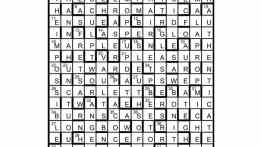
2501: Delightful – solution

From our UK edition

The ‘Transport of Delight’, in the song by Flanders and Swann, was that ‘big six-wheeler, scarlet-painted, diesel-engined, London Transport, ninety-seven horse-power omnibus’. First prize H.

Notice: The Spectator’s agreement with The American Spectator

The Spectator and The American Spectator are pleased to announce the settlement of the recent lawsuit between the parties. The Spectator and The American Spectator are independent publications and have been available in the United States for many decades. Historically, The Spectator has focused primarily on UK politics and affairs while The American Spectator has focused primarily on US politics and affairs. This arrangement has worked well and the publishers have even considered each other to be more friends than competitors. The Spectator has recently decided to launch new publications with a focus on US politics and affairs.

The public has kept its side of the lockdown bargain. Now it’s the government’s turn

From our UK edition

Over the past week, the country has started to spring back to life. Trains and buses are no longer running empty. Bars and restaurants have put out signs proclaiming they are fully booked. Pubs are using school playgrounds as beer gardens and filling every seat. In Soho, people danced in the streets when someone walked through with a stereo. A country that has been locked down for months is finally coming back into the open, with not a penny of government bribery required. There is a palpable sense of both relief and accomplishment. Yet the recent noises from No. 10 have been far from positive. The Prime Minister has claimed, oddly, that the decline in Covid cases has almost everything to do with lockdown and very little to do with vaccination.

Portrait of the week: Covid pills, Chauvin’s conviction and a red card for the Super League

From our UK edition

Home Boris Johnson, the Prime Minister, announced the hunt was on for two effective pills to treat Covid, to be ready (after clinical trials) by the autumn. He had cancelled a visit to India, which has seen an increase in Covid deaths, with Delhi put into lockdown. Scarcely was his trip off than India was added to a ‘red list’ of countries from which most travel to Britain is forbidden. Sir Keir Starmer, the leader of the opposition, visited The Raven public house in Bath only for the landlord to shout at him: ‘Get out of my pub!’ He left. By the beginning of the week 9,416,968 people had received both doses of coronavirus vaccine, 17.9 per cent of the adult population; 60.8 per cent had received one dose. The number with both doses soon rose above ten million.

Who gave Abba ‘nul points’ in 1974?

From our UK edition

Falling from grace Six Premier League football clubs had announced their intention to join a European Super League, from which it would be impossible to be relegated, before changing their minds. When were they last relegated from anything? — Manchester United were relegated from the top tier of English football in 1974, and promoted back the following season. — Manchester City were relegated to the third tier in 1998, climbed back to the second in 1999 and the Premiership in 2000. They were relegated again in 2001, and promoted again the following year. — Liverpool were relegated to the old Second Division in 1954, and promoted to the First in 1962. — Chelsea were relegated for a season to the Second Division in 1988.

2500: 50 x 50 – solution

From our UK edition

The solution grid includes the letter L fifty times (L x 50 = 2500). Coincidentally, Doc and his wife, Jean, celebrated their Golden Wedding anniversary on 3 April, the publication date of the issue.

The enduring power of the monarchy

From our UK edition

Fourteen prime ministers; 18 general elections; seven changes of government. Even in a stable country like Britain it is remarkable how much political water has flowed under the bridge in the 69 years since the late Duke of Edinburgh became consort to Elizabeth II. Britain has gone from a country of outside lavatories to one of conspicuous wealth, from an independent nation to a member of the EU and back again, from an empire to a champion of global trade. Some see the past seven decades as a period of national decline, yet the quality of life has improved hugely. In 1952, life expectancy at birth for Britons was 69; now it is 81. To have lived for almost a century is still an impressive feat, but is a lot more common now than it was at the beginning of the second Elizabethan age.