The Spectator’s 2022 midterms election night: live coverage
From our US edition
Live analysis as the results come in from your favorite Spectator editors, staffers, columnists and contributors (and some you don’t like, for good measure).
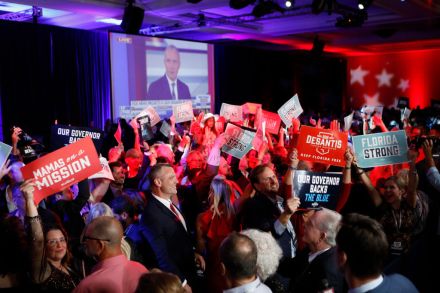
From our US edition
Live analysis as the results come in from your favorite Spectator editors, staffers, columnists and contributors (and some you don’t like, for good measure).
and where yesterday I lay broiling in the vat of my bedroom today a sneaky little breeze tickles my soles — Coo-ee! Only me! shifty at first but soon breeze picks up speed with What — did you think I was gone for good? That me and my three ‘e’s had danced our final conga around your curtains and hightailed it out of the element once and for all? Finita la commedia? Leaving you with only the hot, hot heat to tan your hide? My God, you’re a tragedian. I bet you spent the whole 48 hour heatwave being Blanche Dubois around the place, fainting and drawing cold baths. Don’t tell me. I bet you were writing poetry. Oh God, you were. Oh you have to have your psychodrama, don’t you?
Philip Hensher There were some very good novels this year, but they came from surprising directions. It is astonishing that one as original as Kate Barker-Mawjee’s The Coldest Place on Earth (Conrad Press, £9.99) couldn’t find a major publisher. A friend recommended this wonderfully controlled and evocatively written novel about a heart coming to life in the depths of Siberia. I always enjoy Mick Herron’s half-arsed spy thrillers, but Bad Actors (Hodder & Stoughton, £18.99) took a big step into literary excellence. The dazzling, Conrad-like structure turned an entertainment into a major literary statement. Sheila Llewellyn’s Winter in Tabriz (Hodder & Stoughton, £8.

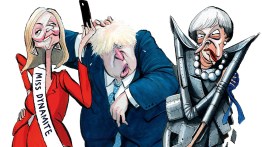
Catalogue of disasters Sir: Matthew Parris, in his article ‘The real cause of all the chaos’ (29 October), asks of our last three prime ministers: ‘What big thing did any of these unfortunate souls do wrong?’ In a spirit of helpfulness: Mrs May: net zero by 2050, derisory defence spending. Mr Johnson: hospital clearances, lockdown, vaccine mandates, derisory defence spending. Ms Truss: tax cuts without public sector spending cuts. As a consequence of these three, Britain is not so far away from having to go cap in hand to the IMF once more, and is again confronted by war in Europe as a result of the failure of conventional deterrence.
in his Clouseau-era. I want to get home knowing at any minute I might karate chop Burt Kwouk as he comes flying round the corner or trap his trouser-tie in the fridge door or flip up the fold-down bed on his head — basically I want to triumph frequently by freakish misadventure. And I want a beige mac and to take liberties with my vowels and I want a range of disguises for every occasion (including one involving lederhosen) and a lava lamp and always at least one eccentric, vastly rich admirer who finds me fascinating. And I want terrible timing that’s also somehow — sublime and I want to be the badass buffoon who might snap the evil villain’s snooker cue but doesn’t break a sweat.
Talking gobblers Has Elon Musk picked up a turkey in Twitter? – Musk paid $54.2 per share. The share price reached $41.57 on its first day of trading in 2013. It slumped to $14.62 in April 2016 and peaked at $77.06 in February 2021. In the first quarter of 2022, it claimed 229 million active daily users, a rise of 15.9% year on year. There were 39.6 million users in the US. – In Q1 2022 the company raised $1.2 billion in revenue: $1.11 billion from advertising and £94 million from subscriptions. However, in the same quarter the company ran up $1.33 billion in costs. Dirty Cop How are Cop conferences doing at cutting their own carbon emissions?
Olaf Scholz will be in Beijing this weekend, making the first visit of a western leader to China since the start of the Covid-19 pandemic. What might at any other time be regarded as a routine piece of diplomatic outreach is instead a matter of deep concern. China’s leader, Xi Jinping, has just cemented his position as dictator-for-life at the Chinese Communist party’s 20th congress. Beijing has followed this up with a series of high-profile visits from countries taking Chinese money for major infrastructure projects. The President of Vietnam arrived on Monday, the Presidents of Tanzania and Pakistan on Wednesday. This will culminate in Scholz’s arrival, the first G7 leader to accept Xi’s invitation. China’s sphere of influence is truly global.
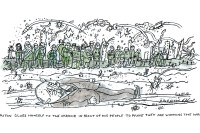
Home Suella Braverman, the Home Secretary, spoke in the Commons of an ‘invasion on our southern coast’ by migrants in small boats. ‘Let’s stop pretending that they are all refugees in distress,’ she said. ‘The whole country knows that is not true.’ She was reacting to a crisis at a migrant processing centre in Manston, Kent, built for 1,600 but housing 4,000. David Neal, the independent chief inspector of borders and immigration, called it ‘really dangerous’. He said an Afghan family had lived in a marquee there for 32 days. It was made more crowded after migrants were moved following an attack with three petrol bombs on a Border Force migrant centre in Dover by a man in a car who then killed himself. On Saturday alone, 990 migrants crossed the Channel.
Drake, the clot, missed it by a mile. That hook of rock failed to snag his sails into the only gap for a thousand miles and the Ohlone breathed easy in their skins unaware of the Great Inevitable whilst the dew on the antelope’s nose lay undisturbed. Salmon knew the river would not deepen. The eagle’s shadow rippled like a whisper over desert ridges. Grassland rolled a parody of Atlantic waves. Crow and Lakota were still safe behind the Appalachians which dipped to the farms of the Puritans and the graves of the Seminole. One curious soul raised his head, wondered what lay beyond the forest and the valleys. To the west.
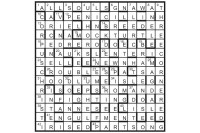
The unclued lights are Oxbridge colleges, hence LIGHT AND DARK blue in the title. First prize A.H. Harker, Oxford Runners-up David Morris, Birchington, Kent; D.
In her, oily tongued Hughie found his perfect foil: a cockney sparrow, whose pixie cut and skinny frame won the hearts of millions in the age of monochrome. Her money more than doubling as she made the ratings soar, bringing with it a rags-to-riches change. The sky seemed the limit, yet something in her ached for her lost world of nine-to-five, round the corner local, down-to-earth mates. Until finding herself broken on the wheel of flashbulb fame, she threw in the towel, hoping to return to her old, ordinary ways. Instead, uprooted for too long, she withered, took to God and pills, deadheading herself with an overdose on one light-starved, February day.
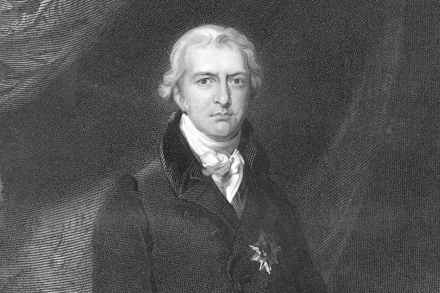
Prime numbers At 42, Rishi Sunak is Britain’s youngest PM since Lord Liverpool took office the day after his 42nd birthday in June 1812. He replaced Spencer Perceval, the only British prime minister to be assassinated. Much is made of Sunak’s wealth, but he hasn’t enjoyed the privilege Lord Liverpool did (his father was an adviser to George III). Thanks in part to his connections, Lord Liverpool was elected to the Commons as member for Rye at the age of just 20. As he had to be 21 to sit in the Commons, he went on a Grand Tour of Europe until he came of age. He was PM for 15 uninterrupted years. Asian heritage How large is the Asian British population? – According to the ONS, there are 4.2m people in England and Wales – 7.
Sculpting a solution Sir: Noel Malcolm’s article ‘Relief fund’ (22 October) rightly suggests that legislators should consider the issue of the Parthenon sculptures seriously. Yet the article does little in the way of advancing a meaningful solution. What makes The Parthenon Project unique and not just ‘the latest in a sequence’ is that it offers a real, viable way of breaking the impasse on a centuries-old debate. Its proposal of a win-win solution involving the return of the sculptures to Athens and the establishment of a rotating exhibition of Greek artefacts in London is new but already changing minds – including my own.


When Russia invaded Ukraine in February, German protesters lined the streets holding placards saying ‘Better a cold shower than Putin’s gas’. Their resolve was soon to be tested: energy costs surged and Berlin’s longstanding policy of relying on Russian gas started to cost the country dear. Germany set itself the hugely ambitious target of having its gas stores 95 per cent full by November, a policy that remained even after Moscow turned off the Nord Stream pipeline. It seemed a near-impossible target. But this target has now been met ahead of schedule. German gas usage is down by about a third after major changes to industry. With the panic over, the price of commercial gas contracts – in Germany and Britain – has now fallen to levels last seen in the spring.
Home Rishi Sunak, aged 42, became Prime Minister. At the weekend Boris Johnson had flown back from a holiday in the Dominican Republic in response to the resignation of Liz Truss. She said she could not ‘deliver the mandate on which I was elected by the Conservative party’. The 1922 Committee devised a hurdle of 100 nominations for any MP to be considered as leader, with secret ballots of MPs and, if two candidates remained, an online vote by party members. It was thought that if Mr Johnson secured 100 votes, the membership would elect him. At 9 p.m. on Sunday, the day before nominations closed, he withdrew from the contest. Next day, a minute before nominations closed, Penny Mordaunt withdrew. So Mr Sunak won.
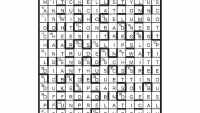
The unclued lights are names of the men who followed Armstrong and Aldrin (Apollo 11) in walking on the moon First prize Glynn Downton, Maidstone, Kent Runners-up D.V.
Rishi Sunak is Britain's third prime minister this year. On Tuesday, Sunak assembled a new top team with the hope of unifying the fractured party. The cabinet departures included Jacob Rees-Mogg among those heading to the back benches. As for the arrivals, Suella Braverman is back in the role of Home Secretary just under a week after being forced to resign over a security breach. Here are the key developments: Jeremy Hunt has been reappointed as Chancellor. Suella Braverman is back as Home Secretary. Ben Wallace remains Defence Secretary and James Cleverly stays as Foreign Secretary. Dominic Raab is deputy PM and Justice Secretary. Nadhim Zahawi is party chairman. Grant Shapps becomes Business Secretary.

Seldom has support for a government fallen so far, so fast. Polls show that 24 per cent of the public would vote for the Conservatives if there was an election now, vs 52 per cent for Labour: figures that make 1997 look like a good result for the Tories. This is not just a one-off rogue poll, but the sustained average of six. It reflects what Tory MPs hear from voters appalled at the disgraceful shambles of the past few weeks. It won’t be forgotten in a hurry. This magazine gave its verdict on the Liz Truss agenda in August: ‘To attempt reform without a proper plan is to guarantee failure,’ we argued. She lost no time in proving this point. But others are drawing wider and deeper – and rather dangerous – conclusions.
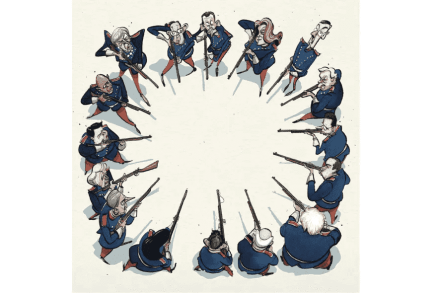

Out to grass If Liz Truss is forced out of office (and doesn’t also resign her parliamentary seat as Tony Blair did on resigning as prime minister), there will be three ex-PMs sitting on the backbenches of the Commons. When was the last time this happened? — Between Jim Callaghan’s defeat in the 1979 general election and Harold Wilson’s retirement from the Commons four years later, Callaghan, Wilson and Edward Heath were all still in parliament. As for the number of living ex-PMs, we are already at a modern record, with Boris Johnson, Theresa May, David Cameron, Gordon Brown, Tony Blair and John Major.

Paying the price Sir: Lionel Shriver’s piece about university standards rang true to me (‘University is supposed to be hard’, 15 October). When I, then working for a distinctly moth-eaten British university, visited a very famous private college in Massachusetts in 1985, I expressed my envy of his luxurious surroundings to a professor of English. His reply was: ‘Don’t envy us. You have something we don’t have. It’s called standards.