The Spectator

A-level results: has government reversed grade inflation?

As A-level results come out today, we will find out if the government has made any progress in stemming exam grade inflation. As always, some candidates will celebrate while others will be disappointed. This year, though, the latter group is expected to be more numerous because exam boards are supposed to be clamping down on the implausibly high grades awarded during the two years when school exams were suspended due to lockdowns. Anyone looking solely at exam grades without other information to hand might wonder: what was it about Covid that appeared to boost the educational attainment of so many 18-year-olds? In 2019, the last normal year, 76 per cent of A-level entries were awarded grades A* to C.

What are the rules around ex-presidents’ paperwork?

Tracing paper FBI agents raided Donald Trump’s estate in Mar-a-Lago, Florida, in search of papers he is accused of removing illegally from the White House. What are the rules? — The Presidential Records Act, passed in 1978 in the wake of Watergate, makes clear that documents relating to a president’s time in office are public property. They may not be destroyed or removed from the White House except with the written permission of the US archivist, which may be given if the records are no longer deemed to have historical or evidential value. — The public can obtain access to the records under freedom of information laws five years after a president has left office. However, in limited circumstances a former president can delay that for up to 12 years.

Portrait of the week: Energy bills up, NHS waiting lists down and hosepipes off

Home Energy bills will be £4,266 for a typical household by January, according to the consultancy Cornwall Insight, which had put the sum at £3,616 only a week earlier. Ofgem had decided since then to shorten the period over which suppliers can recover their costs. Gordon Brown, prime minister 2007-10, declared that Boris Johnson, the Prime Minister, and Liz Truss and Rishi Sunak, competitors to succeed him, must hold an emergency Budget to deal with the ‘financial timebomb’ of energy prices. ‘If they do not,’ he said, ‘parliament should be recalled to force them to do so.

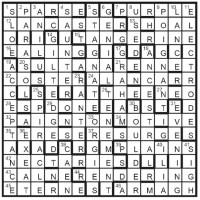
2562: 3 X 2 – solution

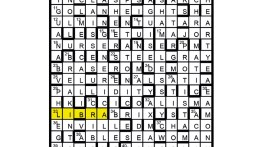
The unclued lights are words (or one phrase) which contain three pairs (3 x 2, in the title) of double letters: 13 Tennessee, 15/14 Sweet tooth, 17/37 Successfully, 21/24/39 Whippoorwill, 31/2 Bookkeeper, 41 Committee, 42/6 Barrenness.

Can Liz Truss be trusted?

Liz Truss has taken the lead in the Tory leadership race with an agenda that seems radical and ambitious, whereas Rishi Sunak appears to offer only elegantly managed decline. Truss promises instant relief from the rising cost of government; Sunak offers to reverse barely half of his own tax rises – and over the course of the rest of the decade. To promise more, he says, is to sell ‘fairytales’. Truss says a better future is possible with enough vision, ideas and, perhaps most importantly, resolve. Ms Truss came up with a promising idea this week: regional pay boards, so that civil service salaries could be set relative to the local cost of living.

When did ‘best before’ dates begin?

An idea past its sell-by date Waitrose has announced the removal of ‘best before’ dates from many food products. – The idea of printing dates began with Marks & Spencer in the 1950s, but only for use in the stockroom. They first appeared in the company’s shops in 1970 and were named ‘sell-by’ dates from 1973, launched with an advertising campaign saying: ‘The sell-by date means that St Michael foods are fresh.’ There was also a TV advert which featured Twiggy. – The concept was quickly adopted by other supermarkets after evidence that shoppers liked the reassurance of a date.

Portrait of the week: Hosepipe bans, England’s women win the Euros and a strike over dragons

Home BP reported quarterly profits of £6.9 billion, its biggest for 14 years, after oil and gas prices rose steeply. Typical domestic energy bills were forecast by the consultancy Cornwall Insight to go above £3,600 a year in the coming winter. Under the family scheme for visas, 31,300 Ukrainians had arrived in the United Kingdom, and 72,700 under the sponsorship scheme. British Airways suspended new ticket sales for short-haul flights from Heathrow until at least 15 August, to meet the airport’s limit on the number of passengers departing each day of 100,000. On 1 August, 696 migrants crossed the Channel in small boats; in July the total was 3,683, and more than 17,000 so far in 2022.

Germany’s energy crisis is a warning to Britain

During the eurozone crisis, southern European states had to go cap in hand to Germany to stave off national bankruptcy. A decade on and it is Berlin doing the begging. Europe has reluctantly agreed a 15 per cent cut in gas use this winter in the hope that German factories can stay open and German citizens can keep from freezing. Meanwhile, Russia’s state-controlled energy giant Gazprom threatened to reduce the gas flowing through the Nord Stream 1 pipeline yet again so that Germany would receive only a fifth of the amount it did before the Ukrainian invasion. While Berlin has said it plans to wean itself off Russian gas over the next few years, Vladimir Putin is taunting Europe by cutting supplies faster than Germany can cut its dependence.

Portrait of the week: Sunak vs Truss, London dodges a blackout and 94st walrus capsizes boats

Home In a television debate between the two contenders for the leadership of the Conservative party (and hence the prime ministership), Rishi Sunak said it would be irresponsible to put the country in even more debt by cutting taxes and Liz Truss said that the tax rises he approved would put Britain into a recession. Mr Sunak was criticised for interrupting. A later proposal he made to cut VAT when the price cap on energy bills rose above £3,000 only brought accusations of a U-turn. He agreed to be interviewed by Andrew Neil on Channel 4, but Ms Truss didn’t. Opinion polls put Ms Truss well ahead among Conservative voters; Labour voters preferred Mr Sunak.

Which country has hosted Eurovision the most?

The longest heatwave How did the recent heatwave compare with that of 1976? That year, the temperature peaked at 35.9˚C at Cheltenham on 3 July. This did not even break the UK temperature record at the time – 36.7˚C recorded in Northamptonshire on 9 August 1911. No recording from 1976 currently features on the list of Britain’s ten hottest recorded days. By contrast, in 2022 temperatures peaked at 40.3˚C in Coningsby, Lincolnshire. Spectators at Wimbledon protect themselves from the sun wearing newspaper hats and books on their heads, during the 1976 heatwave (Getty Images) – However, the 1976 heatwave was far more prolonged. Temperatures surpassed 90˚F (32.

Just how hot has it got in the UK?

Hot topic Last week’s Barometer detailed past UK temperature records. Those were broken by this week’s heatwave. On Monday a new Welsh record was set when temperatures hit 35.3˚C in Gogerddan and on Tuesday England measured a new high of 40.3˚C at Coningsby in Lincolnshire. Source: Met Office Inn crowd The World’s 50 Best Restaurants released its 20th annual listing of top dining spots around the globe. Italy and Spain have the most with 6 each. Denmark, France, Japan, Peru and the US have 3, while Belgium, Brazil, Germany, Mexico and the UK have 2. Source: The World’s 50 Best Restaurants Pop around Queen became the first band to sell seven million copies of one album in the UK.

Portrait of the week: Record-breaking heat, a summer of strikes and a warning for snake-owners

Home In the contest for the leadership of the Conservative party, Jeremy Hunt and Nadhim Zahawi were the first of the eight contenders to be eliminated, followed by Suella Braverman, Tom Tugendhat and Kemi Badenoch. After two televised debates, Rishi Sunak and Liz Truss, the frontrunners, refused to take part in a third, which was cancelled. The debates were bitter and accompanied by negative briefings. Lord Frost said he had ‘grave reservations’ about Penny Mordaunt, and had ‘had to ask the PM to move her on’ when she was his junior during Brexit negotiations. After parliament rose for the summer two names were to be put before party members in a postal ballot.

Letters: What William Blake meant

Procurement profligacy Sir: In response to Susan Hill’s query ‘Who allows the profligacy in NHS hospital procurement to continue?’ (‘Best medicine’, 16 July), it seems the national scale of public sector bureaucracy is just too great. Given the size and spending power of the NHS, no one should come close to achieving equal efficiencies in economies of scale, nor gain better prices from suppliers. But this is not the case. As a non-clinical procurement professional in the NHS, having come from the private sector, I’ve been surprised to consistently find the national purchasing authority of the NHS (formerly ‘NHS Supply Chain’, now ‘SCCL’) to be the worst pricing option available to us.

The heatwave shows the lockdown instinct is still alive

Trains were running even more slowly than usual. Schools were closed again. Offices were empty. No one would deny that Monday and Tuesday were on the warm side, at least by British standards. Even so, there was something more alarming than the temperature: how quickly the authorities started to close down society – and showed that the lockdown instinct is still very much alive. The Met Office, a body that has turned from fairly comical to slightly sinister in recent times, started advising everyone to stay at home. The unions asked for schools, offices and transport systems to be closed down. There were no trains north out of King’s Cross or Euston, and Luton airport closed completely. Sadiq Khan lost no time in asking people not to have barbecues.