The Spectator

Portrait of the week: Rail strikes, rates rise and a record-breaking stingray

Home A rail strike on three alternate days, bringing the system to a standstill for a week, was organised by the Rail, Maritime and Transport workers’ union. On the first day, the London Underground came out too. Tram drivers in south London arranged a strike of their own. Sir Keir Starmer, the Labour leader, instructed his frontbenchers not to join strikers’ picket lines, but some did. EasyJet announced plans to cut 7 per cent of its 160,000 flights scheduled between July and September after Gatwick, easyJet’s main airport, said it would reduce the number of flights taking off. Flights carrying up to 5,000 passengers were cancelled at Heathrow airport on one day because of trouble with baggage-handling.

Cutting the cost of government is the only solution to this crisis

A little over a year ago, The Spectator printed a cover story about the risk of inflation. Britain, we argued, was hugely vulnerable: the national debt was structured in such a way that even a small uptick in inflation followed by a rise in interest rates would inflict immense damage on public finances. The conventional wisdom was that there was no such risk, that rates would be ‘low for long’. But what if this consensus was wrong? The Financial Times took the unusual step of writing a story about our story. ‘The Spectator joins the inflation doom-mongers,’ it announced. ‘Doom’ was pushing it a bit: we simply sought to underline the complacency with which governments, central banks and many analysts viewed the economic horizon.

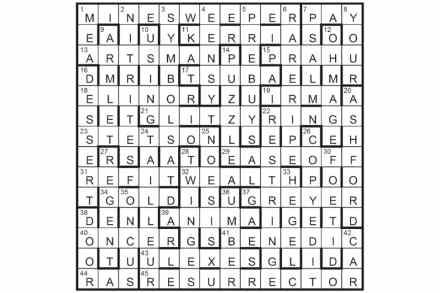
2558: Blonde, 78 – solution

Unclued lights were associated with JUBILEE: years (CALENDAR, SCHOOL, FINANCIAL), clips (CROCODILE,PAPER, TIE) and London underground lines (CENTRAL, CIRCLE, NORTHERN). The title suggested PLATINUM (element 78, and type of blonde).

Letters: Boris Johnson might be the leader we need

The leader we need? Sir: Matthew Parris excoriates Boris Johnson for administrative incompetence, mendacity, personal immorality and utter lack of political vision (‘I told you so’, 11 June). Mr Johnson may have multiple personal failings, but surely it is obvious that we live in times which call not for a leader with lofty political vision, but for one who can react instinctively and reasonably competently to exogenous events. Johnson’s refusal to be battered down by successive crises, his cocksure ebullience, and his ability to turn patent negatives into positives clearly irritate his former journalistic colleagues – and infuriate his political opponents.

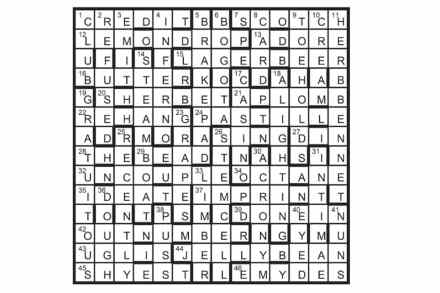
2557: Heroes – Solution

The perimetric knights are MO FARAH, JASON KENNY, STEVE REDGRAVE and CHRIS HOY, all OLYMPIC WINNERS. Together they have amassed TWENTY-TWO (44) GOLDS (35). The DATE (17) linking them all is 23 March, indicated by 23 (DAY) and 3 (MONTH), which is the birthday of all four.

Politicians caused the Rwanda deportation debacle

The problem with the bishops in the upper chamber is not that they speak too much, but too little. The attack on the government for sending migrants to Rwanda was a rare example of clerical intervention, but where were the bishops during the discussions about the evils of people-smuggling and the problem of migrants risking their lives in shoddy boats? The reason we have religious leaders in the House of Lords is so that they can add thoughtful insights into important political issues of the day. Illegal immigration and the great dangers faced by migrants in their struggle to come here are just the sort of moral dilemmas that needs their attention, but they have for the most part been silent. It is clear that our politicians are in urgent need of good advice.

What does Prince Charles find appalling?

He really is appalled Prince Charles was reported to have described the government’s plan to send asylum-seekers for processing in Rwanda as ‘appalling’. The Prince of Wales has been associated with the word since at least 1988, mainly because of the ‘Heir of Sorrows’ column in Private Eye, where many things elicit the reaction ‘it really is appalling’. He has, however, used the word in real life – most recently last November at the ceremony to remove the Queen as head of state in Barbados, when he talked of the ‘appalling atrocity’ of slavery. Breach of contract The economy contracted by 0.3% in April, but some sectors bucked the trend. Effect of sector on overall growth figure: Vehicle and motorcycle repair +0.

Levelling up by numbers

Some 42% of the public understood what levelling up meant. But this varied in different nations, with people in Wales and Scotland reporting the lowest understanding: 31% and 29% respectively. Amazon estimates that some 11.6m Britons require digital skills training to bring them up to speed Education The think tank ResPublica has some useful background on skills inequalities in the UK. Its research shows that: The UK still has nearly 6.5m adults (or 15.4% of the adult population) who are not qualified above level 2 (i.e. GCSE). There are stark geographic disparities. For example, the proportion of people without any formal qualification in Richmond Park is 1%. In Dudley North it is 20%. However, there are also disparities within regions.

Wanted: video editors

The Spectator is looking to expand Spectator TV. Our YouTube channel now has more than 160,000 subscribers, and we want to make more videos for our growing audience. We recently started filming Chinese Whispers and Women With Balls, and want to start putting out new shows later this year. We’re looking for talented video editors to help. We don’t care about your background – university students and retirees are equally welcome. All that matters is that you can do the job. To apply, please do the following: 1. Download these files from a recent episode of Chinese Whispers.  2. Using Premiere Pro (a free trial is available here), edit the show however you think looks best. This is how our final cut looked: https://www.youtube.com/watch?

Airlines must accept the blame for the travel chaos

If you have a flight booked in the next few months, it’s time to worry. A new era of air travel has arrived, in which reliability has been replaced with roulette. Airlines take bookings for flights they know might not take off. If staff shortages mean the flight is cancelled, passengers aren’t told until the last minute and are often denied compensation. And good luck finding a more reliable carrier. EasyJet, Wizz Air, British Airways: they’re all at it. Heathrow airport says the disruption may last until the end of next year. There is no doubt that lockdowns were crippling for the air industry. Even when foreign travel was permitted again, it was under intimidating regulations.

Portrait of the week: A no-confidence vote, a marginal win and the Queen’s Jubilee

Home Boris Johnson won a vote of confidence in him as prime minister among Conservative MPs by 211 votes to 148 (58.8 per cent in favour, compared with 63 per cent in favour of Theresa May in 2018). No more such votes are allowed for a year. Workmen had still been dismantling the staging in front of Buckingham Palace from the Jubilee celebrations when Sir Graham Brady, the chairman of the 1922 Committee, announced that, as at least 54 MPs had written letters requesting it, there would be a secret ballot on the question. Boris Johnson had been booed by people in the crowd as he walked up the steps of St Paul’s with his wife Carrie for the service of thanksgiving for the Queen’s 70 years on the throne.

2556: Recent origins – solution

The unclued entries give the origins of elements 110-118 now named Darmstadtium, Roentgenium, Copernicium, Nihonium, Flerovium, Moscovium, Livermorium, Tennessine and Oganesson. First prize Susan Edouard, Bexhill-on-Sea, E. Sussex Runners-up Trevor Evans, Drulingen, France; Phillip Wickens, Faygate, Horsham, W.

How much do the royals like curry?

Curry in favour The BBC apologised after one of its guests for the Jubilee coverage, Len Goodman, revealed that his grandmother had referred to curry as ‘foreign muck’. The corporation might have used it as a way into a discussion of royal eating tastes. In an interview with Radio 1 in 2017, the Duchess of Cambridge revealed that while she liked a hot curry, her husband ‘wasn’t good with spice’. The Queen’s opinion on curry, too, has been reported to be lukewarm. Prince William’s tastes are in contrast to those of his great-great-great-great grandmother Queen Victoria, who gained a taste for curry cooked by an Indian servant, Abdul Karim, in 1887.

What is the most significant year of the Queen’s reign?

Andrew Roberts The most important moment came on 11 November 1975 when her governor-general in Australia, Sir John Kerr, dismissed the Labour government under Gough Whitlam, doing so in her name. Although the Queen knew nothing about it before it happened (indeed, she was asleep at the time), it reiterated the vital constitutional principle that there is a power above politicians, even elected ones as in Whitlam’s case. Whitlam had driven Australia to the brink of economic and social collapse, but Kerr saved the country using the Queen’s royal prerogative. His decision was enthusiastically endorsed by the Australian people at the subsequent general election, with a landslide victory for Malcolm Fraser.

Which monarchs have had the longest reigns?

Long to reign over us The Queen is the world’s current longest-serving monarch, but two in history have had longer reigns. – Louis XIV of France ascended the throne aged four in 1643 and served until his death in 1715 aged 76 – 72 years, 110 days on the throne. He was succeeded by his five-year-old great-grandson. – Rama IX was king of Thailand from 9 June 1946 until his death on 13 October 2016 – a period of 70 years, 126 days. – The Queen will overtake Rama IX on 12 June this year, but will have to reign until 21 May 2024 before she eclipses Louis XIV to become the longest-ever reigning monarch. Set in stone What should the next jubilees be called (to go by a selection of jewellers’ websites)?

Letters: Who’s responsible for Putin’s rise if not Russians?

Russian misrule Sir: Your editorial (‘Sanction Schroder’, 21 May) laments that western sanctions may be harming ordinary Russians, given that they too ‘are victims of Vladimir Putin’s corruption and misrule’. Yet who if not the Russian people themselves are more culpable for the rise of Putin? The unpalatable fact that both he and his assault on Ukraine still enjoy such considerable popular domestic support cannot be put down merely to his iron grip on the levers of coercion and propaganda. For most of the last century the Russian people have allowed themselves to be misruled and oppressed by a succession of malevolent tyrants and despots. There comes a point when the people of a country have to take responsibility for their leaders.

Portrait of the week: Jubilee celebrations, energy bill discounts and a trade deal with Indiana

Home The Jubilee for the Queen’s 70 years on the throne was marked by two days of public holiday, 16,000 street parties, a service at St Paul’s, Trooping the Colour, late pub opening, beacons, bells, and anxiety about the Queen’s health. After Rishi Sunak, the Chancellor of the Exchequer, announced in parliament that he had added £15 billion of public money to the £9 billion allocated in the spring statement to relieving energy bills, the nation questioned what it meant for their pockets and for Conservative politics. The government would get some of the money for the plan from a windfall tax, or ‘energy profits levy’, of 25 per cent on the profits of oil and gas producers, expected to yield £5 billion this year.