The Spectator

The Spectator at war: Good sons and noble mothers

From 'Humours of War Relief in the East End’, The Spectator, 26 June 1915: There may be often in the minds of the mothers and wives a little confusion as to what their menkind are actually doing at the war, but they frequently give a dashing and graphic description of what they imagine it to be, such as "Quelling them Turks," or "following up the Indians and Russians," while another said her son was "driving a motor in the mountainous parts of Paris." Anyhow, they make a better shot than the Hampshire farm yokel, who said he "’eard 'ow as our Bill is in the Sewage Canal, because o' them turkeys.

The Russians are coming

From ‘The Inexpugnability of Russia’, The Spectator, 26 June 1915: At this moment, after nearly a year’s fighting, Russia is only just beginning to be mistress of her resources in men and munitions. The hardy soldiers of her Far Eastern provinces are in many cases only just beginning to be got ready for the firing line. But though Russia is slow ‘she gets there just the same’. Her hundred and seventy millions of population have not yet really begun to make their presence felt in Poland, though we may be sure that they will do so before many months have passed. The giant limbs are stirring, even though the giant is not yet properly awake.

The Spectator at war: Bonds of war

From ‘The New War Loan’, The Spectator, 26 June 1915: The case for a new War Loan is overwhelming. Since the yield of the last War Loan ceased to cover the cost of the war, the country has been living from hand to mouth on money brought in by the issue of Treasury bills. These bills are issued for short periods, and there is a liability to pay them off when they fall due. No prudent Chancellor of the Exchequer could permit this liability to go on extending indefinitely. It was absolutely necessary to take steps to assure the country possession of a sufficient sum of money to meet present needs unencumbered by a liability for repayment after a few months’ interval. The Loan which Mr.

The Spectator at war: Russian resolve

From ‘The Inexpugnability of Russia’, The Spectator, 26 June 1915: In dealing with the military problems which confront Russia we must never forget the size and the thickness of her Empire. It is like an enormous cloak. The fringe may get very ragged, and you may cut huge pieces out of it before and behind, but so vast are its dimensions that it will still remain for all purposes of warmth and security a perfectly serviceable garment. Pieces cut from it are hardly noticed—pieces which if cut from a smaller coat would leave nothing but a collar and a pair of sleeves. That is why the duration of war, which is so dangerous to smaller and more concentrated States, affects Russia so little. Short wars are her danger. Long wars only prove her strength.

The Spectator at war: Shell shortage

From 'Mr Lloyd George's Speech', The Spectator, 26 June 1915: Though we are short of practically all the munitions of war, our most immediate needs are high-explosive shells and machine guns. Till the shortage here is made up we cannot show that activity which, we must never forget, is the essential element in all military operations, the sine qua non which, if it does not exist, must in the end mean defeat. But though in this war we cannot have activity without a great many more shells and a great many more machine guns than we have got at present, it by no means follows, as our pessimists would lead us to believe, that all is lost, or, if not quite all, that the danger is overwhelming.

The Spectator at war: Sunday best

From ‘Favourite Hours’, The Spectator, 19 June 1915: On a Sunday the Church and the world agree, and declare together that the distinctions between master and servant are merely matters of expediency involving no principle, and those who will not listen to the one can hardly avoid hearing the other. By the by, the persons who airily declare that you "never see any poor people in church" immensely overstate the truth, deceived by the fact that very few people look poor on a Sunday—in the country literally no one. Again, the fact that the majority of people have a good dinner on Sunday is a great safeguard against class bitterness.

The Spectator at war: Taxing work

From ‘Taxing Wages and War Profits’, The Spectator, 19 June 1915: Tax is growing much too complicated, and the multiplication of exemptions in the last few years has led to an enormous increase of clerical work at Somerset House. At the same time, the Government have never yet had the courage to carry out the ideal of compelling a return from every individual in the kingdom. Yet practically there are few people who do not have to make such a return either for the purposes of Super Tax, or in order to secure one or other of the numerous exemptions now operative. It would be far better to face the whole problem boldly, to compel a return from every individual, and then to grade the tax scientifically.

Does Yvette Cooper want to be Labour’s Iron Lady?

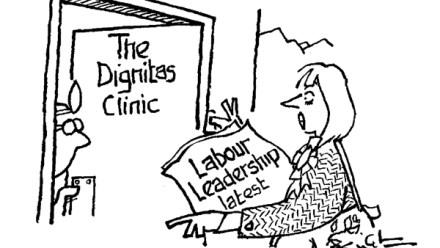
On Wednesday night in the televised Labour leadership hustings, Yvette Cooper channeled Margaret Thatcher, saying: ‘I’m not standing because I want to be something, but because I want to do something.’ So is she trying to pose as Labour’s Iron Lady? After all, it was Thatcher who originally said that: 'It used to be about trying to do something. Now it's about trying to be someone.' Here's the conclusion that Melissa Kite came to in The Spectator, back in 2012: In Yvette Cooper’s home, an entire room is given over to memorabilia of her husband’s life in politics.

The Spectator at war: How to use the Home Guard

From ‘How to Use Our Home Guard Volunteers’, The Spectator, 19 June 1915: There is a technical objection which for the moment seems to raise an insuperable barrier against the military authorities getting what, in many cases, they so eagerly desire, and against the Volunteers rendering the aid which they are equally anxious to render. Clause 6 of the War Office letter of November 19th, 1914, to Lord Desborough, the letter which regularized the position of the Volunteer Training Corps and contains the War Office recognition of all those affiliated to the Central Association of Volunteer Training Corps, and is also the charter of the Volunteers, makes the following stipulation: "No form of attestation involving an oath is permitted.