The Spectator

War and votes for women

From ‘News of the Week’, The Spectator, 25 November 1916: We admit that before the war we should have placed, and indeed did place, Female Suffrage in the catalogue of ‘no compromise’ subjects. The war, however, has modified our view by altering our belief that some fundamental difference of opinion might arise between the sexes upon an issue where action must be confined to the male — i.e., military action. Our acknowledgment of mistake here does not of course exhaust our objections to Votes for Women, but, rightly or wrongly, it does in our opinion render them non-fundamental.

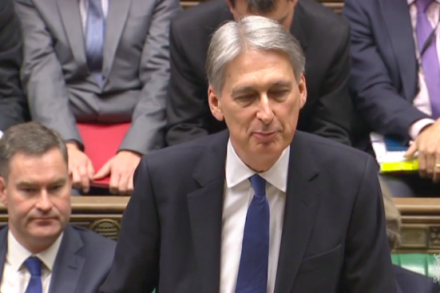
Philip Hammond is just about managing

From the moment she arrived in 10 Downing Street, Theresa May has been commendably clear about her economic priorities for Britain. She wants the country to be a beacon of free trade, at a time when protectionism is on the rise the world over. She is annoyed at the way in which quantitative easing has manipulated asset prices, making property unaffordable. And while David Cameron was very successful in raising the incomes of those at the bottom, she is concerned that those in the middle have not fared as well. She wants a ‘country that works for everyone’ — that is to say, one where effort is always rewarded. This is, alas, no cliché.

Full text: The Autumn Statement

Mr Speaker, It is a privilege to report today on an economy which the IMF predicts will be the fastest growing major advanced economy in the world this year. An economy with employment at a record high – and unemployment at an 11 year low. An economy which, through the hard work of the British people, has bounced back from the depths of recession. And an economy which has confounded commentators at home and abroad with its strength and its resilience since the British people decided, exactly five months ago today, to leave the European Union and chart a new future for our country. That decision will change the course of Britain’s history.

Subscribe to The Spectator’s Evening Blend email

You already know that Coffee House serves up the best analysis, comment and insight into the day’s political events. Why wait for tomorrow’s papers when the best writing is already up online? But our emails – Lunchtime Espresso and Evening Blend – mean you don’t even have to wait until you can log on to Coffee House. Sent to your inbox twice a day, we give you the top stories, top analysis – as well as a diary of tomorrow’s debates, and the vital statistics of the day. To sign up, for free, enter your email address in the box below.

Letters | 17 November 2016

Wisdom of crowds Sir: According to Matthew Parris (‘Can we trust the people?’ 12 November), I have become part of the mob. Nevertheless, I have never really thought of myself in that way. Although it may be reasonable to criticise the antics of Farage or Trump, surely it is wrong to characterise all those who voted for their causes as a mob? My motives in voting for Brexit were simple and reasonable. Many of my generation — who lived as children through the 1940s when our parents went to war to preserve our sovereignty, our justice system and control of our borders — voted to leave the EU because they saw these three vital powers slipping away into the hands of an unelected bunch of bureaucrats.

Portrait of the week | 17 November 2016

Home Nigel Farage, the caretaker leader of Ukip, was photographed with a smiling Donald Trump as the two men held a meeting at Trump Tower in New York. Downing Street was furious at suggestions that Mr Farage might act as a go-between. Theresa May, the Prime Minister, said at the Lord Mayor’s banquet that policies favouring the common good should protect everyone from the effects of globalisation. Boris Johnson, the Foreign Secretary, complained of a European ‘collective whingerama’ about Mr Trump and decided not to attend a summit of EU foreign ministers summoned by Germany; France and Hungary did not attend either.

Barometer | 17 November 2016

Long divisions Donald Trump reaffirmed his plan for a border wall between the US and Mexico, but said parts might end up as a fence. Who has the longest, highest barriers? India-Bangladesh India is still building a 2,545-mile three-metre-high barrier of barbed wire and concrete. Morocco-Western Sahara Separated by a 1,700-mile sand berm, typically two metres high, reinforced with land mines. US-Mexico 580 miles of fence already exist along the 1,950-mile border. Israel-Palestinian territories 440-mile barrier: part concrete wall, part barbed wire. Hungary-Serbia To thwart migration there is a 110-mile, four-metre-high fence. Catholic and Protestant Belfast 25-mile long ‘peace lines’ up to 8.5 metres high still separate some communities.

Germany and the City

From ‘English versus German banking’, The Spectator, 18 November 1916: At the present moment a good many of us are in the mood to feel that we never wish to see any kind of German within our country again; but it is quite certain that this attitude of mind will not endure for ever, and it is equally certain that if we prevent German bankers from establishing themselves in London after the war they will take their business elsewhere, and to that extent London will lose its character as an international banking centre. Mr Pownall well expresses the main proposition: ‘It is the universality of London, its cosmopolitan composition, that creates its character. Deprive it of that character and its pre-eminence dies.

Books of the year | 17 November 2016

Michela Wrong Back in 2006, David Cornwell, aka John le Carré, hired me as guide for his first trip to the Democratic Republic of Congo (DRC), to research The Mission Song. Evenings were spent on the terrace of the Orchids Hotel in Bukavu, watching pirogues languidly traverse Lake Kivu, ice cubes clinking in respective glasses of Scotch. It was easily the most entertaining ten days of my life, despite the stonking hangovers. Cornwell proved to be a thespian manqué. The wry, extremely funny anecdotes about his career as diplomat, spy and writer, his charming conman father, his peripatetic childhood and his encounters with the likes of Yasser Arafat, Richard Burton and Rupert Murdoch were all gloriously enriched by the fact that he can do all the voices.

Letters | 10 November 2016

A downbeat Brexiteer Sir: Alexander Chancellor (Long Life, 22 October) wondered why Brexiteers were not more upbeat about their victory. I suspect many, like me, were worried about Remainers trying anything they can to overturn the vote. The news that the judges have ruled that Brexit cannot be triggered without a parliamentary vote shows how sadly right we are to be downbeat. Marion Gurr Pury End, Northants Shakespeare’s ‘nothing’ Sir: Charles Moore comments upon the difficulty of selecting just one word to sum up Shakespeare’s poetry. Like Cordelia, I would suggest ‘nothing’.

Portrait of the week | 10 November 2016

Home Theresa May, the Prime Minister, said she still expected to start talks on leaving the EU as planned by the end of March, despite a High Court judgment that Parliament must decide on the invoking of Article 50 of the Lisbon Treaty that would set Brexit in train. Opinion was divided over whether the High Court had required an Act of Parliament or a vote on a resolution. The government appealed to the Supreme Court, which is to hear the case from 5 December. The judgment set off a confused game of hunt the issue. One issue was whether the press is allowed to be rude about judges. The Daily Mail’s headline had been ‘Enemies of the people’ and the Daily Telegraph’s ‘The judges versus the people’.

Conditions for surrender

From ‘How to Shorten the War. I. Prisoners’, The Spectator, 11 November 1916: Unless we altogether mistake the mental character of the German military authorities, they will hold that there is only one effective way of dealing with our invitation to a British fireside in a prison camp, and that is by stamping with the utmost ferocity upon any symptom of readiness to surrender… If once we can set one or two plain questions rolling in the German lines, we shall have done what we want to do. ‘Is it worth while to bear this? Are we doing any good by bearing it? Does not the way we are treated give us a right not to bear it?

Books of the year | 10 November 2016

Craig Raine  Philip Hancock’s pamphlet of poems Just Help Yourself (Smiths Knoll, £5): charming, authentic, trim reports from the world of work — City and Guilds, pilfering, how to carry a ladder, sex in a van (‘From the dust-sheet, wood slivers/ and flecks of paint stick to her arse’). One poem is called ‘Knowing One’s Place’; these poems know the workplace. Nutshell by Ian McEwan (Cape, £16.99) was hilarious and compelling. The Pier Falls by Mark Haddon (Cape, £16.99) was grim and compelling. Both books are ripping, gripping yarns — narrative Velcro. Paul Johnson  John Bew’s biography of Clement Attlee, Citizen Clem (Riverrun, £30), is a winner, though it might have been improved by cutting.

Hillary Clinton concedes to Donald Trump – ‘he must be given a chance to lead’

Donald Trump has been elected president of the United States. Hillary Clinton conceded defeat, telling supporters that Trump must be given a 'chance to lead' Barack Obama urged Americans to remember that 'ultimately we are all on the same team' Theresa May congratulated Donald Trump and said she looked forward to working with him. Russian President Vladimir Putin said his country was willing to ‘do everything to return Russian and American relations to a stable path of development’. A different tone was struck by German Chancellor, Angela Merkel, who reminded Trump of the country’s shared values of 'democracy, freedom and respect for the law'.

Theresa May’s passage to India

When a Prime Minister flies off abroad with a few business-leaders it is seldom worthy of comment. Such trade missions tend to achieve little, beyond generating headlines intended to flaunt politicians’ pro-business credentials. But with the impending departure of Britain from the European Union,-Theresa May’s visit to India this week, accompanied by Sir James Dyson and others, has huge significance. For the first time in four decades, a British Prime Minister can discuss doing trade deals — something which we have until now been forced to contract out to officials in Brussels. Mrs May chose her destination shrewdly. With its rapidly expanding economy and the gradual liberalisation of economic policy, India is everything that the EU isn’t.

Brexit means defending UK laws and courts. Brexiteers ought to accept that

The 17.4 million who voted for Britain to leave the European Union were giving advice, rather than an instruction, to Parliament. This ought not to be a controversial point. David Cameron chose to hold a consultative rather than a legally binding referendum - and was able to do this because it would be unthinkable for parliament to ignore such advice, or stand athwart the result of that referendum. All parties regarded the referendum as politically binding. All knew that, if Brexit was voted down, then parliament would be quickly dissolved and a general election called. The British constitution is unwritten, reflecting a British distaste for schematic articles of political faith.

Barometer | 3 November 2016

Strike force Nissan is to expand its plant in Sunderland, building two new models there. The Japanese company is praised for not losing a day to strikes in three decades in the city. But labour relations weren’t always so good. — In 1953, when part of Nissan’s business was assembling Austin cars in Japan under licence, the company suffered a bitter 100-day strike. Occupying US forces became involved, helping the Japanese government to arrest union leaders. — As a result of the strike, a new, less militant union was formed, with a Harvard-educated leader. The union accepted job losses but became involved in discussions over new technology. Global race And where did the UK fit in among the world’s largest car producers in the second quarter of 2016?