The Spectator

Full text: Jeremy Hunt’s Tory party conference speech

From our UK edition

Conference, I believe totally and utterly in our NHS. I want it to offer the safest, highest quality care of any country in the world for you and your family. When I took on this role four years ago I said it was the biggest privilege of my life. Some say it’s the hardest job in government. Others say it’s the safest – because there's not a long line of other ministers who want it. But for me it's the chance to serve our country by guiding our most precious public service through difficult times. And that's why I’m proud to be back in front of you wearing my NHS badge. And why today I want to talk to you frankly about the state of our National Health Service: its successes, its challenges and our plans for the future.

Full text: Amber Rudd’s conference speech

From our UK edition

I succeed one of the most successful Home Secretaries of modern times. You may define success as holding the post for longer than any prior Conservative incumbent since World War Two. You may judge it by introducing the Modern Slavery Act … Which has delivered tough new penalties to put slave masters behind bars. Or, you may judge it by the eventual, hard-won deportation of Abu Qatada – and the message that sent. Well, Theresa May is now Prime Minister, and I am honoured to be Home Secretary in her Conservative-only Government. It’s no secret that earlier this year I campaigned on behalf of the Remain side in the EU Referendum. I travelled the country setting out my views and reasons.

Full text: Michael Fallon’s Tory party conference speech

From our UK edition

This week our party is putting forward a vision of a country that works for everyone. Where you can go as far as your talents take you. Ultimately the opportunity to get on depends on the security provided by our Armed Forces. Today British forces are fighting terrorism, countering aggression, and training troops in democracies as far apart as Iraq and Ukraine, Nigeria and Afghanistan. Here at home, they are patrolling our skies and seas. Serving around the world, around the clock - to keep our country safe. Each one of them deserves our thanks. In Theresa May we have a leader who puts security first. Her first act as Prime Minister was to win an overwhelming majority in Parliament to build the new nuclear submarines that will deter the most extreme threats through to the 2060s.

Full text: Liam Fox’s conference speech

From our UK edition

There was a time when the terms 'Britain' and 'trade' would have been almost synonymous. For over two centuries we were the trading nation. From the intellectual pioneers such as Adam Smith, whose book 'the Wealth of Nations' made the case for free trade, to the Royal Navy’s patrol of the world’s trade routes to the might and resilience of the British Merchant Navy, this country was at the forefront of a free and open trading world. And this party also played its part. When Sir Robert Peel fought against the vested interests of the day to repeal the corn laws and prevent the exploitation of the poor, he set the tone for a Conservative party that was to become the most successful that the democratic world had ever seen.

Full text: Philip Hammond’s conference speech

From our UK edition

It’s great to be back in Birmingham – and a privilege to address this conference as Chancellor of the Exchequer. I don’t think I am giving away any state secrets in admitting that I just might have hoped to have been a Treasury Minister a little bit earlier in my political career! In fact, having been Shadow Chief Secretary for the three years up to the 2010 General Election, I rather think that Liam Byrne’s infamous note to his successor – remember it? - “Dear Chief Secretary, I’m afraid there is no money”– I rather think it was intended for me. But it went to David Laws. Who published it! And so it became, perhaps, the shortest political suicide note in history!

Full text: Boris Johnson’s conference speech

From our UK edition

I was at the UN general assembly in NY the other day and talking to the foreign minister of another country. I won’t say which one, since I must preserve my reputation for diplomacy, but let’s just say they have an economy about the size of Australia (though getting smaller, alas). Plenty of snow, nuclear missiles, balalaikas, oligarchs, leader who strips to the waist you get the picture. After a few tense exchanges my counterpart gave a theatrical sigh and said that any difficulties we had in our relationship were all Britain’s fault: “It was you guys who imposed democracy on us in 1990”.

Full text: David Davis’s conference speech

From our UK edition

Ladies and gentlemen, on the 23rd of June the British people voted for change. And this is going to be the biggest change for a generation: we are going to leave the European Union. It was we, the Conservative Party, who promised the British people a referendum. It was David Cameron, a Conservative Prime Minister, who honoured that promise. And now it will be this government, a Conservative government that will lead the United Kingdom out of the European Union and into a brighter and better future. This must be a team effort. And I am proud to count myself part of Theresa May’s team. I don't know what it is about our great women leaders, but aren’t we lucky that they’re there when we need them?

Full speech: Theresa May on ‘Britain after Brexit’

From our UK edition

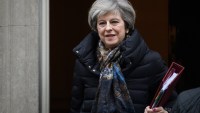
81 days ago, I stood in front of Ten Downing Street for the first time as Prime Minister, and I made a promise to the country. I said that the Government I lead will be driven not by the interests of a privileged few, but by the interests of ordinary, working-class families. People who have a job, but don’t always have job security. People who own their own home, but worry about paying the mortgage. People who can just about manage, but worry about the cost of living and getting their kids into a good school. And this week, we’re going to show the country that we mean business. But first, today, we’re going to talk about Global Britain, our ambitious vision for Britain after Brexit. Because 100 days ago, that is what the country voted for.

Letters | 29 September 2016

From our UK edition

Ground zero Sir: James Forsyth looks for hope for moderates within the Labour party and finds none (‘The party’s over’, 24 September). That is because the most promising source of hope for them is not a change of position by Labour, but one by the Conservatives. The history of British politics since 1990 has been a prolonged fight for the centre ground. This isn’t because that’s where either party naturally wants to be, but because that’s where the votes are. With Corbyn’s renewed mandate, Labour have unilaterally ceded that ground. The Conservatives could, as Forsyth suggests, use the opportunity to dig themselves in there so firmly that Labour will never recover it.

Deadly silence

From our UK edition

There was a time when the humanitarian crisis in Aleppo would have featured strongly in political debate in Britain. Just two weeks after a negotiated ceasefire appeared to have provided some respite, a war of attrition in Syria’s second largest city is escalating into a vast human tragedy. Last Saturday, a bomb dropped by Syrian government forces knocked out a pumping station which had been supplying water to two million people, 250,000 of whom are besieged in the rebel-held east of the city. On the same day, at least 45 people, many of them children, were killed by barrel bombs dropped indiscriminately on civilians — a now common occurrence. Food supplies had already been running low, supply lines to rebel areas having been severed in early September.

Portrait of the week | 29 September 2016

From our UK edition

Home Sir Michael Fallon, the Defence Secretary, said that Britain would oppose attempts to create an EU army, as it would ‘undermine’ Nato. Forecasts for British economic growth in 2016 collated by the Treasury were revised from 1.5 to 1.8 per cent, the level expected in June, before the EU referendum. Mathias Döpfner, the chief executive of Axel Springer, said that leaving the European Union would make Britain ‘better off than continental Europe’ within five years. Scotland began importing shale gas from the United States. Fourteen candidates are to stand in the by-election at Witney on October 20 to replace David Cameron as MP, including one from the Bus-Pass Elvis Party.

Serpent of mud

From our UK edition

From ‘The fall of Combles and Thiepval’, The Spectator, 30 September 1916: The trench — ugly, dirty, dull, untidy serpent of mud and sandbags — will always have the advantage of the most artful fortress. In the last resort, the reason for this seeming miracle is the fact that the trench has something of mobility in it, and mobility is the vital essence of war. You can prolong a trench line to infinity, or to the sea or a neutral frontier, which is even better than infinity. A fortress has a finality about it which is fatal. The moment mobility is abandoned, as in an invested fortress, putrefaction, physical and spiritual, seems to set in.

Full speech: Jeremy Corbyn at Labour party conference

From our UK edition

Thank you for that introduction. And how brilliant it is to see the hall here in Liverpool, absolutely packed for the Labour conference, well I say it’s packed but Virgin Trains assure me there are 800 empty seats. Either way Conference, it’s a huge pleasure to be holding our party’s annual gathering here in this fantastic city that has shaped our country, our economy, our culture and our music. Liverpool and its people have always been central to the Labour party and our movement. And I know some people say campaigns and protests don’t change things. But the Hillsborough families have shown just how wrong that is.

Full speech: Tom Watson at Labour party conference

From our UK edition

Hello, Conference. Thank you for being here in this great city, at this historic gathering of the greatest movement for social change our great country has ever known. It’s a privilege to address you. Thank you. I’d better get the difficult stuff out of the way: Saturday’s result, whatever you think of the man, whatever he’s done, how can Ed Balls be bottom of the leader board on Strictly Come Dancing? Strictly, of course, is a hot bed of media-obsessed prima donnas and harsh critics slating your every move. You’d think after a decade in Parliament Ed would have done better than that. Disappointing, Ed, to be honest.

Full speech: Sadiq Khan at Labour conference

From our UK edition

Labour in power. Not just talking the talk, but walking the walk too. Never sacrificing or selling out on our ideals, but putting them in action every single day. Not a revolution overnight, but real and meaningful change that makes life easier for the people who need it most. Conference, after the election this summer the leadership of our party has now been decided and I congratulate Jeremy on his clear victory. Now it’s time for us all to work together towards the greatest prize: getting Labour back into power. Conference, with Labour in power your home and your commute get more affordable, the air you breathe gets less polluted, you get better pay and conditions at work, our businesses are supported to grow, and new jobs are created.

Full speech: John McDonnell at Labour conference

From our UK edition

Now the leadership election is over, I tell you, we have to become a government in waiting. An election could come at any time. Theresa May has said that she will not be calling an early election, but when could anyone trust a Tory leader? We have to prepare ourselves not just for fighting an election but for moving into Government. To do that successfully we have to have the policies and the plans for their detailed implementation on the shelf, in place for when we enter government whenever that election comes. Everybody in the Party, at every level and in every role, needs to appreciate the sense of urgency about this task, the mess we will inherit. So in this speech I want to address some of the key issues we will face and how we will face them.

Letters | 22 September 2016

From our UK edition

Remote control Sir: Rachel Wolf argues that in education policy ‘the trend, from Kenneth Baker onwards, has been towards giving schools autonomy and promoting a system where parents choose schools’ (‘Bad grammar’, 17 September). Unfortunately, freedom from local authority control has been replaced with unprecedented central interference and control. For teachers, the burdens created by Ofsted inspections far outweigh those imposed by councils. In real terms, education spending has doubled since the introduction of the national curriculum in 1988, yet academic standards have at best stayed still. Wolf cites the success of a few academy chains, ignoring the indifferent performance of most.

Borderline sanity

From our UK edition

Only now does Angela Merkel concede that her admitting a million refugees last year was a mistake. It was obvious to most people in Europe at the time that her warm-hearted gesture would lead to catastrophic results. In declaring that all Syrian refugees would be welcome if they made it to Germany, she doubled the fortunes of the human trafficking industry. The asylum seekers came from Syria and North Africa through Austria and Hungary, having landed on the shores of Italy and Greece. Thousands died on the way. When Theresa May addressed the United Nations this week in New York, she was able to point to a British way of handling the crisis.