The Spectator

On political tribalism

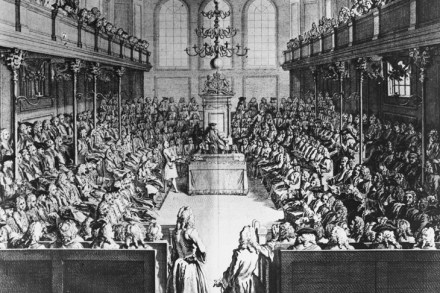
From The Spectator, No. 152, 24 July 1711: There cannot a greater judgment befall a country than such a dreadful spirit of vision that rends a government into two distinct people, and makes them greater strangers to one another, than if they were actually two different nations… A furious party-spirit, when it rages in its full violence, exerts itself in civil war and bloodshed; and when it is under its greatest restraints naturally breaks out in falsehood, detraction, calumny, and a partial administration of justice. In a word, it fills a nation with spleen and rancour, and extinguishes all the seeds of good-nature, compassion and humanity.
Letters | 24 January 2019

Autistic freedom Sir: Jonathan Mitchell, an autistic writer, argues that autism is an affliction and that a cure should be found (‘The dangers of “neurodiversity”’, 19 January). When my son was diagnosed I would have agreed with him, but I disagree strongly now. My son’s autism comes with real challenges, but I value the ways it’s helped him become a thoroughly decent person: he doesn’t lie, it wouldn’t occur to him to be nasty and he’s totally logical. Surely, the world needs more people like him, not fewer. As Mr Mitchell says, the autism spectrum is huge, encompassing people who can’t communicate, who are locked in a sensory hell and need a high level of care, often for conditions that are not part of their autism.

Portrait of the week | 24 January 2019

Home Theresa May, the Prime Minister, having survived a parliamentary vote of no confidence, came to the Commons with an amended plan for Brexit which would entail changing the Irish backstop agreement with the European Union. Otherwise Plan B looked very much like the Plan A that had been defeated by a majority of 230 a week earlier. There would now be a vote on 29 January, with Labour putting down an amendment that could open the way for another referendum. Amonportg British MPs there was a good deal of plotting in the wind. Margaritis Schinas, the European Commission’s chief spokesman, said that in the case of a no-deal Brexit, ‘I think it’s pretty obvious — you will have a hard border’ with the Irish Republic.

to 2389: All change

The paired unclued lights are anagrams of one another, most being symmetrically arranged; 2/21, 5/23, 12/41, 15/25, 19D/20.   First prize Alan Peevers, Manchester Runners-up Martin Dey, Hoylandswaine, S.

Raw and noisy debate is exactly how laws should be made

An unexpected outcome of the tortuous process of Brexit negotiations has been the enhancement of Britain’s reputation as a parliamentary democracy. For many years, it has seemed as if political debate was draining away to the TV and radio studios, or even to social media — with MPs reduced to simply rubber-stamping decisions which have already been made elsewhere. This week, the Commons reasserted its authority in the most dramatic way imaginable, inflicting the largest ever government defeat on a substantive motion. The rejection of the Prime Minister’s Brexit deal is a humiliation on a scale which confounded the government’s attempts at expectation-management. To Mrs May’s credit, she immediately conceded that MPs must decide what happens next.

Barometer | 17 January 2019

Turkey and the deep state Boris Johnson said that if Brexit was blocked, the public would blame it on the ‘deep state’. The expression comes from the Turkish Derin Devlet — coined to express the conspiracy of military, police, intelligence bodies and even organised criminals which many Turks believed were operating against their democratically elected government. It made its way into the English language in the 1990s when Kurdish separatists were threatening to declare independence. While there is little doubt that police and the military were involved in the underhand suppression of Kurdish insurgents, their efforts did not support the existence of a well-organised secret government.

Portrait of the week | 17 January 2019

Home Brexit threw politics into unpredictable chaos. The government was defeated by an unparalleled majority of 230 — 432 to 202 — on the withdrawal agreement it had negotiated with the EU. The result was greeted by cheers from demonstrators outside the House, both those in favour and those against Brexit. Labour tabled a motion of no confidence for the following day. Theresa May, the Prime Minister, said in the House after the vote: ‘The House has spoken and this government will listen.’ She said she would talk to senior parliamentarians and that the government would return to the House on Monday with proposals. This arrangement was in line with a business amendment by Dominic Grieve that the Speaker had allowed the week before.

Rude health

An unexpected outcome of the tortuous process of Brexit negotiations has been the enhancement of Britain’s reputation as a parliamentary democracy. For many years, it has seemed as if political debate was draining away to the TV and radio studios, or even to social media — with MPs reduced to simply rubber-stamping decisions which have already been made elsewhere. This week, the Commons reasserted its authority in the most dramatic way imaginable, inflicting the largest ever government defeat on a substantive motion. The rejection of the Prime Minister’s Brexit deal is a humiliation on a scale which confounded the government’s attempts at expectation-management. To Mrs May’s credit, she immediately conceded that MPs must decide what happens next.

Where every Tory MP stands on Brexit: the full list

As things stand, it looks inevitable that Theresa May's Brexit deal will be defeated in the House of Commons on Tuesday, but what happens afterwards is the great unknown. While a number of MPs have voiced their opposition to May's deal and no deal, the majority still have not made clear what they would support in its place. And unless there is a parliamentary majority for another option, Britain will leave the EU on 29 March without a deal by default. So what is there a majority for in the Commons? In an attempt to find out, Coffee House has compiled the public Brexit position of every single Tory MP. Their views have been split into five different categories: supporting May's deal, no deal, a second referendum, Norway, or 'Undeclared’.

Letters | 10 January 2019

The changing EU Sir: If, as Frederik Erixon writes, ‘there is a strange pre-revolutionary atmosphere in Brussels’ and ‘power will be handed back from Brussels to the nation states’ (‘The Last Heave’, 5 January), isn’t this what we have wanted and shouldn’t we delay our Brexit negotiations in order to see what happens? The Brexiteers have always said that the EU, its immigration policies and the euro are not sustainable. After the elections across Europe in 2019 the forces for change will be greater than David Cameron found. Surely we need to combine with other like-minded nations, as we have done in the past, to strengthen the forces demanding change rather than walking away, leaving us unable to influence what happens in Europe?

Portrait of the Week – 10 January 2019

Home The government drifted towards a vote by the Commons, which it had cancelled in December, on its withdrawal agreement from the EU. British and European officials discussed extending the period under Article 50 before Britain leaves the EU, which would otherwise come into effect on 29 March. ‘We’re continuing to work on further assurances, on further undertakings from the European Union in relation to the concern that’s been expressed by parliamentarians,’ Theresa May, the Prime Minister, said. She even invited groups of MPs for a drink at 10 Downing Street to court their votes. The government was defeated by 303 votes to 296 on a cross-party amendment to the Finance Bill to limit tax-raising powers for no-deal preparations unless authorised by Parliament.

to 2388: Sea rocket

The quotation was ‘IN MY BEGINNING IS MY END’ (12/15) from East Coker (an anagram of the title), second poem of T.S. Eliot’s Four Quartets. Remaining unclued lights are words whose first half is the same as their second half: 5, 16, 42, 43, 10 and 13. ELIOT (diagonally from the twelfth row) was to be shaded.   First prize Mike Conway, Grantham, Lincs Runners-up Edward Staveley, London SW15; S.C.

Barometer | 3 January 2019

Paths of infection 2019 marks the 100th anniversary of the height of the Spanish flu pandemic which is believed to have killed 3 per cent of the world’s population. But how Spanish was it, and what should it have been called? Spanish flu: There is little evidence it originated in Spain, but news of the disease first appeared in the Spanish press, because the country was not subject to the wartime reporting restrictions of most European countries, so it was assumed it started there. French flu: Virologist John Oxford has suggested the disease crossed to humans at Étaples, a transit and hospital site in the Great War.

Letters | 3 January 2019

Lords reform Sir: How astonishing that the historian Robert Tombs (‘Beyond Brexit’, 15 December) should think that the Lords might ‘at last be seriously reformed’ after more than a century of schemes that foundered in the Commons. MPs have an unthreatening upper house; they will never agree on substantial changes that would increase its power. They will leave the Lords to implement its own sensible plans to cut its numbers to 600 by bringing party strengths into line with those in the Commons over the next few years.