The Spectator

Rough crossings

It has been a messy start to the new year for Sajid Javid. For months now, migrants using small boats have been landing in Kent, usually no more than a dozen people at a time. For a country that receives up to 2,500 asylum applications a month, this falls short of a national crisis. It was quite absurd for Tory MPs to talk about deploying the Royal Navy to fend off a few dinghies, and absurd for the Home Secretary to rush back from his holiday to handle the non-crisis and declare it a ‘major incident’. It is a minor incident, but may turn into a major one if the government panics. Migration patterns change, as do the methods.

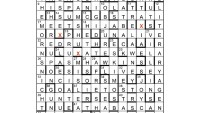
2387: On the Spot

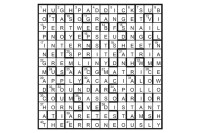
The HISPANIOLA was the ship that brought the other unclued answers to TREASURE ISLAND in the novel by R L Stevenson. No pirates were named in the grid, except Ben GUNN who joined against them, but (Long John) Silver appeared in the clues, which had a nautical/piratical flavour. The map in Treasure Island had three red X’s, like the grid.

A model president

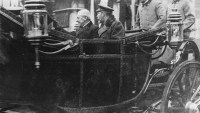
From The Spectator, 4 January 1919: President Wilson arrived in London on Thursday week, and was greeted with full expression of the heartiest goodwill. The welcome began at Dover; and when the visitors drove through the streets of London, they passed through a heavy barrage of cheering, which was renewed when the President appeared with the King on a balcony of Buckingham Palace.

From the archive: The Spectator’s original verdicts on literary classics

Wuthering Heights by Emily Brontë, reviewed 18 December 1847 An attempt to give novelty and interest to fiction, by resorting to those singular ‘characters’ that used to exist everywhere… the incidents and persons are too coarse and disagreeable to be attractive, the very best being improbable, with a moral taint about them, and the villainy not leading to results sufficient to justify the elaborate pains taken in depicting it. Bleak House by Charles Dickens, reviewed 24 September 1853 Bleak House is chargeable with not simply faults, but absolute want of construction.

The drone problem could be just beginning

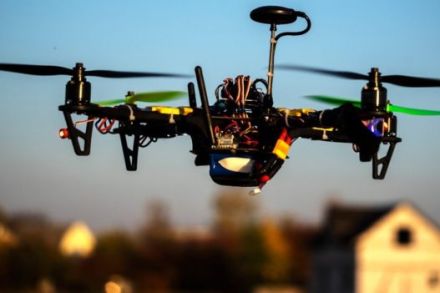
We’ve seen over the last 48 hours the disruption that drones can cause – and frankly it's surprising it's taken this long for it to happen. The UK Airprox Board, which monitors air safety, says these incidents are on the rise: from 29 in 2015, to 71 in 2016, and 92 last year. Among those recorded are serious incidents like near misses with commercial aircrafts. This is largely because drones are becoming increasingly common.

Letters | 13 December 2018

Life in the borderlands Sir:  The Irish border question has grabbed political headlines this year, but spare a thought for those who live near it. The border takes a haphazard route along river banks, and even through farms. I recall visiting a farm in Fermanagh: I drove into the farm from Northern Ireland but the farmer showed me an exit which led straight into the Republic. For a number of years the Methodist Church in Pettigo (NI) had a minister whose house was on the other side of the border. This porousness is remarkable considering the historical conflict between our two countries. To this day, many Irish call Northern Ireland ‘the North’, as if to deny the border exists.

Barometer | 13 December 2018

Crisis at Christmas MPs were warned that they might have to give up part of their holidays to deal with Brexit. Here are some other political crises from Christmases past: 1066 William I was crowned on 25 December. Trouble was expected from the English so the streets of Westminster were lined two deep with soldiers. The service was interrupted by a boisterous crowd and houses near the abbey were set alight. 1974 Embarrassment for Harold Wilson on Christmas Eve — his former postmaster general John Stonehouse turned up in Australia, having faked his own death. 1989 Deposed Romanian president Nicolae Ceausescu and his wife Elena had their festive season curtailed by a brief trial, after which they were shot.

Two futures

Last Christmas, The Spectator set up an appeal — not for money to be given to charity, but for our readers to use what influence they have to offer internships for children selected by the Social Mobility Foundation. The response was wonderful. Offers arrived from across the country and, as a result, teenagers found themselves in barristers’ chambers, railway companies, even the royal household. It was such a success that we are repeating our appeal this year. Several of our readers wrote in to make an interesting point: that while they were delighted to help, they could not pretend their motives were entirely charitable. There is great demand for young talent nowadays, so shrewd employers go the extra mile to find it.

Portrait of the year | 13 December 2018

January Four young men were stabbed to death in London as the New Year began. The Crown Prosecution Service was to review rape cases, after several prosecutions collapsed when evidence was not disclosed to the defence. Carillion went into liquidation. London Zoo delayed its annual stock take after a fire killed an aardvark called Misha. Turkish forces shelled the Kurdish enclave of Afrin. The supreme court of Iceland upheld an import tariff on potato chips of 76 per cent. The Grand Mufti of Egypt said that bitcoin was forbidden by Islam. California legalised recreational cannabis. February The Charity Commission launched an inquiry into Oxfam staff paying for prostitutes in Haiti in 2011.

The Spectator’s original verdict

Wuthering Heights by Emily Brontë,  reviewed 18 December 1847 An attempt to give novelty and interest to fiction, by resorting to those singular ‘characters’ that used to exist everywhere… the incidents and persons are too coarse and disagreeable to be attractive, the very best being improbable, with a moral taint about them, and the villainy not leading to results sufficient to justify the elaborate pains taken in depicting it. Bleak House by Charles Dickens, reviewed 24 September 1853 Bleak House is chargeable with not simply faults, but absolute want of construction.

Pick a painting

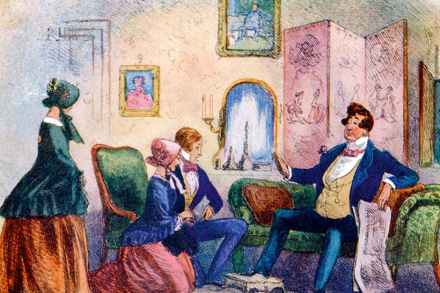
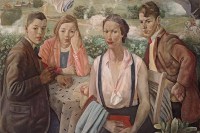
  Alexander McCall Smith   There is a painting in the Scottish National Gallery of Modern Art that I find quite haunting. It is called ‘A Portrait Group’, and is by the Scottish artist James Cowie. Cowie painted this picture in 1933 and then reworked it in 1940. He was an art teacher, and often used his pupils as models. In this painting, he didn’t get the models to sit together, but created the painting from separate studies he had made of various sitters. For me it is about friendship. Here are four young people on the cusp of their adult lives. What lies ahead of them? Will they find friendships as strong as those of these early years?

Christmas quiz – the answers

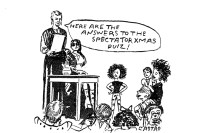
You don’t say 1. President Donald Trump, in a tweet 2. Donald Tusk, the President of the European Council, in an Instagram 3. Gavin Williamson, the Defence Secretary 4. Boris Johnson on the niqab 5. Sarah, Duchess of York, on the engagement of her daughter Eugenie 6. Serena Williams, to the referee, on being docked points during the American Open final 7. Jeremy Hunt, the Foreign Secretary, in China 8. President Emmanuel Macron of France 9. Danny Dyer 10. Rt Revd Michael Curry, preaching at the wedding of the Duke and Duchess of Sussex Flick books 1. Harry Potter and the Sorcerer’s Stone 2. All Quiet on the Western Front 3. Kes 4. Full Metal Jacket 5. Slumdog Millionaire 6. One Shot 7. Die Hard 8. And Then There Were None 9. Trilby 10. The Lady Vanishes.

Letters of no confidence in Theresa May: live updates

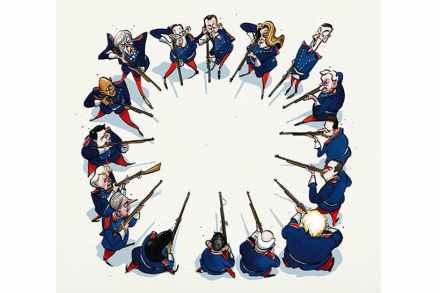
UPDATE: 48 letters of no confidence have now been reached. It's been four long weeks since the last rebellion against Theresa May, when the ERG and Brexiteers fell short of the numbers they needed to trigger a leadership election. Now, it's being reported that Tory MPs have had enough, and are once again submitting letters of no confidence to the chairman of the 1922 committee, Graham Brady. Speculation is rife that the total number of letters has already been reached this evening. Once 48 letters have been submitted, a confidence vote will be triggered. But before them, Brady is likely to let the PM know in private first, to give her the chance to resign before any confidence vote takes place.

The birth of minimalism

The Spectator is responsible for many coinages. One of the most significant came in 1968, when an article by our 24-year-old music critic, Michael Nyman, appeared with the headline ‘Minimal Music’ (reprinted below). It was a wry joke about music that was more experimental than strictly minimal but it stuck and a musical style that, whatever you think of it, has rarely been matched in influence or reach was born. Walking home from the Fugs’ concert, organised by the Middle Earth at the Round House last week, I was shocked by the 4 a.m. silence — by its awesome superiority to a lot of modern music, and by its unfamiliarity.

Letters | 6 December 2018

Sleeping on the streets Sir: Mark Palmer claims that ‘homelessness is hardly a top government priority’ (‘Home truths’, 1 December). I was disappointed to read this, given the ambition of this government to make rough sleeping a thing of the past. As I have said previously in this magazine, we are committed to supporting people off the streets and have committed £1.2 billion to tackle all forms of homelessness. We are working tirelessly to end rough sleeping by 2027 and have outlined our long-term plan — backed by £100 million — to get people into a safe and secure home where they can rebuild their lives.