The Spectator

Former Supreme Court Justice: ‘This is what a police state is like’

The former Supreme Court Justice Jonathan Sumption, QC, has denounced the police response to the coronavirus, saying the country is suffering 'collective hysteria'. This is an edited transcript of his interview with BBC Radio 4's World at One programme earlier today.  Derbyshire police have shamed our policing traditions BBC interviewer Jonny Dymond 'A hysterical slide into a police state. A shameful police force intruding with scant regard to common sense or tradition. An irrational overreaction driven by fear.' These are not the accusations of wild-eyed campaigners, they come from the lips of one our most eminent jurists Lord Sumption, former Justice of the Supreme Court. I spoke to him just before we came on air.

Portrait of the week: Salmond cleared, Olympics postponed and Britain told to stay home

Coronavirus Sunday dawned with 233 people in the United Kingdom dead thus far from the coronavirus Covid-19 (a week earlier it had been 21), and more than 12,000 in the world. Three days later it was 442 in the UK and more than 18,000 worldwide. About 107,000 of the world’s 410,000 cases detected had recovered. A billion people in the world were confined to their homes, joined from Sunday by a billion more in India, where confusion reigned. Testing was uneven, but, in fatalities, Italy, with 6,820 by Tuesday, had gone far beyond China (with 3,277). Iran admitted to 1,934 deaths and Spain had 2,800. China was reporting few new home-transmitted cases and Wuhan was to lift its lockdown in April.

How much food have we really been stockpiling?

Time out When did British workers start being ‘furloughed’? The word furlough is first recorded in the English language in 1625, believed to be derived from the Dutch verloffe, meaning a leave of absence of a sailor from the navy. It seems to have come back into parlance in Britain thanks to it being used in the US prison system to describe temporary leave for an inmate. It was the title of a 2018 American film in which a female prisoner is allowed out of jail for the weekend to visit her dying mother. The film was later renamed Time Out, perhaps because not everyone knew what ‘furlough’ meant. But to no avail — the film, which is reported to have cost $3 million to make, grossed just $8,472 at the US box office.

The government must be as ready to remove restrictions as it was to impose them

For days, the Prime Minister had been resisting the kind of measures which have placed many other countries into lockdown, confining their citizens largely to their homes. Civil servants had pointed to studies saying that many ‘social distancing’ strategies might do more harm than good. In the end, the trajectory of the virus — and the global response — meant the restrictions now in place were inevitable. But at every stage, the Prime Minister has made it clear he was acting with reluctance. While he has been criticised by those seeking a heavier-handed approach, opinion polls suggest most of the country is with him. Yet public opinion can be fickle.

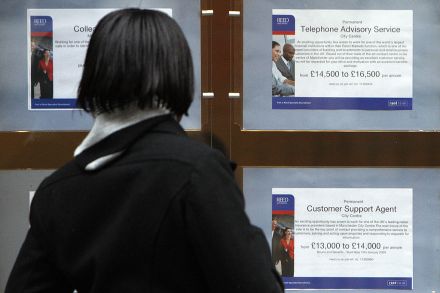
The Spectator offers free job adverts during Covid-19 crisis

This is a crisis like no other: the economy is crashing, with bars and restaurants closing. In spite of Rishi Sunak’s offer of help, thousands have already been laid off. Many self-employed and freelancers are looking at months of uncertainty. Yet at the same time, certain parts of the economy are surging – and hiring. Grocers and supermarkets are in the news, with Tesco seeking 20,000 more workers to cope with demand. A great many smaller companies are looking to hire as the economy reorients towards serving a country in lockdown. Some of the jobs are in home delivery, but many are not. Big supermarkets have rightly made headlines with their job offers.

Portrait of the week: Coronavirus hits pubs, offices, sport, the FTSE and Mount Everest

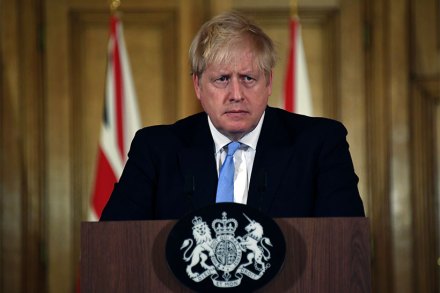
Coronavirus The government asked all people over 70 to cease from social contact for at least 12 weeks in order to avoid catching the coronavirus Covid-19. If anyone had a high temperature or new continuous cough, the whole household should stay in for 14 days. Everyone should work from home if they could and avoid pubs and theatres. All non-urgent operations in England would be postponed from 15 April. Boris Johnson, the Prime Minister, said: ‘Although the measures are extreme, we may well have to go further.’ Earlier, he had said that many families would ‘lose loved ones before their time’ to the disease.

Where does ‘helicopter money’ come from?

Taking off Who came up with the concept of ‘helicopter money’? — The term is derived from an essay in 1969 by the economist Milton Friedman, who suggested a theoretical experiment where a helicopter flew over a community suffering from low growth and dropped $1,000 of banknotes which were then eagerly collected by the residents and spent. — The idea was revived in a speech by the then chairman of the Federal Reserve, Ben Bernanke, in 2002. — Come the banking crisis, however, central banks opted for an indirect way of pumping extra money into the financial system, via quantitative easing.

Letters: The perfect song to wash your hands to

British science Sir: Dr Fink is right that the UK bats well above its weight through curiosity-driven research (‘Back to basics’, 14 March). This forms the bedrock of scientific progress, but it is misleading to imply that ‘blue skies’ thinking and practical application are mutually incompatible. Should we not nurture both? In this way the UK will lead in discovery and exploitation for societal benefit through the earliest application of new ideas, preventing us from dropping the ball as we have in the past. He is right that we should let scientists focus on delivering new science, but is it too much to spend a few weeks outlining forward plans every five years?

The lockdown list: books to read during quarantine

From our US edition

Now we’ve got time on our freshly cleaned hands, The Spectator’s literary luminaries are lubricating the wheels on time’s wingèd chariot and seizing the chance to boost their morale and brain function, reflect on the meaning of life and catch up on a good book or six. Each day, the Lockdown List carries our bibliophilic recommendations. Day 74: Indian summerRoss Clark The success of Black Lives Matter has deflected attention from a group which has no less a cause for grievance over its treatment throughout US history: native Americans. Indeed, to this day Native Americans, thousand for thousand, have an even greater chance of being killed by police officers as do African Americans.

custer

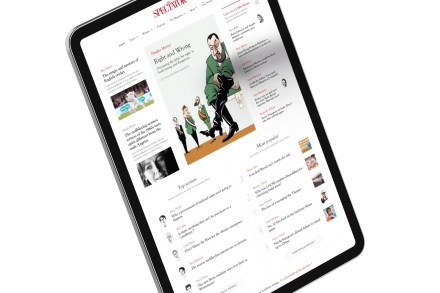
The Spectator launches new website to mark its 10,000th issue

Today The Spectator launches a new website, designed to showcase its world-class journalism, popular podcast channels and 24/7 news coverage and commentary. The website has been designed in advance of our 10,000th issue, as The Spectator – the oldest magazine in the word – becomes the first publication in history to reach this milestone The issue, which goes on sale on 23 April – St George’s Day – will look back on our 192-year history as well as mark the start of a new digital era. The website’s redesign pays tribute to the print magazine, while modernising our look and feel to showcase the variety of what The Spectator produces.

Is Boris about to abandon his own debt rules?

It’s always tempting for governments to respond to economic trouble with a debt-fuelled spending splurge, but it’s a notoriously blunt tool. The root of the current problem is not financial panic but a rational response to the coronavirus. People are travelling less, staying away from shops and the workplace, delaying various projects, and they will keep doing so while the uncertainty remains. This disruption is painful but temporary. It is not symptomatic of financial malaise. It would be a mistake for the Conservatives to use this as a pretext to abandon their five-year plan to control the public finances. The £30 billion stimulus to address jitters over coronavirus was quite a figure, especially as the extent of the economic impact of Covid-19 is far from clear.

Letters: The BBC licence fee is an anachronism

Coronavirus predictions Sir: While precautionary advice regarding the coronavirus should be followed, Ross Clark is right (‘Feverish imaginations’, 29 February) to urge an open mind on the doomsday predictions which are edging us towards panic. In 1996 the then government’s chief scientific adviser, Professor Kenneth Calman, predicted that 500,000 people could die within a few years from the human form of BSE. Another official adviser, Professor Richard Lacey, described the disease as ‘the time bomb of the 20th century, equivalent to the bubonic plague’. In the event, the reported death toll was 177, while the scare cost the UK an estimated £7 billion.

Portrait of the week: Panic buying, Budget announcements and farewell to Harry and Meghan

Home At the beginning of the week 319 people in the United Kingdom had been found to be suffering from the coronavirus Covid-19, with five deaths by Monday evening; by the next day there were another 54 cases and another death. Of the total, 91 were in London. Testing was extended to anyone hospitalised with a respiratory tract infection. Nadine Dorries, a health minister, caught the virus. Shares in London fell by 7.8 per cent on Monday, like those in other European exchanges, then bounced back a little. Supermarkets were allowed to receive deliveries in the dead of night to avoid shortages. There was a curious tendency to panic-buy lavatory paper. The Bank of England announced an emergency cut in interest rates from 0.75 per cent to 0.

The great Tory Budget giveaway

It’s always tempting for governments to respond to economic trouble with a debt-fuelled spending splurge, but it’s a notoriously blunt tool. The root of the current problem is not financial panic but a rational response to the coronavirus. People are travelling less, staying away from shops and the workplace, delaying various projects, and they will keep doing so while the uncertainty remains. This disruption is painful but temporary. It is not symptomatic of financial malaise. It would be a mistake for the Conservatives to use this as a pretext to abandon their five-year plan to control the public finances.

Full text: Rishi Sunak’s Budget statement

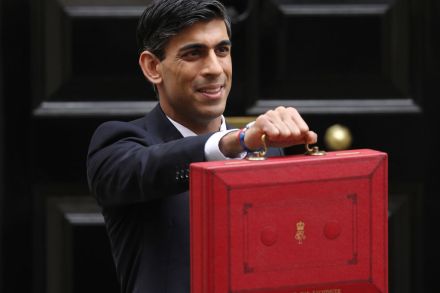
Rishi Sunak unveiled his first Budget today. The Chancellor has promised a £30bn war chest for tackling coronavirus. There is also £6bn of new funding for the NHS, a new £2.5bn pothole fund and £5.2bn for flooding defences. Here is his full speech: I want to get straight to the issue most on everyone’s mind– coronavirus COVID19. I know how worried people are: worried about their health, the health of their loved ones, their jobs, their income, their businesses, their financial security. And I know they get even more worried when they turn on their TVs and hear talk of markets collapsing and recessions coming. People want to know what’s happening, and what can be done to fix it.