Sam Leith

Sam Leith

Sam Leith is literary editor of The Spectator.

The 75th anniversary of Brideshead Revisited

42 min listen

In this week's Book Club podcast we're talking about Brideshead Revisited. Evelyn Waugh's great novel is 75 years old this week, and I'm joined by our chief critic Philip Hensher, and by the novelist's grandson (and general editor of Oxford University Press's complete Evelyn Waugh) Alexander Waugh. What made the novel so pivotal in Waugh's career, what did it mean to the author and how did he revise it -- and why have generations of readers, effectively, misread it?

Philippe Sands on the trail of Nazis

38 min listen

In this week’s Book Club podcast my guest is the writer and human rights lawyer Philippe Sands. His new book The Ratline: Love, Lies and Justice on the Trail of a Nazi Fugitive describes his painstaking quest to track down the real story of a Nazi genocidaire who fled justice into the murky underground society of postwar Italy. Philippe tells me about the strange world of shifting allegiances he uncovered, and his own no less shifting relationship with his subject’s son - who continued against all the evidence to believe his father was a good man.

Mark O’Connell on the fantasy and fear of the apocalypse

39 min listen

In this week's books podcast I'm joined by Mark O'Connell, a writer whose latest book Notes from an Apocalypse: A Personal Journey to the End of the World and Back sees him investigate doomsday preppers, wannabe Mars colonists, the Ayn Rand billionaires buying up New Zealand, and the tourist route through Chernobyl. Why, he asks, is the apocalypse something we seem to fantasise about as much as fear?

Why America loves Shakespeare

35 min listen

In this week's books podcast I'm joined from across the Atlantic by the eminent Shakespearean James Shapiro to talk about his new book Shakespeare in a Divided America, which discusses the myriad ways in which America has taken Britain's national playwright up as its own; and then used him as a lightning-rod for the deepest issues about its own national identity - issues of masculinity, race relations, immigration and assassination.

Heads in the cloud

From our US edition

‘Nothing will ever be the same again.’ You hear a lot of that glibly categorical punditry around the COVID-19 outbreak. Already, the progress of a mindless virus through the human population is being touted as the herald of the reorganization of the world’s economic system and the end of neoliberalism, the harbinger of a world in which nurses and shelf-stackers are valued more highly than investment bankers. Well, we’ll see. There are, as has been often said, two great things of which we can always be certain: death and taxes. The former is currently enjoying a bit of a moment. But the latter, sooner or later, is going to make the sort of roaring comeback not seen since First Blood Part II.

connected lockdown heads covid-19

The wisdom of Salman

From our US edition

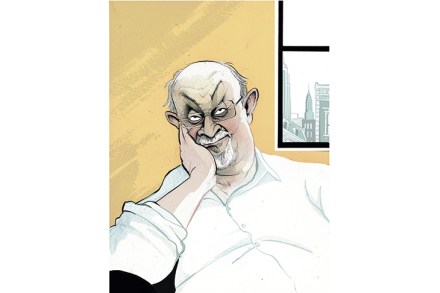
‘Things that would have seemed utterly improbable now happen on a daily basis,’ Sir Salman Rushdie tells me. ‘The implausible has now become everyday.’ Isn’t this a problem for a writer whose books derive from the fantastical traditions of magic realism and science fiction, where crazy stuff happening is what sets them apart? ‘It is.’ The active threat to Rushdie’s life from radical Islam is two decades behind him. His novels have a way of dealing in sour, sometimes apocalyptic ironies. His latest, the Booker-shortlisted Quichotte, is set in what it describes as ‘the Age of Anything-Can-Happen’.

salman rushdie

Salman Rushdie: ‘The implausible has become everyday’

When I say goodbye to Sir Salman Rushdie in his offices at New York University in Lower Manhattan in early March, we bump elbows. Not that it’s much more than a gesture, by this stage: we shook hands unthinkingly on first meeting, and we’d just shaken hands again. It’s a novelty, still halfway to being a joke. As I descend in the lift to Cooper Square, it occurs to me that if I’ve given Rushdie coronavirus I will be halfway to achieving what the mullahs couldn’t. Halfway funny as a hypothetical; halfway not at this distance, writing the piece up three weeks later. As Alan Moore’s nihilistic Rorschach puts it: ‘Good joke. Everybody laugh. Roll on snare drum. Curtains.’ I don’t imagine Rushdie will take offence at this.

Salman Rushdie on the Age of Anything-Can-Happen

61 min listen

‘Things that would have seemed utterly improbable now happen on a daily basis’, Sir Salman Rushdie said to Sam when they spoke in an interview for the Spectator's 10,000th edition. Sam met Salman in New York a few weeks ago, before coronavirus struck down the city. This episode is a recording of that interview, where they discuss everything from his latest book Quichotte, to his relationship with his father, who we learn made up the surname 'Rushdie', and how he feels about The Satanic Verses now. Sam's full interview is out in this Thursday's issue.

How narcos transformed Colombia

41 min listen

In this week's Book Club podcast, I talk to the reporter Toby Muse about the vast, blood-soaked and nihilistic shadow economy that links a banker's 'cheeky little line of coke' to the poorest peasants in Colombia. Toby's new book Kilo: Life and Death inside the Cocaine Cartels traces cocaine's journey from that unremarkable-looking shrub to its entry into a multi-billion-dollar criminal enterprise, interviews farmers, prostitutes, pious assassins and cartel capos - and along the way describes how it has transformed Colombia's whole politics and way of life.

Coronavirus has made amateur mathematicians of us all

‘What is the point of learning maths? When do you ever actually need it? How does it ever affect your life?’ That’s the frequent complaint of my school-age children, labouring over their times tables and number bonds. It was my complaint as I struggled to tell median from mean, or sine from cosine. Well. Now we have a nation and a world bewitched and terrified in equal measure by a ground-level demonstration of what an exponential function does. Our entire society is being shaped for a generation by that elegant, predictable, horrifyingly steepening curve. One shred of comfort in this catastrophe is the thought that no journalist will ever again write ‘increasing exponentially’ as a fancy-sounding way of saying ‘increasing a lot’.

Craig Brown on the kaleidoscopic Beatles

35 min listen

My guest in this week's podcast is the multi-talented satirist Craig Brown, whose new book One Two Three Four: The Beatles In Time is, I feel confident in guessing, the most entertaining book about the Fab Four ever written. Craig joins me to talk about how he goes about his jackdaw work picking out the most curious and striking details from the mass of information in his research, what attracts him to his subjects, and why Paul McCartney has always been his favourite Beatle. Plus: a flabbergasting cameo for our own Stephen Bayley.

A history of poetry with Professor John Carey

35 min listen

This week's Book Club podcast features one of the great wise men of the literary world: Professor John Carey - emeritus Merton Professor of English at Oxford, author of authoritative books on Milton, Donne and Dickens as well as the subject-transforming broadside The Intellectuals and the Masses. (He's also lead book reviewer for a publication we shall call only the S****y T***s, but we pass over that.) In his new book, A Little History of Poetry, he sweeps us with his usual elan from the Epic of Gilgamesh to the backyard of Les Murray. I asked him (among other things) what constitutes poetry, why 'Goosey Goosey Gander' has it all, what he discovered in his researches, and why the so-called New Criticism got old.

The warm, generous side of Andy Warhol

33 min listen

On this week’s Book Club podcast, I’m joined by Blake Gopnik — the author of a monumental new biography of Andy Warhol. Blake tells me how everything — fame, money, and other human beings — were 'art supplies' to Warhol, but that underneath a succession of contrived personae Warhol could be warm, generous and even romantic; that the affectlessness of his art was not the expression of an affectless man; and that if he’d lived on, Gopnik thinks, he could have produced something equal to the late work of Titian.

The Twilight Zone inspired confessions of a poet

27 min listen

My guest on this week’s Book Club is the poet Don Paterson — whose new book Zonal finds him accessing a new, confessional mode, a longer line and a childhood interest in the spooky TV show The Twilight Zone. Don talks about the relationship between poetry and jazz, the split between 'page poetry' and spoken-word material, the shortcomings of Rupi Kaur, whether poems should include 'spoiler alerts', and lifts the lid on his vicious feud with the man he calls 'Alan Jacket'.

There’s no sign of apocalypse in East Finchley – yet

I was mansplaining to my wife earlier this week about why we ought to be very, very concerned by the coronavirus. It wasn’t the prospect of one person in 50 dying, I said — or not just that. It was more, I said sagely, the knock-on effects. You know, if everyone self-isolates, you’re only about two missed Ocado deliveries away from starvation, looting, cannibalism etc. ‘You’re always catastrophising,’ said my wife. ‘You were like this about Trump. And Brexit. I think it’s because you spend too much time reading the news.’ ‘But Trump is very bad,’ I said, because he is. ‘He could start a war.’ ‘He hasn’t started a war.

Hadley Freeman: tracing my family’s escape from Europe

34 min listen

In this week’s Book Club, my guest is the writer Hadley Freeman, whose new book House of Glass tells the story of 20th century jewry through the hidden history of her own family. The four Glahs siblings — one of them the writer’s grandmother — grew up in a Polish shtetl just a few miles from what was to become Auschwitz. They fled the postwar pogroms to Paris; and then had to contend with the rise of a new and still more dangerous anti-Semitism under the Vichy regime. Hadley traced their story through two wars and across continents, and tells me how the story reflects both on Jewish history and on urgent concerns of the present day.

Christina Lamb: how rape is used as a weapon of war

38 min listen

In this week’s Book Club podcast, my guest is the veteran foreign correspondent Christina Lamb. Christina’s new book, Our Bodies Their Battlefield: What War Does To Women is a deeply reported survey of rape as a weapon of war, described in our pages by Antony Beevor as the most powerful and disturbing book he has ever read.

Why 42 is the answer to Life, the Universe and Everything

30 min listen

Don’t Panic! Next month marks the 42nd anniversary of the first radio broadcast of The Hitchhiker’s Guide to the Galaxy. Joining me on this week’s podcast to discuss the genesis, genius and legacy of the show and the books it spawned are the literary scholar and science fiction writer Adam Roberts, and John Lloyd, the founder of QI and a close collaborator and lifelong friend of Douglas Adams. Do we let slip the answer to Life, the Universe and Everything? Nearly.

The internet is taking the joy out of quotations

‘Quotation (n.) — The act of repeating erroneously the words of another.’ Ambrose Bierce said that, or at least wrote it in the Devil’s Dictionary. That was in 1906, and those are words for the ages. In his Rhetoric, centuries before the birth of Christ, Aristotle identified one of the most common and effective ways of making an argument seem stronger. In his section on ‘proofs’ he talked about what he called ‘ancient witnesses’. By this he meant not only the testimony of witnesses such as you might call in court — but the witness borne by proverbs and quotations. Any speaker or writer can get an extra fillip of authority by quoting a revered forbear. Don’t just take my word for it, we say: Shakespeare or Montaigne put it best.