Ross Clark

Ross Clark

Ross Clark is a leader writer and columnist who has written for The Spectator for three decades. He writes on Substack, at Ross on Why?

The state bailed out our banks. Should it also save our steel industry?

'We cannot have a situation where the banks are able to privatise their profits and nationalise their losses,' declared Vince Cable in 2008 in the midst of the banking collapse. But steel companies?  That is a different matter. Cable has demanded that the government take on the pension liabilities of Tata’s British employers in a last gasp attempt to attract a buyer and save the plants. On the subject of nationalising pension liabilities, Cable has form – as business secretary he forced the taxpayer to take on the responsibility for paying postmen’s pensions so that he could sell off the Royal Mail – which he did, at a giveaway price. The taxpayer might have preferred it had the government clung onto the Royal Mail’s huge estate.

In defence of Boris Johnson

It is good that Matthew Parris has taken on Boris. The Mayor has had too easy a press in many quarters. There is a good reason for this: he is one of us. There is a bit of the Bullingdon in Fleet Street: we are often too disinclined to attack our own. Matthew Parris acknowledges this, and the vitriolic nature of his Times column on Saturday is an attempt to redress the balance. But for me, my objection is not that Matthew has gone over the top in his attack on Boris – it is that his line of attack is fundamentally wrong. The same is true of Nick Cohen’s blast yesterday on the same subject. Let’s brush over Matthew’s complaint that a man who once supported Clause 28 has no right to boast on an LGBT ‘out and proud’ video.

What the RSS Boaty McBoatface saga really tells us about British democracy

Our leaders, of course, love democracy – until it comes up with an answer different to the one they were expecting. Last week, the Natural Environment Research Council (NERC) announced an online poll for the public to vote for the name of a new Arctic and Antarctic-going vessel to replace my ageing near-namesake the RRS James Clark Ross. The outcome will tell us volumes about what public bodies really think of public opinion.

Can a school share out its success?

They have enviable results in the classroom and on the sports field. They command substantial fees and send large numbers of pupils to top universities. So why have leading private schools found it such heavy going transferring their success when sponsoring state schools? It seemed the ideal solution to help break down the great barrier between state and private schooling, as well as to address the charge that private schools were not doing enough to justify their charitable status: a leading private school takes a struggling state school under its wing, lends it some expertise, allows it to use some of its facilities and even shares some of its teachers. Results surely cannot fail to be impressive.

The Left are making a pact with God over Sunday trading laws

Later today, barring last minute developments, Labour and SNP MPs will temporarily unite with the Conservatives’ religious right to defeat the government’s plans to liberalise Sunday trading laws -- echoing the defeat which Mrs Thatcher suffered on the same subject 30 years ago. The Left will chirrup, but why is it apparently in favour of keeping Sunday special when logic dictates that it ought to be against? The Reverend Giles Fraser aside, the Left nowadays is generally quite anti-God –-- or it is certainly against the promotion of Christianity as an established religion. In the diverse, multi-cultural society of its dreams, no religion is superior than any other and none of them should be trying to impose their beliefs on others.

Even the French are starting to realise that Hinkley Point is a nuclear turkey

The finance director of EDF, the French energy giant, has quit over its plans to build George Osborne’s new pet project : a new power plant at Hinkley Point in Somerset. At first glance, this seems odd: isn’t the whole problem that the Chancellor has pledged so much taxpayers’ money to this white elephant so the public will be royally ripped off to the benefit of French (and, recently, Chinese) investors? When it’s up and running, yes. But meanwhile someone has to build this, and there have already been delays and cost multiplications. Osborne has sold a third of the stake to the Chinese – not known for their prowess in civil nuclear energy.

Big business backing the ‘In’ campaign shows us what’s wrong with the EU

So, FTSE 100 company bosses have come out in favour of staying in the EU – even if, as Ed West notes, the 198 signatories in a letter to the Times represent only 36 companies. I wonder if anyone dropped out at the last moment to reduce the tally below the figure of 200. Of course big business supports the EU. It always has and always will. But who cares? What matters is what smaller, wealth-creating and job-creating businesses think. And they are much more Eurosceptic. A YouGov poll published in January revealed the huge divide between big business and the rest of the private sector on the issue. Out of 501 leaders of small and medium enterprises polled only 47 per cent favoured continued membership, with 42 per cent favouring withdrawal.

The whale has become Britain’s sacred cow

[audioplayer src="http://rss.acast.com/viewfrom22/thenextrefugeecrisis/media.mp3" title="Simon Barnes and the Sea Watch Foundation's Dr Peter Evans discuss whales" startat=1400] Listen [/audioplayer]Imagine if a bunch of Bollywood celebrities turned up in Britain to protest outside steak houses, lie down in front of abattoir trucks as they tried to leave beef farms and started describing Britain as ‘barbaric’ for killing cattle. You have just got an idea of what it must be like to be a Faroe Islander trying to go about your business harvesting whales from the Atlantic. As has become clear over the spate of stranding at Skegness and Hunstanton, whales have become our sacred species, as Simon Barnes points out in an article in the latest issue of The Spectator.

Investment: This dragon won’t bite

At the risk of sounding like Neville Chamberlain, how bizarre that we should be panic-selling our stock-market investments in reaction to the news of a slight economic slowdown in a faraway country to which we export little and whose direct investments in our own economy created fewer than 5,000 new jobs last year. Throughout the mini-crash of 2016, it has become received wisdom that a Chinese slowdown is threatening the global economy, spreading contagion to every corner of the globe. The fear manifested itself in a 3.

Oxbridge colleges are drowning in celebrity appointments like Emma Watson and Benedict Cumberbatch

An Oxford College has done something really offensive, and it doesn’t involve a statue of a white supremacist. Lady Margaret Hall has appointed Benedict Cumberbatch as a visiting fellow. It gets worse. It has elected Neil Tennant of the Pet Shop Boys and Emma Watson from the Harry Potter films to the same post. Why they didn’t go the whole hog and appoint Giles Fraser as college dean and Jamie Oliver as steward I don’t know. Oxbridge is gradually being drowned in celebrity appointments. The latest were the brainchild of one himself: former Guardian editor Alan Rusbridger, who became Principal of Lady Margaret Hall last September.

Does John McDonnell have any savings for a rainy day?

It is very sporting of John McDonnell to release his tax return for us all to inspect. It is reassuring to see that he isn’t posing as a hero of the working man while living off rent from a property portfolio, and that he hasn’t been working on the side for Vodafone or Google while laying into their tax affairs. Presumably it is the very simplicity of his tax return with which he hoped to impress us. But that is what is bothering me – the lack of entries. Apart from his income of £61,575 as an MP and a pension of £14,421 from his career in local government he seems to have no taxable income whatsoever. Most worrying of all he appears to have earned not so much as a pound in interest from a savings account.

Why would anyone invest in energy when the policies are so fickle?

In 2007 Vincent de Rivaz, chief executive of EDF’s UK arm, made the now-infamous promise that by Christmas 2017 we would be cooking our turkeys using energy generated at Hinkley C nuclear power station. That has already been put back to well into the 2020s. But if you are making plans for Christmas 2025 it might be an idea to base them around eating cold turkey sandwiches by candlelight around a wind-up gramophone. The French newspaper Les Echos reports today that an EDF board meeting about Hinkley has been postponed, amid fears that EDF is having more problems funding the project. EDF has already looked to China’s Nuclear Power Corporation, which last October agreed to take a one third stake in the project.

A select committee revelation: the doors were painted red 20 years ago

The whole purpose of parliamentary select committees was supposed to be to help inform policy-making. Instead, they have sunk to becoming rather vulgar kangaroo courts used by wannabe barristers of the backbenchers to boost their egos. It took about five minutes at today’s session of the Commons Home Affairs Committee to establish that neither G4S nor Jomast (the landlord which provides properties in Middlesbrough for the housing of asylum-seekers) have a policy of deliberately painting front doors red in order to help identify the occupants as asylum-seekers. Only 59 per cent of properties in the town occupied by asylum-seekers are red, it turns out. Moreover, the doors have been painted red for 20 years – long before they were used to house asylum-seekers.

There’s a reason why Middlesbrough asylum-seekers’ doors are red, and it’s not ‘apartheid’

Was there ever a less convincing scandal than the revelation that a landlord who rents houses to G4S for housing asylum-seekers in Middlesbrough chooses to paint all their doors bright red? This, apparently, is ‘apartheid’, according to a hyperbolic Times headline yesterday morning. As if that were not enough, Ian Swales, former Lib Dem MP for Redcar, said the firm’s decoration policy reminded him of Nazi Germany. Presumably, tomorrow’s paper will divulge the devastating finding that the Duke of Devonshire paints all the doors at Edensor, the village on the Chatsworth Estate, a rather fetching shade of dark blue.

Forget ‘peak home furnishings’. We may have reached ‘peak Ikea’

Retail empires, like the political and military kind, are tragedies. They grow from modest beginnings, pushing all others aside until they reach their apogee when all competitors seem to have been vanquished. Then they collapse from within.  The only difference is that instead of leaving us magnificent cathedrals and palaces they leave us enormous tin sheds. For the past 20 years Ikea has carried all before it. Positioning itself as a mass-market Habitat, at MFI prices, it has all but extinguished the market for traditional furnishings and antiques, which now are sold for peanuts by increasingly desperate auctioneers. In 2005, 4000 people turned up when the Swedish chain opened its new store in Edmonton.

The Hatton Garden mob are greedy and immoral. Stop treating them as folk heroes

The Today programme often has one choking on one's porridge, but this morning's edition had an item even more infuriating than usual. A barrister who had represented one of the men accused in last April's Hatton Garden raid -­ in this case acquitted -­ was invited onto the show to speak of his 'grudging admiration' for the men who have just been convicted. 'They were clever, they were brave, they were elderly,' he began, suggesting that the raid had 'captured the imagination' of all of us. He was then followed by a crime writer who likened the gang's takings to a 'lottery win', and suggesting that it had cheered us all up at a time when many are struggling with their own finances.

The author of the RBS ‘sell everything’ note has been predicting disaster for the last five years

Should we sell everything because Andrew Roberts (not the historian but an analyst at RBS) tells us to in the expectation of crash? Before you press the ‘sell’ button, it might just be worth reflecting on the fact that there has always been a time when some analyst somewhere has been handing out the same advice. Quite often that somebody has been Andrew Roberts himself. In June 2010, for example, he said: 'We cannot stress enough how strongly we believe that a cliff-edge may be around the corner, for the global banking system (particularly in Europe) and for the global economy. Think the unthinkable,' he said. The unthinkable in that case turned out to be that, contrary to the Cassandras' warning of a double dip recession, it didn’t happen.

Wanted: someone with a grounding in PR, dam-building and Caribbean geography

The tragedy of Sir Philip Dilley’s short reign as chairman of the Environment Agency, which ended when he resigned today, is that until he chose to stay in Barbados rather than travel back to Britain to take control of the response to the floods, he was unusually well-qualified for the job. With his appointment in September 2014 we finally had an engineer in charge of the nation’s flood defences. Prior to that the quango had been led by a long line of chairmen and chief executives who seemed to have little grounding in water management or any kind of construction. Baroness Young of Old Scone, chief executive between 2000 and 2008, had come to the job from the Royal Society for the Protection of Birds.

Hungary’s Prime Minister shares similar views to Donald Trump. Should he be banned too?

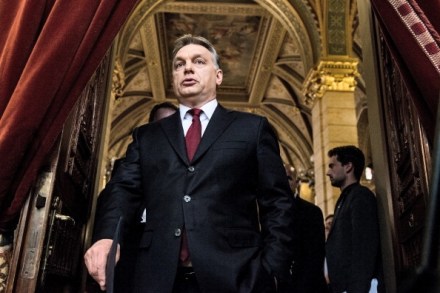
If you are going to try to put people beyond the pale on the grounds of what they have said it pays at least to be consistent. This week, left-wing MPs were cock a hoop at achieving the required number of signatures on a petition calling for Donald Trump to be banned from the UK for the matter to be debated in Parliament.  More than 560,000 signed, with the result that the issue will be discussed in Westminster Hall on 18 January. There was no visible protest, on the other hand, against David Cameron meeting Hungarian PM Viktor Orban in Budapest this week, no audible call for Mr Orban to be banned from making a return visit to the UK. There was even praise from liberals for Mr Orban’s strong words to David Cameron complaining about negative images of Hungarians in the UK.

Health killjoys are now using alcohol guidelines to promote gender equality

To adapt Pastor Martin Niemoller’s famous dictum on the failure of the Germans to tackle Hitler, 'First they came for the smokers and I did not speak out because I was not a smoker…’ How right the smoking lobby was when it warned that once the health Nazis had banned smoking in enclosed public spaces they would target the rest of us. Red meat, cured meat, sugar – all are the subject of increasingly belligerent health campaigns. Today the Chief Medical Officer has upped the ante on alcohol.  No amount of alcohol intake is safe, she says. We risk cancer with every sip we take.   The recommended maximum for men has been reduced from 28 to 14 units a week and for women from 21 to 14 units.