Richard Bratby

Richard Bratby is the chief classical music critic of The Spectator

Border lands, 200 years of British railways & who are the GOATs?

38 min listen

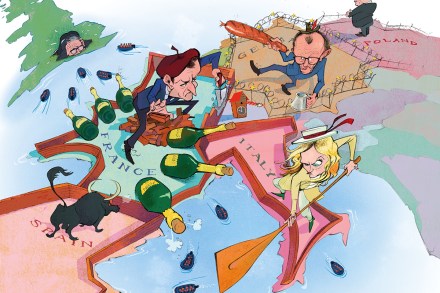
First: how Merkel killed the European dream ‘Ten years ago,’ Lisa Haseldine says, ‘Angela Merkel told the German press what she was going to do about the swell of Syrian refugees heading to Europe’: ‘Wir schaffen das’ – we can handle it. With these words, ‘she ushered in a new era of uncontrolled mass migration’. ‘In retrospect,’ explains one senior British diplomat, ‘it was pretty much the most disastrous government policy of this century anywhere in Europe.’ The surge of immigrants helped swing Brexit, ‘emboldened’ people-traffickers and ‘destabilised politics’ across Europe. Ten years on, a third of the EU’s member states within the Schengen area have now imposed border controls. Can freedom of movement survive in its current form?

How the railways shaped modern culture

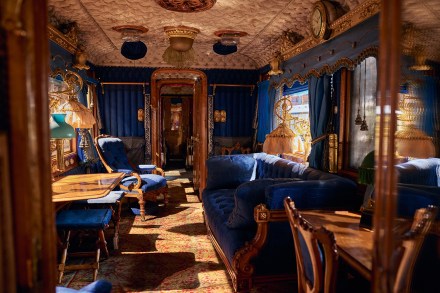
Cue track seven of Frank Sinatra’s 1957 album Only the Lonely and you can hear Ol’ Blue Eyes pretending to be a train. It’s not that he’s a railway enthusiast (though Sinatra, like many musicians, was an enthusiastic collector of model trains). No, it’s written into the words and music of Harold Arlen and Johnny Mercer’s song ‘Blues in the Night’: ‘Now the rain’s a-fallin’, hear the train a-callin’ “whoo-ee”.’ And so Sinatra sings it, just as Ella Fitzgerald, Peggy Lee and Louis Armstrong sang it. It’s an American classic, defined by the sounds that permeate the soul of American popular music: the sounds of the railway.

Disconcerting but often delightful new Bach transcriptions

Grade: B Everyone loves the music of Johann Sebastian Bach. Rather fewer people love the sound of an unaccompanied organ, so a cottage industry has developed among conductors and composers, retrofitting Bach for full orchestra. From Elgar and Mahler to showman-maestros like Stokowski and Henry Wood, orchestral Bach transcriptions have tended towards the spectacular, and they annoy all the right people. When Wood arranged the D minor Toccata and Fugue for a super-sized orchestra, he pre-empted the backlash by crediting it to a fictional Russian modernist, ‘Paul Klenovsky’. The critics duly raved.  Still, who knew that the late Sir Andrew Davis – the closest thing we had to a latter-day Thomas Beecham – was in on the same game?

The excruciating tedium of John Tavener

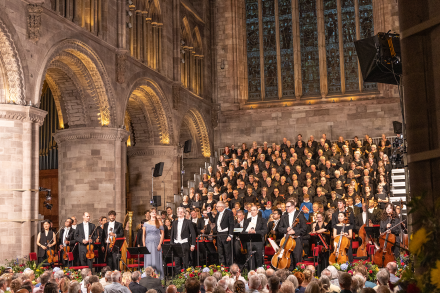
The Edinburgh International Festival opened with John Tavener’s The Veil of the Temple, and I wish it hadn’t. Not that they were wrong to do it; in fact it was an heroic endeavour. Drawing on three large choirs, members of the Royal Scottish National Orchestra and a sizeable team of soloists, this eight-hour performance was the sort of occasion that justifies a festival’s existence – the kind that, done well, can transform your perceptions of a work or a composer. It was certainly done well, and it certainly transformed mine. I’d never much minded the music of John Tavener. By the fifth hour of The Veil of the Temple, I was beginning to detest it.

Three cheers for the Three Choirs Festival

The Welsh composer William Mathias died in 1992, aged 57. I was a teenager at the time, and the loss felt personal as well as premature. Not that I knew him; and nor was he regarded – in the era of Birtwistle and Tippett – as one of the A-list British composers (John Drummond, the Proms controller of the day, was particularly snobbish about Welsh music). But Mathias was a composer whose music I had played; whose music, indeed, me and my peers actually could play. His Serenade was a youth orchestra staple. It felt good to know that its creator was alive and well and working in Bangor, and when he wrote his Third Symphony I listened to the première in my bedroom, live on Radio Three. Like I say, it felt personal.

Ian Thomson, Patrick Kidd, Mike Cormack, Ursula Buchan and Richard Bratby

36 min listen

On this week’s Spectator Out Loud: Ian Thomson on what the destruction of the Hotel Oloffson means for Haiti (00:54); Patrick Kidd analyses Donald Trump and the art of golf diplomacy (06:43); Mike Cormack reviews Irvine Welsh’s Men In Love (16:49); Ursula Buchan provides her notes on the Palm House at Kew (20:38); and, Richard Bratby argues that Johann Strauss deserves better than to be the victim of snobbery – plus listen to the end for an extract from Strauss’s Emperor Waltz (24:24).  Produced and presented by Patrick Gibbons.

Why has the world turned on the Waltz King?

On 17 June 1872, Johann Strauss II conducted the biggest concert of his life. The city was Boston, USA, and the promoters provided Strauss with an orchestra and a chorus numbering more than 20,000. One hundred assistant conductors were placed at his disposal, and a cannon shot cued The Blue Danube – the only way of silencing the expectant crowds. Estimates vary, but the audience was reckoned to number between 50,000 and 100,000; in all, there must have been a minimum of 70,000 people present. This month’s Oasis reunion only played to 80,000. The result, in an age before modern amplification, was much as you might expect. ‘A fearful racket that I shall never forget as long as I live,’ was Strauss’s own description. Still, the point stands.

Brilliant rewrite of Shakey: Hamlet, at Buxton Opera House, reviewed

‘There is good music, bad music, and music by Ambroise Thomas,’ said Emmanuel Chabrier, but then, Chabrier said a lot of things. I adore Chabrier – who couldn’t love the man who wrote España and turned Tristan und Isolde into a jaunty quadrille? – but it doesn’t do to take him too literally. Thomas ended his career as a notoriously crusty director of the Paris Conservatoire, and when the French musical establishment puts you on a pedestal younger composers invariably start hurling the merde. Scraps of Thomas’s music survive in all sorts of odd corners (a snippet from his opera Mignon crops up in The Life and Death of Colonel Blimp). I’ve always found it rather appealing.

A cross between Peter Rabbit and Queen Victoria: Bliss: The Composer Conducts reviewed

Grade: A– There’s a classic trajectory for British composers: a five-decade evolution from Angry Young Man to Pillar of the Establishment. Right now, you can watch it happening in real time to Thomas Adès and Mark-Anthony Turnage – inevitably, unwittingly, falling unto the pattern established by Sir Arthur Bliss, who shocked critics in the 1920s but died in 1975 as a KCVO, CH and Master of the Queen’s Music. I knew musicians who played under him at the end of his life. One described him as ‘a cross between Peter Rabbit and Queen Victoria’. Bliss was a very capable conductor and this collection of live broadcasts of his own music gives us back the firebrand behind the national treasure.

A contradictory staging, but the music floods the ear with splendour: Semele at the Royal opera reviewed

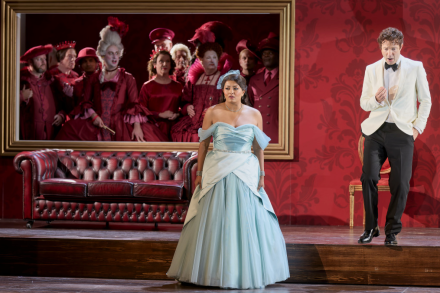
The past is a foreign country: they do things differently there – and opera directors really, really wish they didn’t. The problem is particularly acute if, like the Royal Opera’s Oliver Mears, you believe in staging Handel’s concert works as if they were operas. Broadly speaking, Handel’s oratorios affirm the moral and political consensus of Hanoverian England – Protestantism, marriage, loyalty to Church and Crown. All deeply uncool now, of course, so when Mears staged Jephtha in 2023 he duly inverted its central premise. The good guys became the bad guys. Unfortunately, Handel missed that production meeting and the result was as incoherent as it was dour. Semele is a slightly different case. Handel is trying something altogether friskier – disarmingly so, at times.

Brave and beautiful: Longborough’s Pelléas et Mélisande reviewed

King Arkel, in Debussy’s Pelléas et Mélisande, is almost blind, and he rules over a kingdom of darkness. Debussy’s score is so luminous that it’s easy to forget just how dark it supposedly is, this mythical realm of Allemonde – even despite the libretto’s references to gloomy caves, shadowy castles and forests that block out the sunlight. Many productions take their visual cues from the music rather than the words, providing endless opportunity for shimmering effects and the subtle play of light and shade. Jenny Ogilvie’s staging for Longborough Festival Opera doesn’t just embrace the darkness; it goes all in. Shadows texture the huge, brutalist wall of Arkel’s castle and occasionally – briefly – it’s pierced by shafts of sunlight.

I’ve rarely seen a happier audience: Grange Festival’s Die Fledermaus reviewed

‘So suburban!’ That’s Prince Orlofsky’s catchphrase in the Grange Festival’s new production of Die Fledermaus, and he gets a lot of wear out of it. You couldn’t really describe the Grange Festival as suburban – it’s hard to imagine a corner of the Home Counties that’s more remote from urban civilisation. No, if the vibe at Garsington is plutocratic, and West Horsley is pure Stockbroker Belt, the Grange Festival is definitely county, in a comfy, faded, Aga-and-chintz sort of way. The picnic takes precedence over the opera, and you’ll see evening wear that was new around the time that Alan Coren retired from Punch. Anyway, this lively Die Fledermaus knows its public and wants them to enjoy themselves.

If you think all orchestras sound alike, listen to this recording

Grade: B+ These are gloomy days, so here’s a burst of melody and colour to cheer you up. Back in the LP era it wasn’t unusual for classical recordings to be put together like a concert that you might actually want to hear: a sequence of works by different but complementary composers, offering the possibility of a happy discovery. Come for the Strauss, stay for the Reznicek – that sort of thing. This lively new disc from the Borusan Istanbul Philharmonic adopts the same principle. The unifying theme is early-20th-century eastern European nationalism – the folksong-collecting variety, not the Archduke-assassinating kind. But it’s the opposite of monotonous.

Summer opera festivals have gone Wagner mad

Another week, another Wagner production at a summer opera festival. This never used to happen. When John Christie launched Glyndebourne in the 1930s, he hoped to stage the Ring. So he gathered a team of refugee musicians from Germany, who quickly assured him that it was impossible and he should stick to Mozart. The man who changed all that was Martin Graham, the plimsoll-wearing founder of Longborough Festival Opera, who died in April at the age of 83. Graham was irrepressible; a self-taught enthusiast. With no one around to tell him it couldn’t be done, he pushed ahead regardless, staging the Ring cycle twice in as many decades. And now look.

Thrilling: Garsington’s Queen of Spades reviewed

Tchaikovsky’s The Queen of Spades is one of those operas that under-promises on paper but over-delivers on stage. It’s hard to summarise the plot in a way that makes it sound theatrical, even if you’ve read Pushkin’s novella, and I’ve never found a recording that really hits the spot. And yet, time and again, in the theatre: wham! It goes up like a petrol bomb. With a good production and performers, Tchaikovsky hurls you out at the far end feeling almost hungover – head swimming, and wondering where those three hours went. The cast and staging at Garsington are very, very good.

Sincere, serious and beautiful: Glyndebourne’s Parsifal reviewed

‘Here time becomes space,’ says Gurnemanz in Act One of Parsifal, and true enough, the end of the new Glyndebourne Parsifal is in its beginning. We don’t know that, at first: the sickbed image that’s glimpsed during the prelude doesn’t resolve itself until the opera’s closing scenes. In between, characters appear on stage in multiple forms, at different ages – past and future selves attendant on the present, whatever ‘present’ means in Monsalvat. Wagner, after all, makes it clear enough that time in the Grail Domain moves in mysterious ways, and his whole musical strategy reinforces that truth.

James Heale, Angus Colwell, Alice Loxton, Lloyd Evans, Richard Bratby, Christopher Howse and Catriona Olding

38 min listen

On this week’s Spectator Out Loud: James Heale analyses the splits in Labour over direction and policy (1:27); Angus Colwell asks if the ‘lanyard class’ are the new enemy (6:21); Alice Loxton explains why bite-sized histories have big appeal (9:58); Lloyd Evans reports on how Butlin’s is cashing in on nostalgia (15:00); Richard Bratby on Retrospect Opera, the non-profit record label that resurrects the forgotten works of British opera (20:40); Christopher Howse provides his notes of typos (27:27); and, Catriona Olding reflects on the death of her partner, the Spectator’s Jeremy Clarke, two years ago this week (32:15).  Produced and presented by Patrick Gibbons.

The forgotten story of British opera

British opera was born with Purcell’s Dido and Aeneas, and then vanished for two-and-a-half centuries, apparently. Between the first performance of Dido in 1689 and the première of Britten’s Peter Grimes in 1945, serious British operas effectively didn’t exist – or so we’re told in textbooks and biographies. But what if there was a different story; a forgotten story of a lively, eclectic British operatic tradition that thrived in those missing centuries, and was buried only through a combination of accidents, economics and our enduring national snobbery about theatre that’s sung rather than spoken? And what if there was an organisation devoted to excavating these forgotten works and giving them a chance to live again?

A spate of re-releases suggests that Wolfgang Sawallisch was no B-lister

Grade: A It’s clearance-sale time for the great classical labels of the 20th century. As streaming platforms drain the remaining value out of once-prestigious recorded catalogues, even B-listers are being pulled up from the vaults and remastered for one last re-release. Eleven-disc Rafael Frühbeck de Burgos edition? Walter Weller’s complete Decca recordings? Now’s your chance: everything must go! The Bavarian conductor Wolfgang Sawallisch, who died in 2013, was never exactly B-list. His name always commanded respect. But in the golden age of LP collecting he was regarded as a safe pair of hands rather than a blue-chip name. Listening to a mini spate of Sawallisch re-releases suggests that we underrated him.

Our half-time scorecard on the Royal Opera’s Ring cycle

With Die Walküre, the central themes of Barrie Kosky’s Ring cycle for the Royal Opera are starting to emerge, and one of them seems to be wood. Not trees, so much; at least not as a symbol of life. After the rapid assembly of a world from theatrical nothingness (a bare stage), Hunding’s forest hall is simply a wall of blackened planks, with no World Ash Tree in sight. Then you notice the protruding hilt of the sword Nothung: no, that is the World Ash Tree, and Hunding has recycled it into building material. We knew he was a wrong ’un, but really: this is Sycamore Gap-level wickedness. Various ex-trees recur in Rufus Didwiszus’s designs. The huge, maimed log from Das Rheingold reappears during Siegmund and Hunding’s duel, spewing blood as the betrayed hero falls and dies.