Richard Bratby

Richard Bratby is the chief classical music critic of The Spectator

If your instinct is to undermine Beethoven, you’re directing the wrong opera: Fidelio reviewed

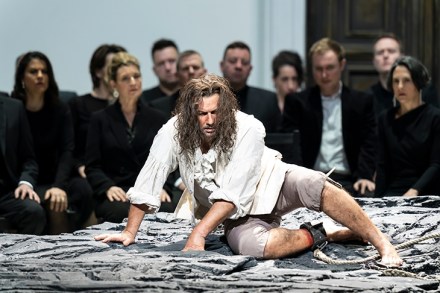
‘People may say I can’t sing,’ said the soprano Florence Foster Jenkins, ‘but no one can ever say I didn’t sing.’ There were groans of dismay as an official walked out before the start of the Royal Opera’s new Fidelio: Jonas Kaufmann was not feeling on top form, but he was going to perform the role of Florestan regardless, and begged our indulgence. The mind plays tricks and after an announcement like that it’s hard to be entirely sure whether you’re hearing a skilfully proportioned interpretation or a singer dialling it down. But let the record show that Kaufmann did sing, and if you’ve booked for this production on the strength of that magic name alone, you can breathe easy.

Eurotrash Verdi: ENO’s Luisa Miller reviewed

Verdi’s Luisa Miller is set in the Tyrol in the early 17th century, and for some opera directors that’s a problem. After all, they’re busy people. They probably never had time to read Wolf Hall, or to speak to any of the 100 million people worldwide who watched Game of Thrones. It’s self-evident to them that modern audiences will be unable to empathise with anything involving swords, castles or feudal hierarchies. Which is why they work hard to imagine new contexts that can make these hopelessly dated dramas address contemporary life as we live it, right here, right now. Counts, village maidens and men in ruffs? Baffling. But a clown strapped to a gyrating crucifix being stabbed with arrows by a group of dancers in flesh-coloured swimming caps and black fetish wear?

Weill’s Broadway opera is made for telly: Opera North’s Street Scene reviewed

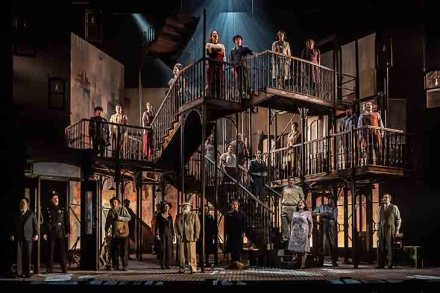
It’s a sweltering night in Manhattan, circa 1947, and on the doorstep of a brownstone tenement three women are waiting for their menfolk to return. There’s plenty to gossip about. The Hildebrands upstairs are being evicted tomorrow, and the Buchanans are expecting a baby. And what’s the deal with Mrs Maurrant and Steve the milkman? Old Mr Kaplan reads the newspaper and denounces the bourgeoisie. A kid cadges a dime and big, kind Lippo Fiorentino arrives home from work with ice creams for everyone. At which point it becomes fairly safe to conclude that the America of Kurt Weill’s Street Scene is not the America of his Mahagonny. Forget the acid harmonies and hard-left caricatures of his Berlin collaborations with Bertolt Brecht.

Are we going to have to start taking Calixto Bieito seriously? ENO’s Carmen reviewed

Calixto Bieito’s Carmen: three words to make an opera critic’s heart leap. Until quite recently, Bieito was the operatic provocateur of the century — the director who opened Verdi’s Un ballo in maschera with a row of men defecating on stage, and who presented Mozart with a side order of torture porn. Veterans of his Carmen told of fellatio and gratuitous nudity; it all sounded very promising. Add the malicious pleasure of seeing what unrevivable horrorshow ENO had lumbered itself with now — what steaming paella of body fluids it was about to dish up to an audience who’d paid for an evening of good tunes and sultry senoritas — and the review practically writes itself.

Inspired programming and a proper celebration: Barbican’s Beethoven Weekender reviewed

Beethoven wears a feather boa and pink shades. He wrangles an electric guitar. A red lightning flash streaks across that familiar, scowling face. ‘Genius before Elton. Radical before Prince. Iconic before Bowie’ proclaimed the posters for the Barbican’s Beethoven Weekender, and apparently there’ve been complaints about them, which probably means that they’ve got the tone about right. Two hundred and fifty years after his birth, Beethoven still has a way of driving all the right people round the bend. US campus musicologists have called for his music to be suppressed (you’d think that champions of inclusion would support a year-long celebration of a disabled composer, but it seems not. Wrong chromosomes).

The joy of Radio 3’s Building a Library

So, you’ve fallen in love with a piece of classical music and you want to buy a recording. The problems begin when you hit Amazon. Any reasonably established classic will have been recorded numerous times: do you go for the performer you’ve already heard of? The crackly vintage recording with the gushing five-star reviews? Or the budget-priced unknown with the vaguely Slavic name; after all, it’s the same music. Isn’t it? Radio 3’s Building a Library sorts it out so you don’t have to. Tucked away within Record Review each Saturday morning, the format is simple: every week, the BBC details a critic to listen to as many recordings of a given work as is humanly possible.

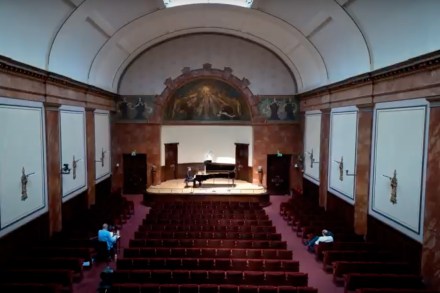
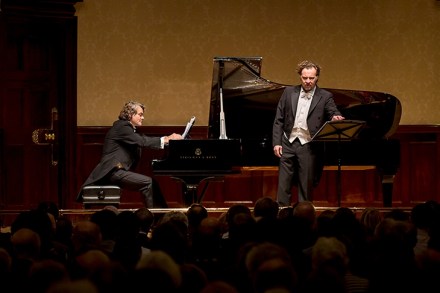
The audience were in tears: Christian Gerhaher/Gerold Huber at the Wigmore Hall reviewed

‘Popular’ classical music is a relative term. Show me someone who thinks Beethoven is surefire box office, and I’ll show you someone who’s never tried to sell tickets for the Op. 9 string trios. Even Mahler, the blockbuster concert phenomenon of the past four decades, has his limits. Audiences love him, sure. But in 2011, when several orchestras performed complete Mahler cycles, the limits of that love became embarrassingly clear. The Second and Eighth symphonies — roof-raising choral spectaculars — promptly sold out. The gentle Fourth and the knotty, reconstructed Tenth: not so much. As for his songs, forget it. Well, that’s lieder for you.

Warmth, energy and gripping momentum: Stephen Hough’s Wigmore Hall residency reviewed

In the summer of 1878 Johannes Brahms finally succeeded in growing a beard. It was his third attempt. ‘Prepare your wife for the grisly spectacle, for something so long suppressed cannot be beautiful,’ he wrote to a friend, and by all accounts he wasn’t wrong. Clara Schumann pleaded with him to shave it off. She’d have remembered Brahms as the golden-haired 20-year-old who had arrived on her doorstep in September 1853, glowing with genius; in the words of her husband Robert, ‘a young blood at whose cradle graces and heroes stood guard’. For modern listeners, though, the beard has long since conquered — as if, like one of Philip Pullman’s daemons, it somehow embodies Brahms in his gruff and hairy definitive form.

Beer, sweat and jockstraps: the real history of the CBSO

In childhood, the theme tune to The Box of Delights was the sound of Christmas. The melody was ‘The First Nowell’ but that wasn’t what cast the spell. It was the way the harp glinted and pealed, and the eerie wisp of the ‘Coventry Carol’ that drifted through on muted violins: a masterclass in orchestration for a BBC teatime audience. After inquiries at Circle Records in Liverpool (this was pre-Amazon), my father established its identity: the Carol Symphony, by a composer with the pleasingly Edwardian name of Victor Hely-Hutchinson. And that was that, for me anyway, until three decades later, rifling through the archive of the City of Birmingham Symphony Orchestra, I noticed the initials ‘VHH’ on files from the 1940s.

Don’t tell me model railways aren’t art. My little engine is a thing of spirit and beauty

It’s a summer day at Llangenydd station, and the afternoon train is already late, not that anyone seems to mind. A smartly dressed man has leaned his bicycle against the station’s water tower, and his terrier jumps up as he unwraps his sandwich. A commercial traveller, perhaps, or a professor from Liverpool University on a cycling tour of Snowdonia. Even though we’ve never been here before, we can guess where we are. The colour of the stone, the yellow gorse on the embankments, and the distant glimpse of the sea all tell us that we’re in the top left-hand corner of Wales.

Sadistic and repellent and thrilling: Mascagni’s Iris reviewed

If you’ve ever felt that poor Madama Butterfly had a bit of a raw deal, then you really, really don’t want to know what happens in Mascagni’s Iris. Take that as a spoiler alert: our Japanese heroine is so young that as the opera opens, she’s playing with a doll. She’s abducted, installed in a brothel and offered up for the delectation of a noble client, whose advances she is too innocent to comprehend. Disowned by her blind father, by the beginning of Act Three she’s literally lying in a sewer listening to disembodied voices telling her that nothing could have prevented this outcome. Obviously, it sounds exquisite. You don’t have to be a social justice warrior to find Iris a bit much.

Meet the unrivalled Sun King of early music, William Christie

It’s morning in the garden of William Christie, and he’s talking about home improvements. ‘I planted three pines up there actually,’ he says, pointing. ‘One blew over in a storm in ’99. But I was able to plant on both sides and create a vista. It’s getting there.’ He gestures across topiary and lawns and away towards the opposite hillside, where an avenue of trees and classical pillars sweeps up towards the skyline. Hang on: he created that too? It’s not unknown for famous conductors to act like Bourbon princes.

Ravishing and poignant: ENO’s Orphée reviewed

Billy Wilder, asked for his opinion of Andrew Lloyd Webber’s musical version of his movie Sunset Boulevard, famously replied: ‘Those boys hit on a great idea. They didn’t change a thing.’ I don’t think you could say exactly that about Netia Jones’s new staging of Philip Glass’s Orphée, a piece that takes the script of Jean Cocteau’s 1950 film and turns it into — well, into an opera by Philip Glass. Cocteau’s shimmering cinematic imagery (think Man Ray come to life) defies physical realisation, so Jones and her designers Lizzie Clachan (sets) and Lucy Carter (lighting) have found poetic, often blindingly beautiful theatrical equivalents.

Why are Haydn’s operas so lousy? La fedelta premiata reviewed

There’s a book about musicals that every opera lover should read. Not Since Carrie by Ken Mandelbaum is a history of musical theatre’s greatest flops: a comprehensive study of the thousand ways in which a collaborative artform can crash and burn. It’s unbelievable stuff. The Broadway cast of 1961’s Kwamina participated in a voodoo ritual to neutralise the show’s critics (English National Opera is rumoured to be planning something similar). Adverts for Jule Styne’s Subways Are for Sleeping were banned from New York public transport after vagrants took them as an invitation to spend the night on board.

The joy of Malcolm Arnold’s optimistic, hummable tunes

Never meet your heroes, they say. But if you grew up with classical music in the 1980s, there was fat chance of that. Stravinsky, Britten, Shostakovich, Walton: you’d just missed them. Which is why, in 2001, and finding myself duty-managing an 80th birthday concert for Sir Malcolm Arnold, I inched past his minders and delivered a few trite, polite but entirely sincere words of gratitude and admiration. No response: Sir Malcolm stared blankly ahead. Then he gripped my hand, and started shaking. And kept shaking, faster and faster, his grip tightening like a vice. Raising his head slightly, and pumping my hand with increasing force, he growled: ‘I’m not letting go until you call me Sir.

More misogynistic than the original: ENO’s Orpheus in the Underworld reviewed

It’s Act Three of Emma Rice’s new production of Offenbach’s Orpheus in the Underworld, and Eurydice (Mary Bevan) is trapped in the backroom of a Soho peep show. But that doesn’t really matter because Jupiter (Willard White), a cigar-toking love walrus in a silk bathrobe, has transformed himself into a fly and is about to ravish her, once he’s worked out the practicalities of doing so while three millimetres long. Eurydice’s more than game. ‘Zzzz, zzz,’ she sings, draping herself lasciviously over the mattress. ‘Zzzz, zzz,’ buzzes Jupiter, wings popping erect. Rice’s puppeteer darts about with a toy fly on a string, dressed in a black catsuit and (the killer detail) a beatnik beret.

Simon Rattle’s Messiaen is improving with age

Two flutes, a clarinet and a bassoon breathe a chord on the edge of silence. As they fade, the sound quietly intensifies, morphing into the metallic buzz of cor anglais and muted horn. The third of Arnold Schoenberg’s Five Orchestral Pieces of 1909 doesn’t have a conventional melody, and there’s even less in the way of rhythmic or harmonic activity. It’s entirely about those minutely graded shifts in timbre. And having rendered this idea with such poetry, Schoenberg, being Schoenberg, duly slapped it with a label as clunky as his music was subtle: klangfarbenmelodie, literally, ‘sound-colour melody’. Apologies: it’s too easy to poke fun at Schoenberg.

Needed a shot of Stolichnaya: The Tchaikovsky Project reviewed

Grade: B+ I’m not sure about ‘Projects’. Aren’t those what ageing rockers produce, in a haze of sedatives, when their ego finally outgrows their talent? In classical music, there’s something unseemly about the idea of Maestro X condescending to bestow their attention upon music that is — or should be — bigger than they’ll ever be. Still, the conductor here is the Russian-born Semyon Bychkov, unambiguously one of the good guys, who, after decades spent paying his dues, has recently hit the sweet spot where every note speaks, every gesture ignites, and — crucially — critics actually notice.

Why this première felt important: James MacMillan’s Fifth Symphony reviewed

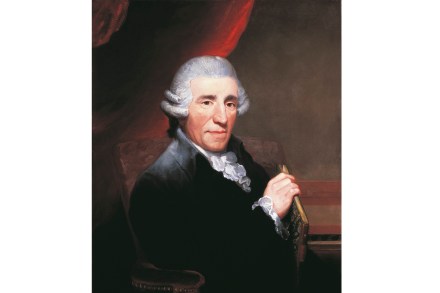
All symphonies were sacred symphonies, once. Haydn began each day’s composition with a prayer, and ended every score with the words ‘Laus Deo’. ‘These thoughts cheered me up,’ he told his biographer Albert Dies. Haydn, like Mozart, was a lifelong Catholic, and the Swiss theologian Hans Küng has suggested that the daring, exuberance and glorious wholeness that characterises even Mozart’s secular music comes from a specifically Catholic understanding of the universe: of salvation perceived not as an object of struggle, but as an unshakable, all-embracing certainty. Sir James MacMillan’s Fifth Symphony concerns itself with the Holy Spirit, but he struggled to find an English phrase that did the job, so its title is Le grand inconnu.

Golden threads

When it comes to the opening of Wagner’s Das Rheingold, Mark Twain probably put it as well as anyone: ‘Out of darkness and distance and mystery soft rich notes rose upon the stillness, and from his grave the dead magician began to weave his spells about his disciples and steep their souls in his enchantments.’ As at Bayreuth, so in Dalston. At the start of Julia Burbach’s production for Grimeborn, a man stumbles into a back  alley and, rummaging through discarded boxes, finds a pair of headphones. And there it is: that deep, eternal E flat. Don’t some people say they can hear an all-pervading global hum? Wagner’s world is turning, and for good or for evil the old sorcerer is weaving his spell again.