Raymond Keene

No. 334

From our UK edition

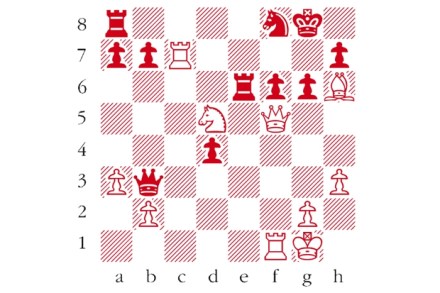
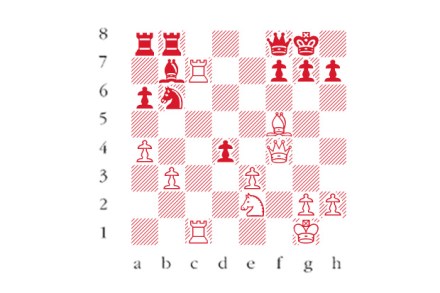
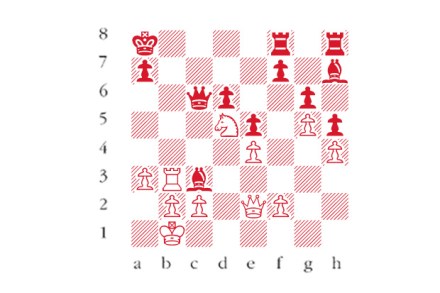
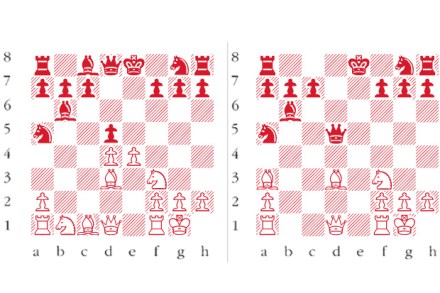
White to play. This position is from Keene-Nunn, Surrey Junior Championship 1963. This game started with the Scotch Game opening. White is winning easily but what is the quickest kill? Answers to me at The Spectator by Tuesday 7 October or via email to victoria@spectator.co.uk or by fax on 020 7681 3773. The winner will be the first correct answer out of a hat, and each week I am offering a prize of £20. Please include a postal address and allow six weeks for prize delivery.

Scotch miss

From our UK edition

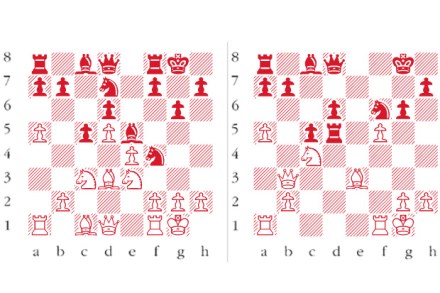
This week, a tribute to the one major Scottish contribution to chess, the invention of the Scotch game, later to become a favourite of Garry Kasparov. The following game, one of the earlier chess encounters whose record has survived, sees play devolve into a complex endgame. Ultimately the London side lose their footing, miss the right path and go down to defeat. Edinburgh Chess Club-London Chess Club: Correspondence match (Game 5) 1824-1826; Scotch Game 1 e4 e5 2 Nf3 Nc6 3 d4 Nxd4 The accepted main line these days is 3...exd4. One heavyweight example is Kasparov-Karpov, Tilburg 1991 which went 3 ... exd4 4 Nxd4 Nf6 5 Nxc6 bxc6 6 e5 Qe7 7 Qe2 Nd5 8 c4 Ba6 9 b3 g6 10 f4 f6 11 Ba3 Qf7 12 Qd2 Nb6 13 c5 Bxf1 14 cxb6 axb6 and now after 15 e6! White gained the advantage and went on to win.

No. 333

From our UK edition

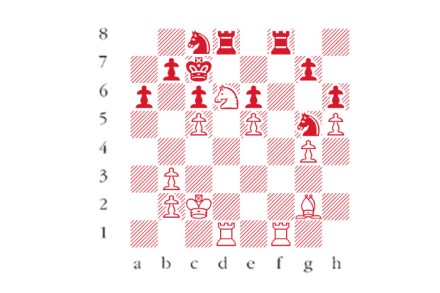
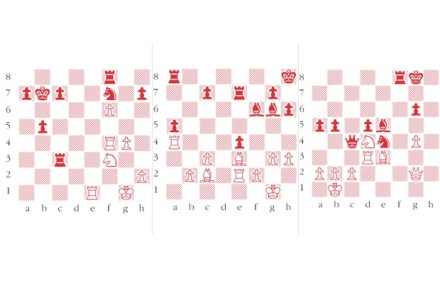
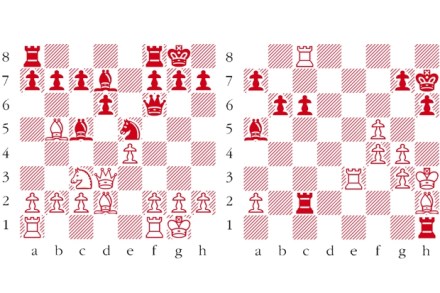
White to play. This position is from Yu--Ganguly, Indonesia 2012. This encounter also started with the Scotch Game opening. Both sides have a bishop en prise. How can White turn the tactics to his advantage? Answers to me at The Spectator by Tuesday 30 September or via email to victoria@spectator.co.uk or by fax on 020 7681 3773. The winner will be the first correct answer out of a hat, and each week I am offering a prize of £20. Please include a postal address and allow six weeks for prize delivery.
Double trouble | 18 September 2014

From our UK edition

The importance of pawn structure cannot be overestimated when planning chess strategy. Although Philidor (18th century) understood the importance of pawns in chess, in the 19th century the health and safety of one’s pawns was often thrown to the wind in the interests of tactical advantages. However, as chess thinking became more sophisticated and was explained by chess philosophers such as Steinitz, Tarrasch and Nimzowitsch, the crucial nature of the pawn constellation became apparent. In modern grandmaster chess, even the slightest weakness in the pawn armature can be fatal.

No. 332

From our UK edition

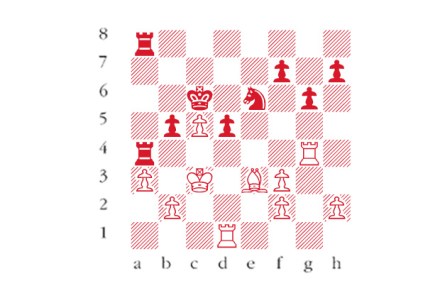
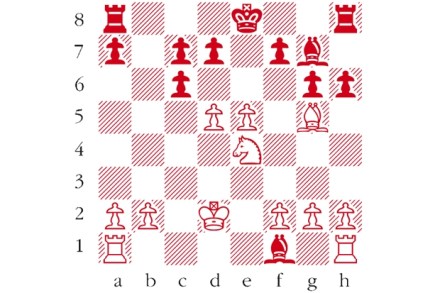
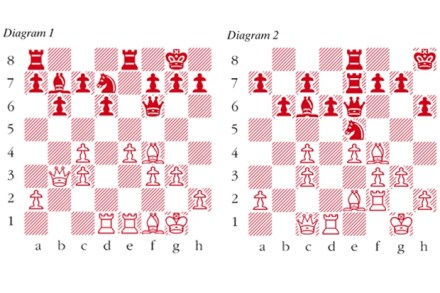
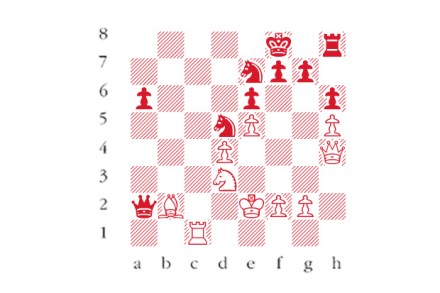
White to play. This position is from Nimzowitsch-Rubinstein, Berlin 1928. White’s passed pawn and active pieces guarantee a winning advantage. Can you spot Nimzowitsch’s fine coup to conclude? Answers to me at The Spectator by Tuesday 23 September or via email to victoria@spectator.co.uk. The winner will be the first correct answer out of a hat, and each week I am offering a prize of £20. Please include a postal address and allow six weeks for prize delivery.
Sinking the field

From our UK edition

Fabiano Caruana has dominated the Sinquefield Cup in St Louis in a way that almost defies belief. The Italo-American grandmaster, just 22 years old, reeled off seven straight wins against an elite field which included the world champion, Magnus Carlsen, as well as two Olympiad gold medal winners. The final scores out of 10 were as follows: Caruana 8½, Carlsen 5½, Topalov 5, Aronian and Vachier-Lagrave 4, Nakamura 3.   To my mind, the most astonishing fact of all is that in every round from one to nine, until he conceded a well-played draw in round ten, Caruana achieved a winning position. This kind of dominance has not been seen since the best days of Garry Kasparov or Bobby Fischer, with whom Caruana is increasingly being compared.

No. 331

From our UK edition

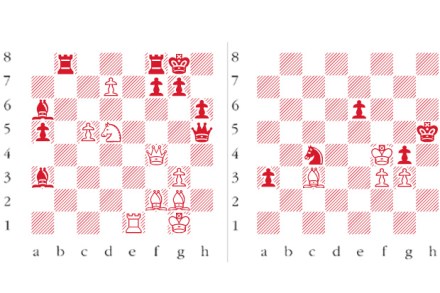
White to play. This is from Caruana--Nakamura, Sinquefield Cup, St Louis 2014. Caruana could have registered an even greater performance in St Louis had he taken his chance here. He played 1 Bf2. What did he miss? Answers to me at The Spectator by Tuesday 16 September or via email to victoria@spectator.co.uk. The winner will be the first correct answer out of a hat, and each week there is a prize of £20. Please include a postal address and allow six weeks for prize delivery.

Gifted and talented

From our UK edition

Despite occasional evidence to the contrary, I have persisted in the belief that the ability to play chess well indicates a powerful intelligence. Goethe wrote that chess was a touchstone of the intellect, while Pascal called it the gymnasium of the mind. Arthur Koestler romanticised the mental power of chess devotees, writing: ‘When a chess player looks at the board, he does not see a static mosaic, a “still life”, but a magnetic field of forces, charged with energy — as Faraday saw the stresses surrounding magnets and currents as curves in space; or as Van Gogh saw vortices in the skies of Provence.’   Conversely, anyone with a strong intellect should be able to rapidly grasp the essentials of chess.

No. 330

From our UK edition

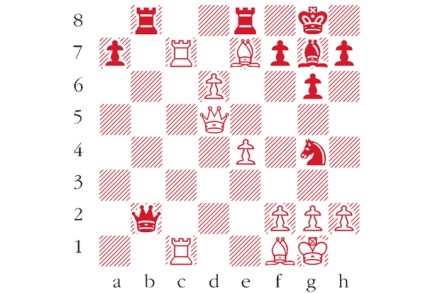
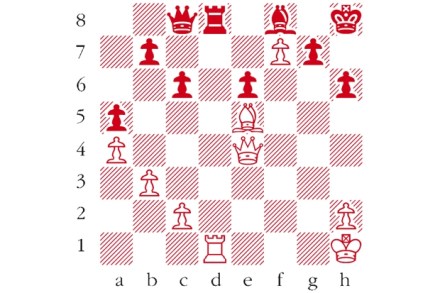
White to play. This position is from Polgar-Bareev, Moscow 1996. Neither king is entirely happy and in such situations having the move can be crucial. It was here — what did Polgar play? Answers to me at The Spectator by Tuesday 9 September or via email to victoria@spectator.co.uk or by fax on 020 7681 3773. The winner will be the first correct answer out of a hat, and each week I shall be offering a prize of £20. Please include a postal address and allow six weeks for prize delivery.
Olympiad highlights

From our UK edition

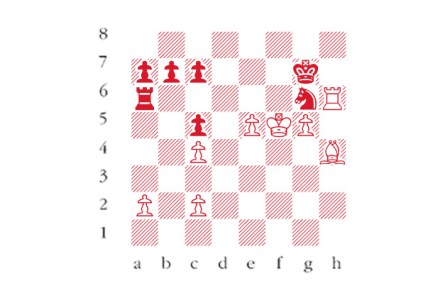
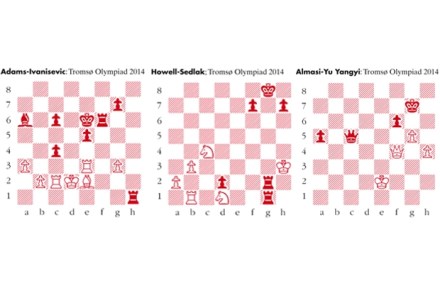
To round off my coverage of the chess Olympiad in Tromsø, which saw a total of 313 teams in the open and women’s sections, thus making it the greatest chess gathering on earth, here are a number of notable and brilliant conclusions from the approximately 6,000 games played in this mega competition.   Michael Adams was the star of the English team, scoring a highly impressive 6½/9 on top board against powerful opposition. This result gave him the silver medal for his performance, behind only Veselin Topalov of Bulgaria. The following win demonstrates the dangers of defending passively in an inferior endgame.   Adams-Ivanisevic: Tromsø Olympiad 2014   43 Kc3 Rg6 44 Kb4 Kd6 45 Ka5 Bb5 46 Bxc4 Bxc4 47 Rxc4 Kc7 Black is becoming too passive.

No. 329

From our UK edition

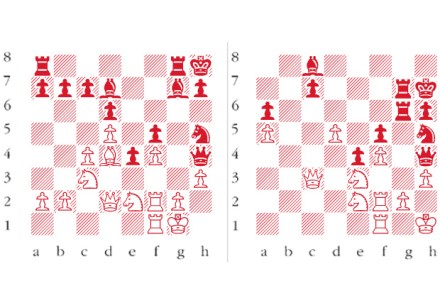
White to play. This position is from Lee-Croes, Tromsø Olympiad 2014. White’s position is overwhelming and he now found a nice finish. Can you see it? Answers to me at The Spectator by Tuesday 2 September or via email to victoria@spectator.co.uk or by fax on 020 7681 3773. The winner will be the first correct answer out of a hat, and each week I shall be offering a prize of £20. Please include a postal address and allow six weeks for prize delivery.   Last week’s solution 1 ...
Great wall

From our UK edition

China have won the Olympiad in Tromsø. I believe that we can now look forward to a sustained Chinese dominance in international team events, reminiscent of the Soviets. The Chinese take sporting success very seriously and in China international competitive chess is most definitely regarded as a sport, with all the benefits in state backing which that implies. China finished with 19 out of 22 possible, while Hungary, India, Russia and Azerbaijan followed at a respectable 2 points distance.   In the other bitter contest at Tromsø, the former world champion Garry Kasparov failed to unseat the incumbent, the eccentric billionaire and self-avowed alien abductee Kirsan Ilyumzhinov, in the battle for the World Chess Federation presidency.

No. 328

From our UK edition

Black to play. This position is from Ivanchuk-Mamedyarov, Tromsø Olympiad 2014. How did Black win material? Answers to me at The Spectator by Tuesday 26 August or via email to victoria@spectator.co.uk or by fax on 020 7681 3773. The winner will be the first correct answer out of a hat, and each week I shall be offering a prize of £20. Please include a postal address and allow six weeks for prize delivery.
Olympiad

From our UK edition

The Tromsø Olympiad finishes on Thursday 14 August, too late for any definitive conclusions to be drawn here as to the likely medallists. The parallel great contest in Tromsø, Norway, where the Olympiad is taking place, was the election for the presidency of Fidé, the World Chess Federation, between the incumbent, Kirsan Ilumzinov (who won), and his challenger, the former world champion Garry Kasparov. Next week I will analyse the outcome of both battles. Meanwhile, here are some critical positions from games between the leading competitors.   Encounters between Vladimir Kramnik and Veselin Topalov are always acrimonious, as demonstrated by the habitual lack of a handshake before or after play in all of their games.

no. 327

From our UK edition

White to play. This is from Kasimdzhanov--Kramnik, Tromsø Olympiad 2014. How did White blast through? Answers to me at The Spectator by Tuesday 19 August or via email to victoria@spectator.co.uk or by fax on 020 7681 3773. The winner will be the first correct answer out of a hat, and each week I am offering a prize of £20. Please include a postal address and allow six weeks for prize delivery.
Two’s a crowd

From our UK edition

The British Championship, which finished in Aberystwyth last week, has been shared by international master Jonathan Hawkins and the defending champion David Howell. Curiously, this is the first occasion on which a tie at the top has resulted in a shared title, rather than some sort of tie-break or play-off, as occurred with Hartston and Basman in 1973 (won by Hartston) and Adams and Short in 2011, where Adams won the decider. In 1954 Leonard Barden and Alan Phillips tied for first prize and also tied in the play-off. In 1997 a four-way play-off took place which resulted in Matthew Sadler and Michael Adams being joint winners.   Without wishing to denigrate the achievements of the two fine players who won jointly at Aberystwyth, I do feel that the public deserves to have one champion.

no. 326

From our UK edition

White to play. This is from Perez Ponsa--Frick, Tromso Olympiad 2014. How did White blast through? Answers to me at The Spectator by Tuesday 12 August or via email to victoria@-spectator.co.uk or by fax on 020 7681 3773. The winner will be the first correct answer out of a hat, and each week I am offering a prize of £20. Please include a postal address and allow six weeks for prize delivery.
Treasure Island

From our UK edition

As I write, young Jonathan Hawkins has stormed into the lead in the British Championship in Aberystwyth with the tremendous score of 6/6. This is not quite a record since in the British Championship of 1976, won by Jonathan Mestel, the new champion won his first nine games, a record unlikely to be surpassed.   It is too early to tell whether Hawkins has won this year but from what I have seen of his games his style exhibits a felicitous blend of accurate strategy and alert tactics, always a difficult combination of talents to confront. The following game is a case in point. Simon Williams is a grand- master, notably gifted in the tactics department, yet Hawkins overruns him with a devastating sequence of sacrificial blows.

no. 325

From our UK edition

White to play. This position is from Rogers-Milos, Manila Olympiad 1992. White is a mass of material down but the black forces on the kingside are irrelevant. Can you spot the brilliant finish?   Answers to me at The Spectator or via email to victoria@spectator.co.uk or by fax on 020 7681 3773. The winner will be the first correct answer out of a hat, and each week I shall be offering a prize of £20. Please include a postal address and allow six weeks for prize delivery.
Witsch craft

From our UK edition

The ever reliable Steve Giddins has just published a new book on that great strategist Aron Nimzowitsch. This is the third tome on Nimzo in the last few years, and in many ways it is the best. Giddins has overturned conventional thinking about Nimzowitsch’s celebrated games in the light of the latest computer analysis and investigations. In some cases the differences are quite astonishing, as in the following game from an elite event which earned Nimzowitsch a brilliancy prize. Notes based on those from Nimzowitsch: Move by Move (Everyman Chess).