Raymond Keene

No. 314

From our UK edition

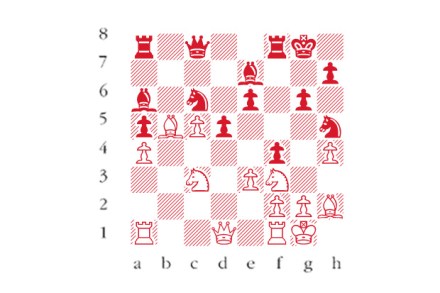
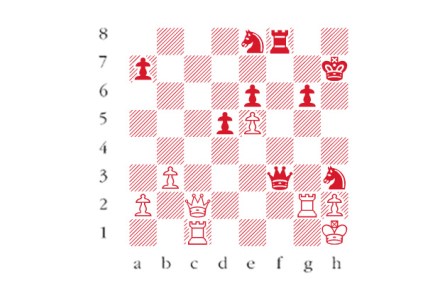
White to play. This is a variation from Caruana-Radjabov, Gashimov Memorial, Shamkir 2014. The advanced White c-pawn gives him an overwhelming position. What is the best way to finish off? Answers to me at The Spectator by Tuesday 20 May or via email to victoria@spectator.co.uk or by fax on 020 7681 3773. The winner will be the first correct answer out of a hat, and each week I am offering a prize of £20. Please include a postal address and allow six weeks for prize delivery.
Pantheon

From our UK edition

From 1950 to 1962, the challenger for the world title was determined by a Candidates tournament of the world’s leading grandmasters, apart of course from the world champion. This was deemed an improvement on the previous system whereby the incumbent could accept or decline challenges as he saw fit, subject to pressures of finance and prestige. Thereafter Fidé, the world chess federation, adopted a number of experiments, some successful, some less so, such as the qualifier for the 2012 championship which was determined by quickplay games, an affront to classical chess.   Since last year, though, Fidé has sensibly reverted to the great tournament format of yesteryear, with splendid events in London and Khanty-Mansisk.

No. 313

From our UK edition

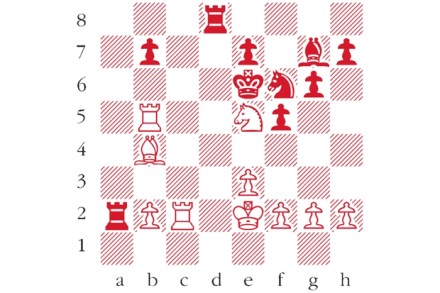
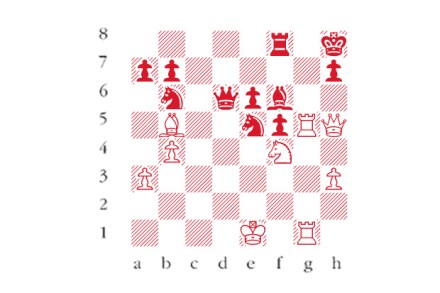
White to play. This position is from Tal-Smyslov, Candidates Tournament 1959. White’s next move was a bombshell which led to a decimation of the black position and a quick victory. What was this key blow? Answers to me at The Spectator by Tuesday 13 May or via email to victoria@spectator.co.uk or by fax on 020 7681 3773. The winner will be the first correct answer out of a hat, and each week I am offering a prize of £20. Please include a postal address and allow six weeks for prize delivery.
Vengeance is mine

From our UK edition

The history of the world chess championship includes five title matches where the challenger was the former champion, seeking his revenge. These are Steinitz v Lasker, 1896; Alekhine v Euwe 1937; Botvinnik v Smyslov, 1958; Botvinnik v Tal 1961 and Karpov v Kasparov 1986. Steinitz and Karpov both failed in their bids to reclaim the championship, while Alekhine and Botvinnik were successful, the latter twice.   After the Candidates’ tournament in Khanty-Mansisk, the former champion Anand becomes the fifth deposed monarch of the chess world to have the chance to stage a comeback. When I organised the 2000 challenge by Kramnik to Kasparov in London, I offered Kasparov the right to an automatic return match should he lose the first time round.

No. 312

From our UK edition

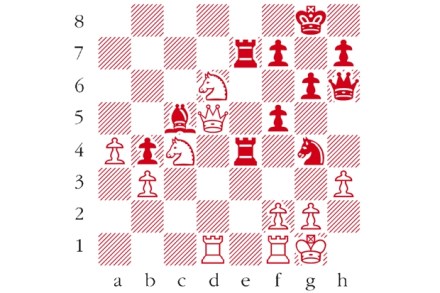
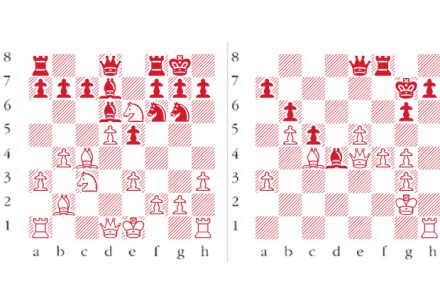
White to play. This is from Botvinnik-Smyslov, World Championship (Game 2) 1958. White’s next was a clever way to win a pawn and achieve an overwhelming position. What did he play? Answers to me at The Spectator by Tuesday 6 May or via email to victoria@spectator.co.uk or by fax on 020 7681 3773. The winner will be the first correct answer out of a hat, and each week I am offering a prize of £20. Please include a postal address and allow six weeks for prize delivery.
No. 311

From our UK edition

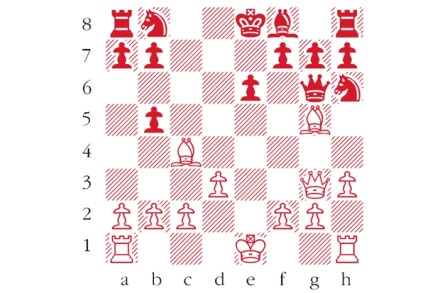
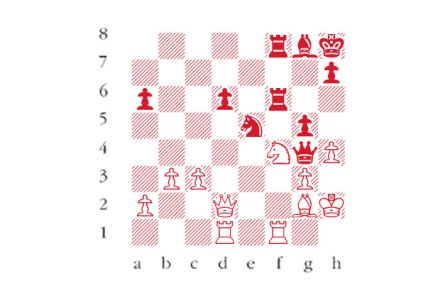
White to play. This is a variation from Carlsen-Leitao, Brazil 2014. White has a big attack on the kingside which Black is attempting to defuse by offering to exchange queens. How can White continue? Answers to me at The Spectator by Tuesday 29 April or via email to victoria@spectator.co.uk or by fax on 020 7681 3773. The winner will be the first correct answer out of a hat, and each week I shall be offering a prize of £20. Please include a postal address and allow six weeks for prize delivery.   Last week’s solution 1 ...
Watch and wait

From our UK edition

While Viswanathan Anand, the former world champion, has been qualifying for a revenge match for the world title, Magnus Carlsen, the new champion, has been awaiting the identity of his challenger. Now that Carlsen knows that he will have to face Anand once again, the time has come to do some serious preparation and get in some practice against the rest of the world’s elite. I believe that the rejuvenated Anand will pose a considerably greater danger than when he succumbed so feebly in Chennai last year, looking like a  pale imitation of himself.   Carlsen has been amusing himself against strong but comparatively lightweight opposition, but he must now switch to a higher gear.

Express train

From our UK edition

The erratic Ukrainian grandmaster Vassily Ivanchuk has scored an overwhelming victory in a rapidplay tournament sponsored by the Latvian railway. Leading scores were as follows: Ivanchuk 13 (out of 14); Malakhov 10; Fridman 9½; Bologan 9; Shirov (and many others) 8½. There is something symptomatic about the colossal scale of Ivanchuk’s victory in this event. Rapid games do not count for ratings or titles, hence it is possible to play without experiencing the kind of pressure which causes Ivanchuk’s ups and downs in classical chess.

No. 310

From our UK edition

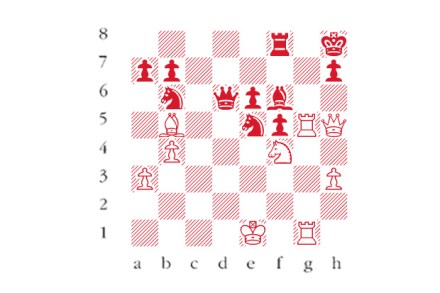
Black to play. This is from Kantans-Malakhov, Latvian Railway Open, Riga 2014. Black has achieved a tremendous build-up on the kingside with pressure on the g-file and along the h1-a8 diagonal. How did he make the most of these? Answers by Tuesday 22 April via email to victoria@spectator.co.uk or by fax on 020 7681 3773. The winner will be the first correct answer out of a hat, and each week I shall be offering a prize of £20. Please include a postal address and allow six weeks for prize delivery.
Vishy regime

From our UK edition

The Candidates tournament has been won by Vishy Anand who adopted the safety-first policy of winning two of his first three games and then drawing most of the rest. By avoiding defeat, Anand more or less coasted to victory, since all of his rivals slipped up on various occasions. Anand, at the age of 44, was the only player in his forties; the next oldest player, Topalov, is five years his junior. It is remarkable that Anand was able to dominate a field which included a former world champion and so many up and coming talents. He is now set for a revenge match against Magnus Carlsen towards the end of this year.   This week, a final selection of critical moments from this important event.

No. 309

From our UK edition

White to play. This position is from Mamedyarov-Aronian, Khanty-Mansisk 2014. White’s next was an ingenious way to demonstrate that his passed pawn on g7 was stronger than Black’s on c3. What did he play? Answers to The Spectator by Tuesday 15 April via email to victoria@spectator.co.uk or by fax on 020 7681 3773. The winner will be the first correct answer out of a hat, and each week I am offering a prize of £20. Please include a postal address and allow six weeks for prize delivery.   Last week’s solution  1 Nxd5 Last week’s winner R.G.

Candidates compendium

From our UK edition

This week I focus on a number of key positions from the World Championship qualifier, the Candidates tournament, which concluded at the beginning of this week in Khanty-Mansisk in Siberia. The Candidates was a remarkable event, with two former world champions, Viswanathan Anand (the ultimate winner) and Vladimir Kramnik, competing, along with a former Fidé (World Chess Federation) champion, Veselin Topalov, the current world no. 2, Lev Aronian, and the seven-times Russian champion Peter Svidler.   On an open board in the endgame, a bishop will usually outperform a knight. Here Anand gives a textbook example.

No. 308

From our UK edition

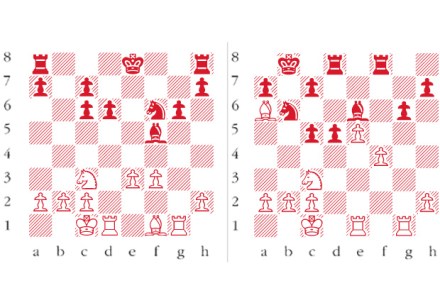
White to play. This position is from Topalov-Kramnik, Fidé Candidates, Khanty-Mansisk 2014. Kramnik has badly misplayed the opening and now Topalov crashed through in decisive fashion. Can you see the key move? Answers to me at The Spectator by Tuesday 8 April or via email to victoria@spectator.co.uk or by fax on 020 7681 3773. The winner will be the first correct answer out of a hat, and each week I shall be offering a prize of £20. Please include a postal address and allow six weeks for prize delivery.
Magnus force | 27 March 2014

From our UK edition

As the World Championship qualifier (aka Candidates tournament) approaches its final rounds in Khanty-Mansisk, it is worth emphasising the Everest which the eventual challenger will have to climb when facing the new world champion, Magnus Carlsen. A new book by the international master Colin Crouch (Magnus Force, Everyman Chess) enters in great detail into Carlsen’s most prominent games against the world’s elite in the run-up to last year’s World Championship match. This week’s game, played after the book was written, shows Carlsen demolishing a Brazilian grandmaster with astonishing ease in the champion’s recent trip to the host nation for this year’s football World Cup.

No. 307

From our UK edition

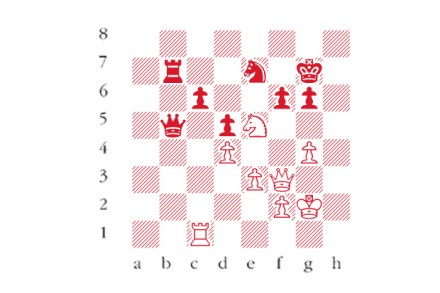
White to play. This is a possible variation from Mamedyarov-Topalov, Khanty-Mansisk Candidates 2014. The black king is rather exposed in the centre of the board. How can White exploit this? Answers to me at The Spectator by Tuesday 1 April or via email to victoria@spectator.co.uk or by fax on 020 7681 3773. The winner will be the first correct answer out of a hat, and each week I shall be offering a prize of £20. Please include a postal address and allow six weeks for prize delivery.   Last week’s solution 1 ... Qf4 Last week’s winner R.
True Blue

From our UK edition

The Oxford v. Cambridge Varsity Match held at the Royal Automobile Club two weeks ago ended in a draw. This is the longest-running chess fixture in the world, dating originally from 1873, when such luminaries as Howard Staunton and Wilhelm Steinitz were in attendance. Cambridge now lead by 58 wins to 53 with 21 drawn matches. This week’s game is a fine win by Oxford.   Weaving-Chiu: Varsity Match, London 2014; Sicilian Defence   1 e4 c5 2 Nc3 e6 3 Nf3 d6 4 d4 cxd4 5 Nxd4 Nf6. After various transpositions we have reached a standard position from the Scheveningen Variation of the Sicilian Defence, one popularised by Kasparov in his world title matches against Karpov. 6 Be3 a6 7 Qd2 b5 8 f3 Bb7. The scene is set.

No. 306

From our UK edition

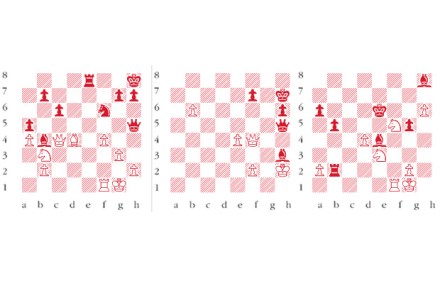
Black to play. This position is from Miles-Hodgson, Zaragoza 1993. Black has a powerful build-up on the kingside. How did he now exploit this to score a quick win? Answers to me at The Spectator by Tuesday 25 March or via email to victoria@spectator.co.uk or by fax on 020 7681 3773. The winner will be the first correct answer out of a hat, and each week I shall be offering a prize of £20. Please include a postal address and allow six weeks for prize delivery.
War fever

From our UK edition

It is a little known fact that Emanuel Lasker, the German world chess champion, who reigned from 1894 to 1921, was keen for Germany to enter the first world war. This seems at odds with his internationalism (he spent a long time in Britain, and represented England, rather than Germany, in the great Hastings tournament of 1895).   Lasker’s immediate response to the outbreak of hostilities was to pen a series of distinctly pro-war articles in the autumn of 1914. In one article, which appeared on 13 September, he stated that ‘the goal of occupation and administration of France by Germans is as sure as mate by rook and king against king’. This is very much a beginners’ checkmate since it is so simple — thus more insulting to the French than to England.

No. 305

From our UK edition

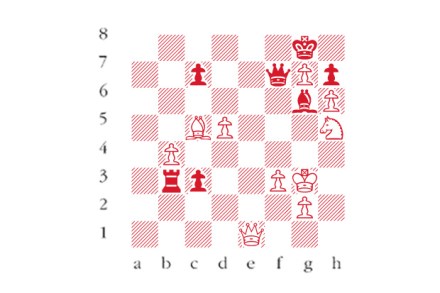
White to play. This position is from Teichmann-NN, Simultaneous Display, Berlin 1914. Can you spot White’s fine finish? Answers to me at The Spectator by Tuesday 18 March or via email to -victoria@spectator.co.uk or by fax on 020 7681 3773. The winner will be the first correct answer out of a hat, and each week I shall be offering a prize of £20. Please include a postal address and allow six weeks for prize delivery. Last week’s solution 1 Rb6+ Kc5 2 Qg1 mates Last week’s winner George Katsugias, Bradford, W.
Varsity match

From our UK edition

On Saturday 8 March the 132nd Varsity match between the teams of Oxford and Cambridge will see Oxford seeking to reduce its historic deficit in a match which can claim to be the world’s longest-running chess fixture. Scores stand as follows: Cambridge lead by 58 wins to 53 with 20 drawn matches. This year’s contest is jointly sponsored by Henry Mutkin, the doyen of the RAC Chess Circle and the Royal Automobile Club itself.   This week’s game is one of my own experiences from an earlier Varsity contest against a player who went on to win the British Championship on two occasions.