Raymond Keene

No. 397

From our UK edition

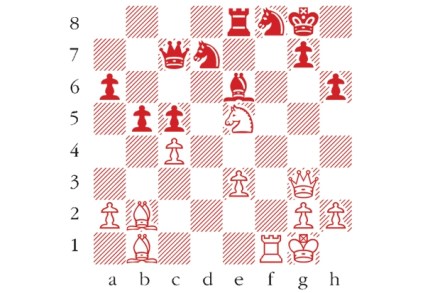
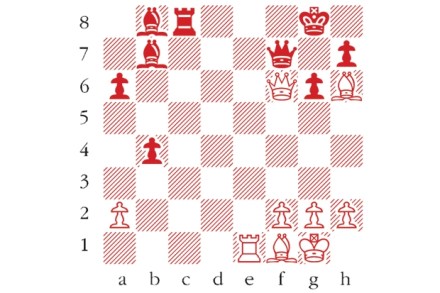
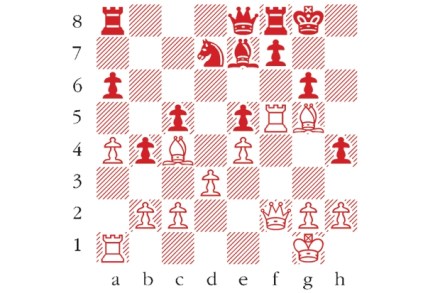
Black to play. This position is from Shirov-Nakamura, Zurich 2016. Black is winning easily but now finished with a fine geometrical concept. What was the key move? Answers to me at The Spectator by Tuesday 1 March or via email to victoria@spectator.co.uk or by fax on 020 7681 3773. There is a prize of £20 for the first correct answer out of a hat. Please include a postal address and allow six weeks for prize delivery.
Rocky 14

From our UK edition

The 14th Tradewise tournament at Gibraltar ended in a triumph for the American grandmaster Hikaru Nakamura. Naka, as he is affectionately known, tied on points with the leading French representative, Maxime Vachier-Lagrave, but in the obligatory playoff, the American nosed ahead to take the £20,000 first prize. Gibraltar, under the auspices of chess-loving hotelier Brian Callaghan OBE, is noted for its promotion of female chess. Anna Muzychuk seized her chance to win the £15,000 reward for top woman competitor. With an enthusiastic female entry vying for record prizes, the social atmosphere at the Caleta hotel is unique. Nakamura-Gupta: Gibraltar Masters 2016 17 g4 White plans to meet the natural 17 ...

No. 396

From our UK edition

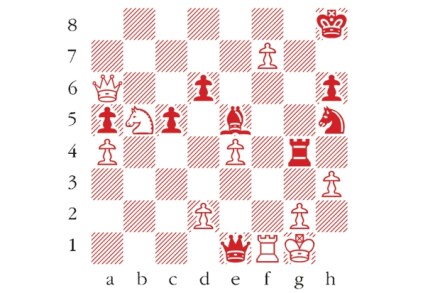
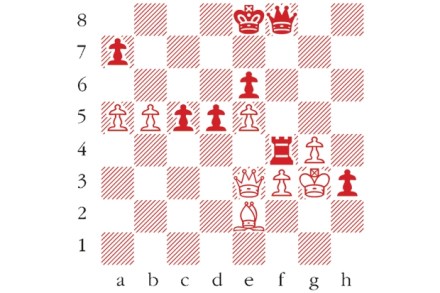
White to play. This position is from Anna Muzychuk-Salem, Gibraltar Masters 2016. How did White conjure up a decisive material gain? Answers to The Spectator by Tuesday 23 February or via email to victoria@spectator.co.uk or by fax on 020 7681 3773. There is a prize of £20 for the first correct answer out of a hat. Please include a postal address and allow six weeks for prize delivery.
Mighty Magnus

From our UK edition

The world champion is back on form. After winning the overall laurels in last year’s Grand Tour, and taking first prizes on tie break at both London and Qatar in December, Carlsen secured a convincing and outright triumph at the Tata Steel elite tournament in Wijk aan Zee, Holland, last month. His margin of victory was clear and he remained unbeaten throughout. Leading scores out of 13 possible were as follows: Carlsen 9/13; Caruana and Ding Liren both 8. Wesley So, formerly of the Philippines but now, like Caruana, representing USA, scored 7, but was the only other unbeaten player. Britain’s Micky Adams gained a disappointing 5 points, which left him sharing last place.

No. 395

From our UK edition

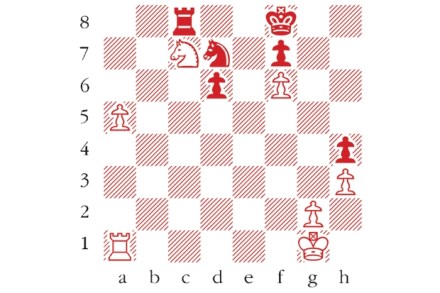
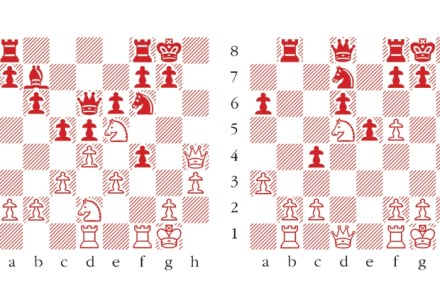
White to play. This position is from Van Wely-Carlsen, Wijk aan Zee 2016. Carlsen had a lucky escape in this game as White could have forced this position. How can he now finish off? Answers to me at The Spectator by Tuesday 16 February or via email to victoria@spectator.co.uk. There is a prize of £20 for the first correct answer out of a hat. Please include a postal address and allow six weeks for prize delivery.
No. 394

From our UK edition

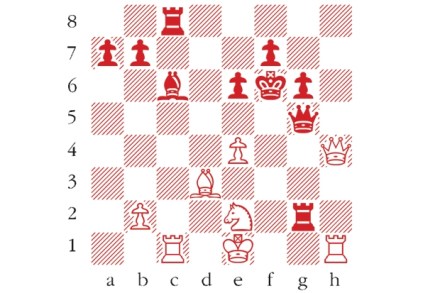
White to play. This position is from Alekhine-Flohr, Bled 1931. White has a positional advantage but can you spot the crushing tactical blow? Answers to me at The Spectator by Tuesday 9 February or via email to victoria@spectator.co.uk or by fax on 020 7681 3773. There is a prize of £20 for the first correct answer out of a hat. Please include a postal address and allow six weeks for prize delivery.
Irresistible force

From our UK edition

Alexander Alekhine was one of the immortals of the chessboard — world champion from 1927, when in an epic war of attrition at Buenos Aires 1927 he had wrested the championship from Capablanca, until 1935, and again from 1937 until his death in 1946. His victories at the tournaments of San Remo 1930 and Bled 1931 number among the most devastating performances in the history of the game. The historic table and pieces, with which the two titans fought their battles, is a prime treasure of the Buenos Aires chess club. Alekhine’s forte was the whirlwind attack.

Keres scene

From our UK edition

This week I conclude my homage to the great Estonian grandmaster Paul Keres, who was born a century ago this month. The game I have selected to round off my tribute is an incendiary victory against the red czar of Soviet chess, Mikhail Botvinnik. In their earlier clashes Botvinnik reeled off a series of wins, and by the mid-1950s the Soviet world champion led by seven to one in terms of decisive games. Then Keres struck back in the USSR championship and Alekhine Memorial tournaments from 1955 and 1956. This week’s game is the latter of those inflammable wins. Keres-Botvinnik: Alekhine Memorial, Moscow 1956; Sicilian Defence 1 e4 c5 2 Nf3 Nc6 3 d4 cxd4 4 Nxd4 Nf6 5 Nc3 d6 6 Bg5 e6 7 Qd2 h6 8 Bxf6 gxf6 Botvinnik often resorted to this double-edged variation of the Sicilian defence.

No. 393

From our UK edition

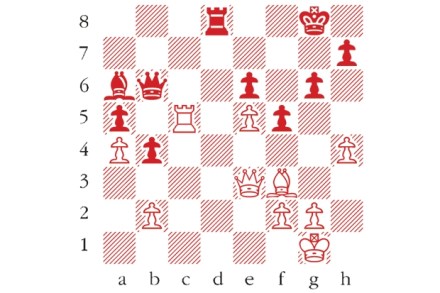
White to play. This is from Keres-Mardle, Hastings 1964. How did Keres ignite his attack? Answers to me at The Spectator by Tuesday 2 February or via email to victoria@spectator.co.uk or by fax on 020 7681 3773. There is a prize of £20 for the first correct answer out of a hat. Please include a postal address and allow six weeks for prize delivery. Last week’s solution 1 Qxg7+ Last week’s winner R.F.
The Islamic world has always had a chequered relationship with chess

From our UK edition

The news that the Grand Mufti of Saudi Arabia has issued a fatwa against the game of chess should come as no surprise. There has always been a chequered history of relations between Islamic clerics and practitioners of the world's most popular board game. Abdul-Aziz ibn Abdullah Al ash-Sheikh is the most powerful Sunni religious figure in Saudi Arabia and issued the fatwa while answering viewers' questions during his weekly television broadcast 'With his Eminence the Mufti'. The show was first broadcast in 2014, ‎but the Grand Mufti's censorious condemnation of chess, during which he compared it to the pre-Islamic Arab game of Maisir, has only this week achieved prominence. According to the Mufti, chess is 'haram'.

Pauline conversion

From our UK edition

Paul Keres, the Estonian grandmaster and many times world championship contender, was born a hundred years ago this month. His record against world champions was very impressive: he defeated all nine in sequence from Capablanca to Bobby Fischer. Keres was probably the strongest player, pace Nimzowitsch, Rubinstein and Korchnoi, never to have won the world title. The hallmark of a Keres win was a flowing initiative, often directed towards the opposing king, frequently converted into victory by a shattering sacrifice. Here he is at his best. Keres-Spassky; Riga 1965 18 d5! Despite the two pawn deficit, Keres has a huge initiative against Spassky’s disorganised and undeveloped position. 18 ...

No. 392

From our UK edition

White to play. This position is from Keres-Spassky, Gothenburg 1955. Can you spot White’s crushing blow? Answers to me at The Spectator by Tuesday 26 January or via email to victoria@spectator.co.uk or by fax on 020 7681 3773. There is a prize of £20 for the first correct answer out of a hat. Please include a postal address and allow six weeks for prize delivery.

Paul stories

From our UK edition

An excellent recent article by Dominic Lawson in Standpoint magazine reminded me of the greatness of Paul Keres. The Estonian grandmaster,whose centenary falls this month, was silver medallist in no fewer than four world championship Candidates tournaments. (I will be writing about him next week.) Another illustrious player (one with the same first name) is Paul Morphy, the victor of Bobby Fischer’s favourite masterpiece. I saw Fischer demonstrate this game to Fidel Castro during the 1966 Olympiad in Havana and it forms the topic of this week’s analysis.

No. 391

From our UK edition

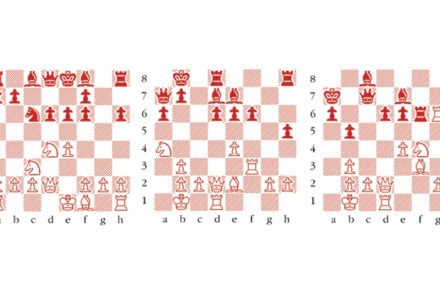
White to play. This is from Fischer-Benko, US Championship, New York 1963. The obvious 1 e5 is successfully parried by 1 ... f5. What did Fischer do instead? Answers to me at The Spectator by Tuesday 19 January or via email to victoria@spectator.co.uk or by fax on 020 7681 3773. There is a prize of £20 for the first correct answer out of a hat. Please include a postal address and allow six weeks for prize delivery. Last week’s solution 1 ... Rxg2+ and 1 ...
Winter’s tail

From our UK edition

The London Classic, the end of the million-dollar Grand Tour, was something of a damp squib. A surfeit of draws meant the event largely boiled down to who was most effectively able to despatch the cellar dwellers Anand and Topalov. Top scores out of nine were as follows: Carlsen, Giri and Vachier-Lagrave 51/2 each, Aronian 5, and Britain’s Mickey Adams 41/2. What to do about such a preponderance of drawn games? In the past, whenever the threat of draw death has loomed, some charismatic genius — Alekhine, Tal, Kasparov — has emerged to revitalise the game at the top. But the reigning champion and overall Grand Tour winner, Magnus Carlsen, effective as he is, simply does not possess this kind of dynamism.

Puzzle no. 390

From our UK edition

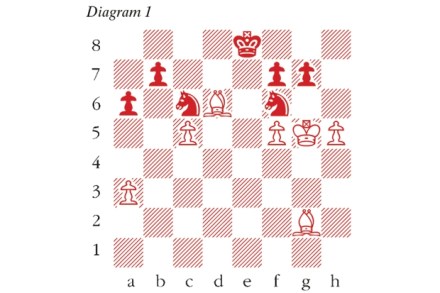
Black to play. This is a variation from Carlsen-Grischuk, London Classic 2015. Carlsen won but this week’s puzzle shows how he could have gone wrong. Black has two ways to win immediately. Can you find both key moves? Answers to me at The Spectator by Tuesday 12 January or via email to victoria@spectator.co.uk. There is a prize of £20 for the first correct answer out of a hat. Please include a postal address and allow six weeks for prize delivery. Last week’s solution 1 ...
Banking on chess

From our UK edition

As the new year begins, I pay a final tribute to the city financier Jim Slater, who did so much to support British chess and who was instrumental, with Henry Kissinger, in rescuing Bobby Fischer’s challenge against Boris Spassky from Reykjavik 1972. Slater offered £50,000 to increase the World Championship prize fund, created awards and prizes for the first British grandmasters (of which I was a grateful recipient) and sponsored tournaments to promote British chess. This new year column celebrates Jim Slater’s first foray into sponsorship of chess. He died towards the end of 2015.

Chess puzzle | 31 December 2015

From our UK edition

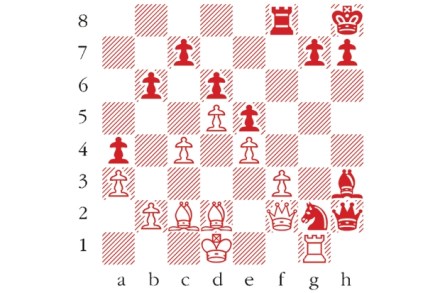
Black to play. This position is from Wright-Keene, Slater Tournament, Southend 1968. Black’s next move destroyed the white kingside and led to a quick win. What did he play? We regret that because of the Christmas printing schedule, this is not a prize puzzle.

London calling | 10 December 2015

From our UK edition

By the time this article appears, the London Classic at Olympia and the newly created brainchild of the indefatigable Malcolm Pein, the introduction of the British Knockout Championship, will have been underway for some time. The prize fund in the Classic is $300,000, this being part of the new global Grand Chess Tour which has tournaments in St Louis and Norway, where the overall prize fund available amounts to over $1,000,000. Given the lavish support for these two events, a recent article in the Guardian by Stephen Moss entitled ‘Grandmaster Crash — How English Chess Pawned Its Future’deserves attention.

Chess Puzzle | 10 December 2015

From our UK edition

White to play. This position is from Fernandez-Jackson, Aberystwyth 2014. White brilliantly exploited the draughty position of the black king with a fine combination. Can you spot the key move? We regret that because of the Christmas printing schedule, this is not a prize puzzle. Last week’s solution The Queen sacrifice 1 Qxh7+ is the key move leading to checkmate.