Raymond Keene

London Classic | 3 December 2015

From our UK edition

The annual London Classic, inspired and organised by the indefatigable Malcolm Pein, is now underway at London’s Olympia. The website is www.londonchessclassic.com and in the stellar line-up are Magnus Carlsen, Fabiano Caruana, Hikaru Nakamura, Veselin Topalov, Alexander Grischuk, Viswanathan Anand, Anish Giri, Lev Aronian, Michael Adams and Maxime Vachier-Lagrave. This is the highest-rated tournament ever held on British soil, though Nottingham 1936 can challenge for quality given that five world champions were competing, namely Emanuel Lasker, Capablanca, Alekhine, Euwe and Botvinnik. London has been the scene of many brilliant games, jewels in the crown of chess art. This week I give two examples of coruscating brilliance.

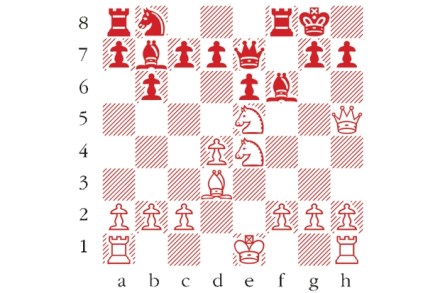
Chess Puzzle

From our UK edition

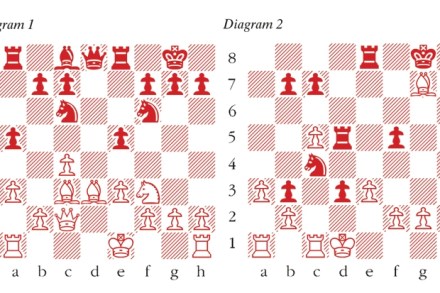
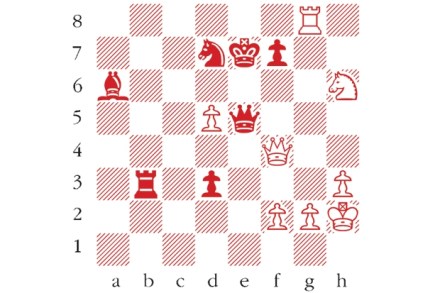
White to play. This position is from Edward Lasker-Thomas, London 1912. This is one of the most famous combinations ever seen in London. What is White’s key move? We regret that because of the Christmas printing schedule, this is not a prize puzzle. Last week’s solution 1 ...

Chess Maecenas

From our UK edition

Last week saw the death of the city financier Jim Slater. He was famous in chess circles for joining Henry Kissinger in persuading Bobby Fischer to play his 1972 World Championship match against Boris Spassky in Reykjavik. Kissinger’s contribution was a diplomatic phone call to Fischer, while Slater pumped extra cash into the prize fund and said Fischer was ‘chicken’ if he did not come out to play. Slater also supported British chess by offering thousands of pounds in incentives for the first British grandmasters and by sponsoring tournaments to promote British talent. I won the first of these, from which this week’s game and puzzle are taken.

No. 389

From our UK edition

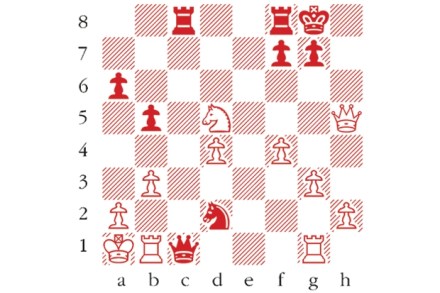
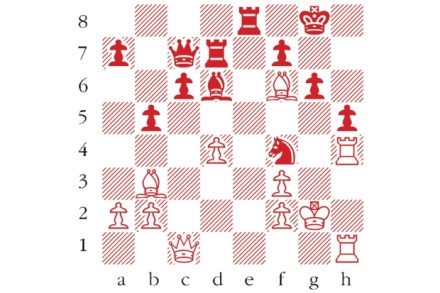
Black to play. This position is from Basman-Keene, Slater Tournament, Southend 1968. How can Black quickly gain a decisive advantage? Answers to me at The Spectator by Tuesday 1 December or via email to victoria@spectator.co.uk or by fax on 020 7681 3773. The winner will be the first correct answer out of a hat, and each week there is a prize of £20. Please include a postal address and allow six weeks for prize delivery. Last week’s solution 1 ...

Grand Larsen-y

From our UK edition

It is said that more books have been written about chess than about any other game, sport or pastime. I can well believe it. When the Chess and Bridge (shop.chess.co.uk) catalogue dropped through my letterbox last week, I counted 360 book titles, and I know that is just the tip of the iceberg. One book that caught my eye in the catalogue was the unlikely entry Best Larsen’s Bent Games of Chess. I know that Bent Larsen, a supergrandmaster who in his time defeated Botvinnik, Smyslov, Tal, Petrosian, Spassky, Fischer and Karpov, sometimes resorted to weird openings, but the catalogue typo seemed to be taking things a little far. The game below is based on one from a new book on Larsen, Larsen Move by Move by Cyrus Lakdawala (Everyman Chess).

No. 388

From our UK edition

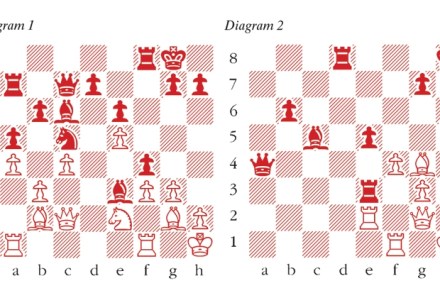
Black to play. This is from Sursock--Larsen, Siegen 1970. How can Black win material? Answers to me at The Spectator by Tuesday 24 November or via email to victoria@spectator.co.uk or by fax on 020 7681 3773. The winner will be the first correct answer out of a hat, and each week there is a prize of £20. Please include a postal address and allow six weeks for prize delivery.

Sporting chance

From our UK edition

I was not quite sure whether to be annoyed or relieved about the recent High Court decision not to recognise bridge as a sport. On the one hand, it’s a comfort to know that there is now little danger of British bridge and, pari passu, chess being classified alongside activities that feature perspiring individuals running around in underwear. Chess should, in my opinion, be dignified by elegant surroundings, with the players in formal attire, as in the fictional sequence of the James Bond movie From Russia with Love, or the encounters between Nigel Short and Garry Kasparov that were screened by Channel 4 in 1987.

No. 387

From our UK edition

White to play. This position is a variation from A.Muzychuk-Dzagnidze, Monaco 2015. How can White finish off with a classic combination? Answers to me at The Spectator by Tuesday 17 November or via email to victoria@spectator.co.uk or by fax on 020 7681 3773. The winner will be the first correct answer out of a hat, and each week there is a prize of £20. Please include a postal address and allow six weeks for prize delivery.

Winter of discontent

From our UK edition

The two great Soviet world champion Russians, Anatoly Karpov and Garry Kasparov, have almost always taken divergent paths. Karpov was the golden boy of the Soviet establishment, while Kasparov was an early supporter of glasnost and perestroika. A détente occurred when Karpov visited Kasparov in prison after he was incarcerated by the Putin regime for taking part in a public protest in Moscow. But their ancient opposition continues. Kasparov’s new book, Winter Is Coming: Why Vladimir Putin and the enemies of the free world must be stopped (Atlantic), is a challenge to the Kremlin and the Russian president. Kasparov prepared for its publication by emigrating to New York.

No. 386

From our UK edition

White to play. This is from Kasparov-Karpov, London/Leningrad (Game 16). Kasparov saw this conclusion many moves in advance. White would be lost if he did not have one particular move. What is it? Answers to me at The Spectator by Tuesday 10 November or via email to victoria@-spectator.co.uk. The winner is the first correct answer out of a hat, and each week there is a prize of £20. Please include a postal address.

Doctor Hou

From our UK edition

Hou Yifan has won what must be considered one of the strongest, if not the strongest, all-women chess tournaments ever held. Staged in the opulent surroundings of the Casino in Monte Carlo, the organisers succeeded in arranging a line-up which could have been improved upon only if Judit Polgar had agreed to participate. Judit, after many years at the top of female chess, has finally retired. Leading scores in Monaco were as follows: Hou Yifan 9/11; M. Muzychuk and Koneru 7; Cramling and Pogonina 6. It was unfortunate that there was no British representation in this stellar competition. Indeed, ever since 1976 when the English women’s team won the silver medals in the Haifa Olympiad, there seems to have been a steady decline in English women’s chess.

No. 385

From our UK edition

White to play. This position is from Koneru-Zhukova, Monaco 2015. How did White quickly exploit the constricted position of the black king? Answers to me at The Spectator by Tuesday 3 November or via email to victoria@spectator.co.uk or by fax on 020 7681 3773. The winner will be the first correct answer out of a hat, and each week there is a prize of £20. Please include a postal address and allow six weeks for prize delivery. Last week’s solution 1 ...

Ex libris

From our UK edition

When I first studied chess I thought it was a golden age for chess literature. There were the classics such as Nimzowitsch’s My System and Reti’s Masters of the Chessboard; a series of publications by Harry Golombek on his heroes Reti, Capablanca, Botvinnik and Smyslov; and Peter Clarke’s wonderful elucidations of the best games of Mikhail Tal and Tigran Petrosian. In the recent past chess authors have tended to rely too much on computer analysis and databases. Fortunately, we are now in a second golden age, where the computer is the servant rather than the tyrannical master. Garry Kasparov’s mighty My Great Predecessors series on world champions may be the best series of chess books ever written.

No. 384

From our UK edition

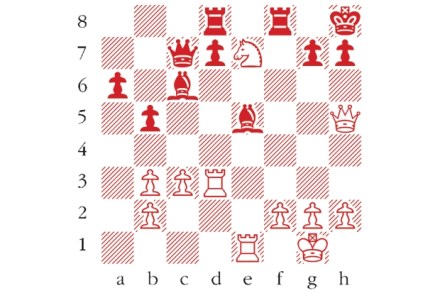
Black to play. This position is from Inarkiev-Salem, World Blitz, Berlin 2015. How did Black conclude the attack? Answers to me at The Spectator by Tuesday 27 October or via email to victoria@-spectator.co.uk or by fax on 020 7681 3773. The winner will be the first correct answer out of a hat, and each week there is a prize of £20. Please include a postal address and allow six weeks for prize delivery. Last week’s solution 1 ...

Thud and blunder

From our UK edition

The Fidé World Cup, which finished last week in Baku, boasted over $1 million in overall prize money, with $100,000 going to the winner. The format consisted of short sharp knockout matches, hardly congenial to heavyweight contenders such as Kramnik, Topalov, Aronian, Nakamura and Caruana, who were all eliminated in the early stages. The final, as befits an ultimate shoot-out, lasted much longer, and extraordinarily the ten games between Sergei Karjakin and Peter Svidler all ended decisively. Karjakin came back from the grave on more than one occasion to secure the laurels, but the tournament was mainly notable for the egregious blunders committed by both sides.

Puzzle no. 383

From our UK edition

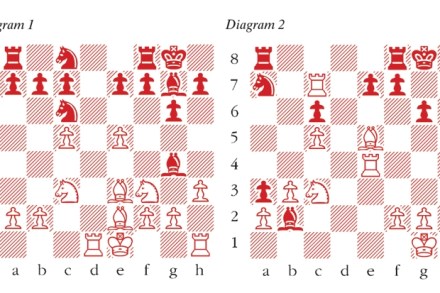
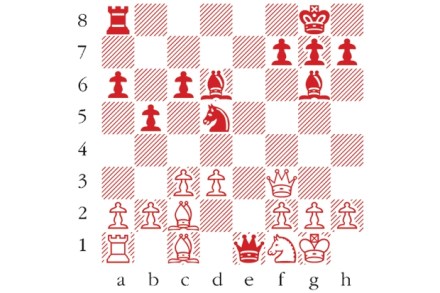
Black to play. This is from Karjakin-Svidler, Fidé World Cup, Baku 2015. The position occurred earlier in the third game detailed above. Black played 1 ... b4, missing something much stronger. What should he have played? Answers to me at The Spectator by Tuesday 20 October or via email to victoria@spectator.co.uk. The winner will be the first correct answer out of a hat, and each week there is a prize of £20. Please include a postal address and allow six weeks for prize delivery.

Puzzle no. 382

From our UK edition

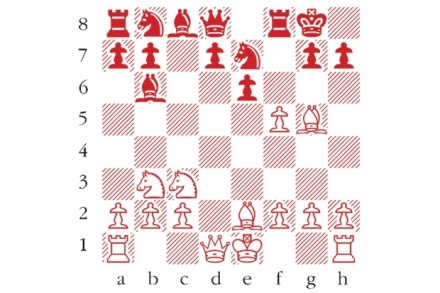
White to play. This is from Blackburne-Schwarz, Berlin 1881. What is the best way to deal with the knight check? Answers to me at The Spectator by Tuesday 13 October or via email to victoria@spectator.co.uk or by fax on 020 7681 3773. The winner will be the first correct answer out of a hat, and each week there is a prize of £20. Please include a postal address and allow six weeks for prize delivery. Last week’s solution 1 ... Bxf2+ Last week’s winner R.F.

Black death

From our UK edition

Joseph Henry Blackburne was the leading British tournament player towards the end of the 19th century. It could be said that he challenged Steinitz for world matchplay supremacy, though he could not hold his own with the great Austrian strategist. A monumental new book by chess scholar Tim Harding represents a huge contribution to chess literature. Harding has produced a full biography with many games, and has done far more than just reproduce 19th-century commentary. In this week’s game he pinpoints a critical fulcrum, missed by previous commentators, where Blackburne could have seized the advantage.

Homer nods

From our UK edition

Paul Morphy, in a strange prefiguration of the later career of Bobby Fischer, was often described as ‘the pride and sorrow of chess’. In the late 1850s he blazed like a meteor across the chess firmament. He sprang to prominence by thoroughly defeating the German master Louis Paulsen in the New York tournament of 1857. Based on this success, Morphy travelled to Europe where, in quick succession, he inflicted match defeats on the established European masters such as Lowenthal, Harrwitz and finally Adolf Anderssen, who was very much regarded as champion after his victory at the London tournament of 1851. Morphy’s victories were so great that we tend to regard him as a titan of chess, but this week’s game shows that he was also human.

No. 381

From our UK edition

Black to play. This is from Botterill-Basman, Eastbourne 1973. What is Black’s best move? Answers to me at The Spectator by Tuesday 6 October or via email to victoria@spectator.co.uk or by fax on 020 7681 3773. The winner will be the first correct answer out of a hat, and each week there is a prize of £20. Please include a postal address and allow six weeks for prize delivery. Last week’s solution 1 ...