Raymond Keene

No. 417

From our UK edition

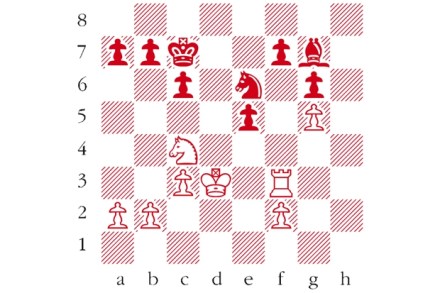
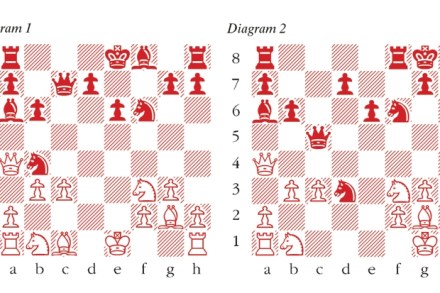
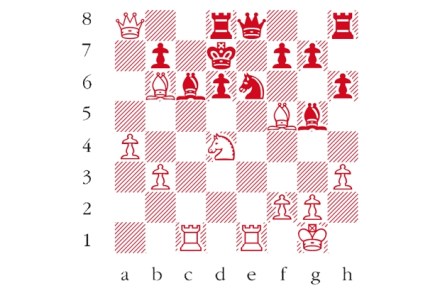
White to play. This position is from Staunton-Horwitz, London (Game 3) 1846. How did White conclude his attack? Answers to me at The Spectator by Tuesday 19 July or via email to victoria@spectator.co.uk. There is a prize of £20 for the first correct answer out of a hat. Please include a postal address and allow six weeks for prize delivery.

Korchnoi’s French

From our UK edition

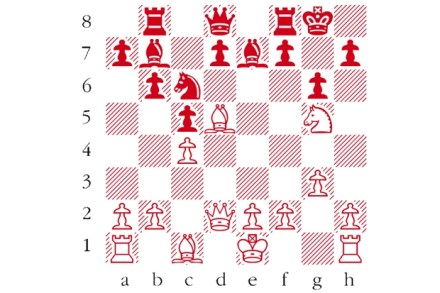
As we bid farewell to the great Viktor Korchnoi, it is worth pointing out that he was one of those rare players who at various times held a diversity of national titles. His record included winning the championships of the USSR, the Netherlands and finally Switzerland. I conclude my tribute to him this week with one of his classic wins in the French Defence. This week’s game is a Korchnoi masterpiece that I found in a new book on one of his favourite defences.    First Steps: The French Defence by Cyrus Lakdawala is published by Everyman Chess.

No. 416

From our UK edition

White to play. This is from Kasparov-Alonso, Simultaneous Display, Moenchengladbach 2016. How did White conclude his attack? Answers to me at The Spectator by Tuesday 12 July or via email to victoria@spectator.co.uk or by fax on 020 7681 3773. There is a prize of £20 for the first correct answer out of a hat. Please include a postal address and allow six weeks for prize delivery.   Last week’s solution 1 g4 (1 ...
No. 415

From our UK edition

White to play. This position is from Nakamura-Caruana, Leuven Blitz 2016. White can now win material. What is the key move? Answers to me at The Spectator by Tuesday 5 July or via email to victoria@spectator.co.uk. There is a prize of £20 for the first correct answer out of a hat. Please include a postal address and allow six weeks for prize delivery.   Last week’s solution 1 ...

Grand tour

From our UK edition

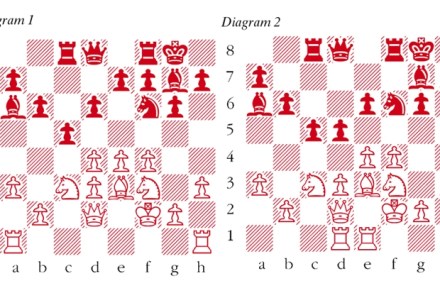
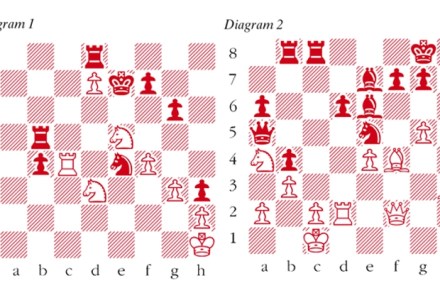
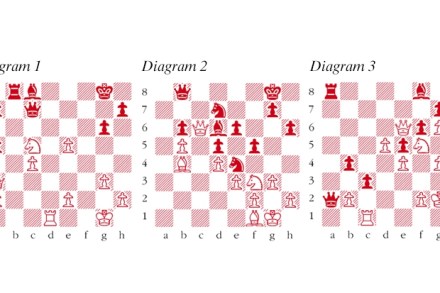
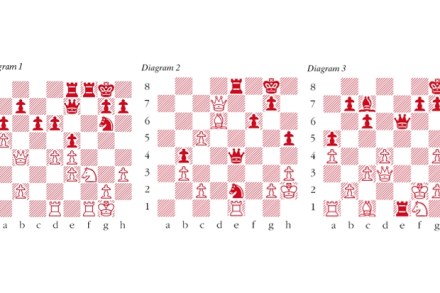
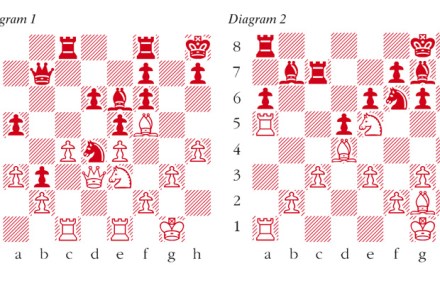
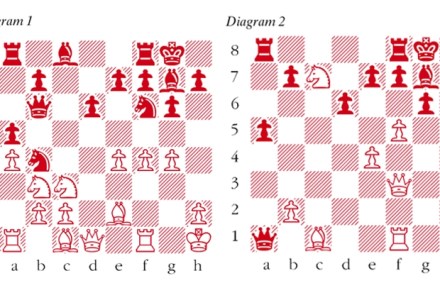
The first two legs of this year’s Grand Chess Tour have now been staged in Paris and Leuven. There will be follow-ups later this year in St Louis and London. The format of Paris and Leuven consisted of a rapidplay and blitz tournament at each venue. After the conclusion of these events the leading overall standings in the Tour are Carlsen 23, Nakamura and So 17.   Carlsen-Anand: GCT Rapid Leuven 2016 (see diagram 1)   Carlsen now shows excellent judgment by heading for an endgame which, at first sight, appears to give Black no problems. 21 dxe5 dxe5 22 Qxe7 Rxe7 One would expect that the extra queenside pawn would be more relevant than White’s doubled e-pawns. However, more important is that the white forces are very active and the e-pawns control important squares.

Memorable Mamedyarov

From our UK edition

Local hero Shakhriyar Mamedyarov won the Vugar Gashimov Memorial in Shamkir, Azerbaijan by virtue of three consecutive victories at the last minute. Two of these wins came against the leaders Fabiano Caruana and Anish Giri. That catapulted Mamedyarov into a tie for first prize with Caruana, and then he went on to win the tie-break. This was a colossal performance by the Azeri frontrunner and it must have thrilled the home crowds. Full scores in the main tournament were as follows: Mamedyarov and Caruana 6 (out of 9); Giri 5½; Karjakin 5; Mamedov 4½; Harikrishna, Safarli and Radjabov 4; Eljanov 3½ and Hou Yifan 2½. Mamedyarov then went on to win the four-game play-off against Caruana by one win with three draws.

No. 214

From our UK edition

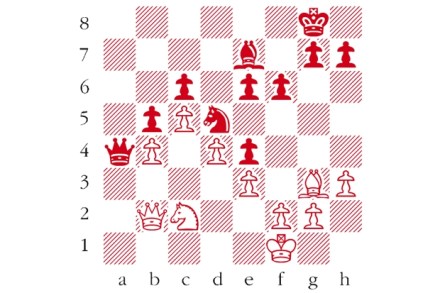
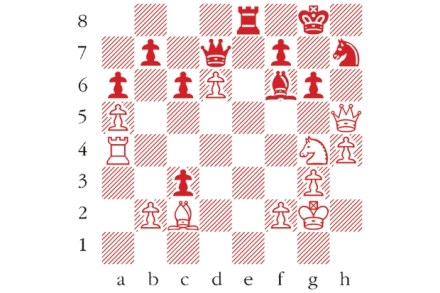
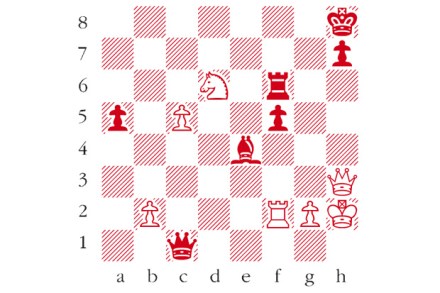
Black to play. This is from Caruana-Mamedyarov, Gashimov Memorial Play-off 2016. Black played 1 ... Kg8 here, missing a clever winning move. What should he have played instead? (This is a tough puzzle.) Answers to me at The Spectator by Tuesday 28 June or via email to victoria@spectator.co.uk. There is a prize of £20 for the first correct answer out of a hat. Please include a postal address and allow six weeks for prize delivery.
Leningrad Lip

From our UK edition

I had intended this week to write about the surprise surge by Mamedyarov which overturned all expectations in the elite Gashimov Memorial. Instead, the death of Viktor Korchnoi, known variously as Viktor the Terrible or the Leningrad Lip, represents a force majeure priority. An outspoken defector and three-times world champion contender, Korchnoi was one of the dominating figures of 20th-century chess.   This week, a win against the legendary Bobby Fischer and a puzzle position against his arch foe Anatoly Karpov. Comments based on those by Cyrus Lakdawala in Korchnoi: Move by Move (Everyman Chess).

No. 413

From our UK edition

White to play. This is from Korchnoi-Karpov, Candidates Final, Moscow 1974. White’s next move destroyed the black position and led to one of Karpov’s quickest ever defeats. What did White play? Answers to me at The Spectator by Tuesday 21 June or via email to victoria@spectator.co.uk. There is a prize of £20 for the first correct answer out of a hat. Please include a postal address and allow six weeks for prize delivery.   Last week’s solution 1 ... Qxc4 (2 Bxc4 Bxc3+ 3 Qb2 Bxe1!
No. 412

From our UK edition

Black to play. This is from Arnason-Keene, London 1981. How did Black bring his bishops to life? Answers to me at The Spectator by Tuesday 14 June or via email to victoria@spectator.co.uk or by fax on 020 7681 3773. There is a prize of £20 for the first correct answer out of a hat. Please include a postal address and allow six weeks for prize delivery.
Edgehogs

From our UK edition

Last week, commenting on Nigel Davies’s new book The Pirc Move by Move (Everyman Chess), I wrote about my win against Dr Jonathan Penrose which clinched the British Championship title for me. I want to expatiate further on the black defensive strategy which is predicated on flank development with the aim of destroying White’s pawn centre from the edges of the board. The Pontifex Maximus of this wing strategy was Duncan Suttles, the Canadian grandmaster, whose exploits are recorded in the multivolume Chess on the Edge: 100 Selected Games of Canadian Grandmaster Duncan Suttles by Harper and Seirawan (available on Amazon). My main contribution to the theory of this edgy branch of chess thought was to refine a system based on an early … Nc6. Here is one example.

Life on the edge

From our UK edition

The grandmaster Nigel Davies has just written a new book on the Pirc Defence, a variation in which Black sacrifices immediate control of the centre to White’s pawns, in the hope of a later counterattack, designed to paint the centre of the board black instead of white. Davies is a solid, dependable and reliable guide to an opening that was once considered heretical but is now mainstream. The game I have chosen to illustrate the principle theme of this defence is the victory I achieved against the ten-times British champion Jonathan Penrose in 1971. This game was instrumental in my winning the British Championship that year.

No. 411

From our UK edition

Black to play. This is from Cherin-Pedini, Italy 2016. Black has just sacrificed some material as he could foresee a simplifying manoeuvre leading to a winning ending. How did he continue? Answers to me at The Spectator by Tuesday 7 June or via email to victoria@spectator.co.uk or by fax on 020 7681 3773. There is a prize of £20 for the first correct answer out of a hat. Please include a postal address and allow six weeks for prize delivery.   Last week’s solution 1 ...
Garry’s comeback

From our UK edition

To great surprise, the former world champion Garry Kasparov staged a brief comeback when he participated in a blitz tournament held to celebrate the close of this year’s US Championship. His opponents were the top three from the championship and an 18-round competition resulted in the following scores: Nakamura 11, So 10, Kasparov 9½ and Caruana 5½.   It is astounding that at the age of 53, with no tournament practice whatsoever for some time, Kasparov can hold his own with the young tigers of the contemporary chess scene. Indeed, had he converted two winning positions against Wesley So, he would have emerged as the clear victor. Instead, in both cases, bad blunders transformed near-triumph into loss for him.

No. 410

From our UK edition

Black to play. This position is from So-Nakamura, Ultimate Blitz Challenge, Saint Louis 2016. How did Black make a key breakthrough while also winning material? Answers to me at The Spectator by Tuesday 31 May or via email to victoria@spectator.co.uk or by fax on 020 7681 3773. There is a prize of £20 for the first correct answer out of a hat. Please include a postal address and allow six weeks for prize delivery.
Cyrus the Great

From our UK edition

I think I hold the world record for the greatest number of chess books written (or co-written) and published. At the last count I managed to identify 199, with several of them translated into a total of 13 different languages. Last week, a new book by the prolific Cyrus Lakdawala dropped through my letterbox. Lakdawala seems to be producing a book every month and I fear he is threatening to overtake me. His latest tome is an exposition of various methods of combating the Sicilian Defence. These include an early c3, in order to build up a formidable pawn centre for White, a quick Bb5 and the feared Morra Gambit where White immediately plays 2 d4 and then continues in sacrificial style with 2 ... cxd4 3 c3, rather than trying to recapture the pawn.

No. 409

From our UK edition

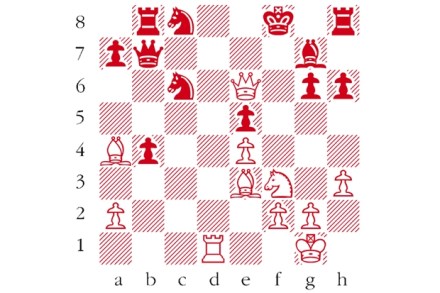
White to play. This position is from Dubov-Yandemirov, Russian Team Championship, Sochi 2016. How can White exploit the unfortunate placing of the black pieces? Answers to me at The Spectator by Tuesday 24 May or via email to victoria@spectator.co.uk or by fax on 020 7681 3773. There is a prize of £20 for the first correct answer out of a hat. Please include a postal address and allow six weeks for prize delivery.
Magna cum laude

From our UK edition

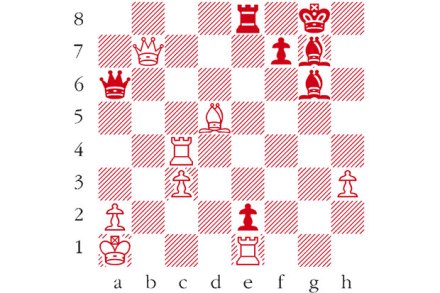
World champion Magnus Carlsen has taken first prize in the Norway tournament at Stavanger which finished last month. Carlsen had dominated proceedings but was briefly derailed by a loss to the triple Olympiad gold medallist Levon Aronian of Armenia, who eventually emerged as the runner-up. As so often, Carlsen pulled a rabbit out of the hat in the last round, overcoming Eljanov to secure first prize. Scores (out of 9) were: Carlsen 6; Aronian 5½; Vachier-Lagrave, Topalov and Kramnik 5; Li and Harikrishna 4½; Giri 4; Eljanov 3 and Grandelius 2½.   Aronian-Carlsen; Norway Chess, Stavanger 2016 (see diagram 1)   Carlsen’s only vague hope here is 26 ... Bh3, speculating on the weak light squares around the white king.

No. 408

From our UK edition

White to play. This position is a variation from So-Kasparov, St Louis 2016. What is White’s quickest kill? Answers to me at The Spectator by Tuesday 17 May or via email to victoria@spectator.co.uk or by fax on 020 7681 3773. There is a prize of £20 for the first correct answer out of a hat. Please include a postal address and allow six weeks for prize delivery.
Out of the book

From our UK edition

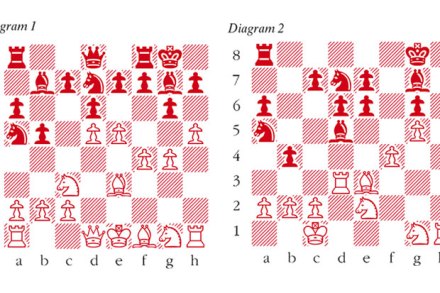
Last week we saw the reigning world champion Magnus Carlsen taking a leaf from Alekhine’s book to destroy eccentric opening play by the Swedish grandmaster Nils Grandelius. This week we see Alekhine himself in action, launching a sacrificial maelstrom which destroys his hapless opponent. Alekhine once wrote, ‘It is especially with respect to the original opening of this game that people often speak of a “hypermodern technique”, a “neo-romantic school” etc. The question is in reality much simpler. Black has given himself over to several eccentricities in the opening which, without the reaction of his opponent, would in the end give him a good game.