Raymond Keene

Coincidence

From our UK edition

My grandmaster colleague James Plaskett has two passions, the pursuit of the mythical giant octopus (ongoing) and a fascination with coincidence. Is the latter just a concatenation of unrelated circumstances, or does it have some deeper meaning, signifying something in the air at a particular time? How, for example, does one explain the virtually simultaneous, yet certainly isolated, discovery of the calculus by Newton in England, Leibnitz in Germany and Kowa Seki in Japan? So Plaskett would, I am sure, be intrigued by the coincidental publication by two quite different publishing houses, of two books, both by American authors, about simplification, liquidation and the exchange of pieces?
No. 380

From our UK edition

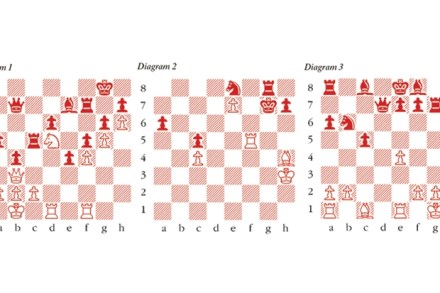
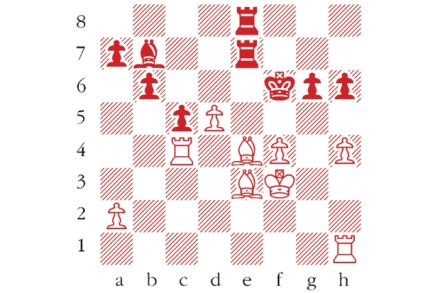
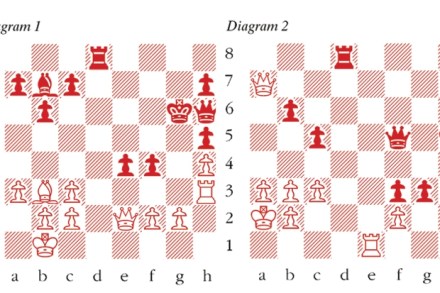
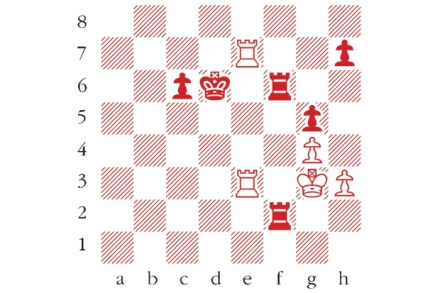
Black to play. This position is from Abramciuc–Nevednichy, Chisinau 2014. How can Black simplify down to a winning endgame? Answers to me at The Spectator by Tuesday 29 September or via email to victoria@spectator.co.uk or by fax on 020 7681 3773. The winner will be the first correct answer out of a hat, and each week there is a prize of £20. Please include a postal address and allow six weeks for prize delivery. Last week’s solution 1 ...

Puzzle no. 379

From our UK edition

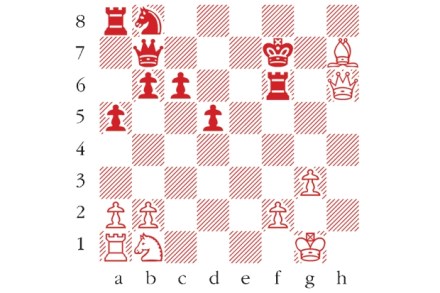
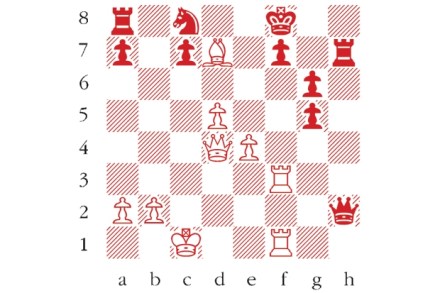
Black to play. This position is a variation from So-Nakamura, St Louis 2015. How can Black conclude the attack with a brilliant coup? Answers to me at The Spectator by Tuesday 22 September or via email to victoria@spectator.co.uk or by fax on 020 7681 3773. The winner will be the first correct answer out of a hat, and each week there is a prize of £20. Please include a postal address and allow six weeks for prize delivery. Last week’s solution 1 ...

Grand Tour

From our UK edition

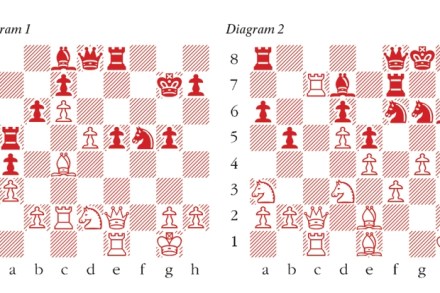
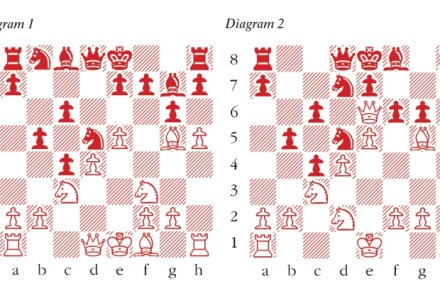
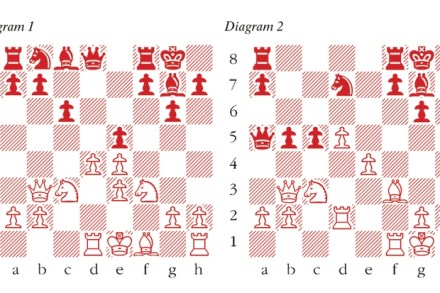
This week I conclude my coverage of the St Louis leg of the million dollar Grand Tour.   Carlsen-So: Sinquefield Cup, St Louis 2015 (see diagram 1)   Although Carlsen is a pawn down here his knight is so much better than Black’s bishop that this small material imbalance is essentially irrelevant. 29 a4 Bd8 30 Rd4 Kf8 31 Rfd1 Rc6 32 Ne3 Bb6 33 Nc4 Bxd4 34 Nxa5 This zwischenzug regains the pawn. 34 ... Qb6 35 Nxc6 Bc5 36 Qd5 e3 37 a5 Qb5 38 Nd8 Ra7 39 Ne6+ Ke8 40 Nd4 Carlsen could have terminated the game more swiftly with 40 Nxc5 Qxc5 41 Qg8+ Kd7 42 Qxh7+ Kc6 43 Qxg6 when the pressure against d6 kills any black counterplay. 40 ...

Checkmate me in St Louis

From our UK edition

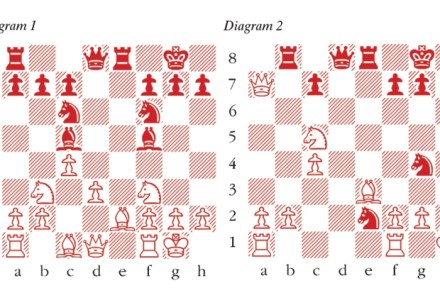
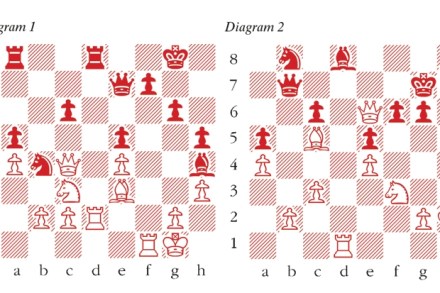
The Sinquefield Cup in St Louis, one of the strongest tournaments of all time, has been convincingly won by the Armenian grandmaster and triple Olympiad gold medallist, Levon Aronian. Unusually for such a high-level tournament, a number of games ended in vicious attacks which resulted either in checkmate or decisive material gain. To start with, here is Aronian demolishing the world no. six.   Aronian-Caruana: Sinquefield Cup, St Louis 2015 (see diagram 1)   The black king has become badly exposed and Aronian now sacrifices material to relocate his pieces in that sector. 25 Ne4 Nd4 26 Qh5 Nxc2 27 Nxg5 Bf5 28 Rf1 Qf6 The key point is that 28 ... Bg6 29 Rf7+ mates quickly.

Puzzle no. 378

From our UK edition

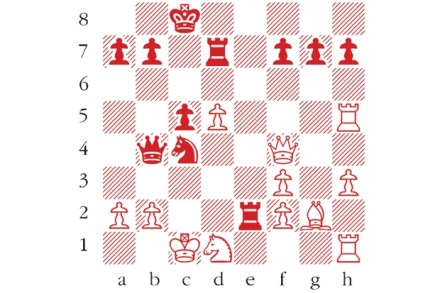
Black to play. This position is a variation from So-Aronian, St Louis 2015. How can Black conclude the attack? Answers to me at The Spectator by Tuesday 15 September or via email to victoria@spectator.co.uk or by fax on 020 7681 3773. The winner will be the first correct answer out of a hat, and each week there is a prize of £20. Please include a postal address and allow six weeks for prize delivery. Last week’s solution 1 ...

BĂȘte noire

From our UK edition

England’s top grandmaster, Michael Adams, exerts a powerful influence over the elite player David Navara. In rating terms Navara and Adams are about equal, but in practice Adams has a 4-0 record against his Czech opponent.   Navara-Adams: Biel 2015; Queen’s Gambit Declined   1 c4 e6 2 Nc3 d5 3 d4 Nf6 4 cxd5 exd5 5 Bg5 The well-known Exchange Variation of the Queen’s Gambit Declined. White has a number of strategies in view, one being an advance of the queenside pawns, as favoured by Petrosian. The alternative is to advance in the centre with f3 and eventually e4, as espoused by Botvinnik. Kasparov has even been known to inject a new element by castling queenside for White. 5 ... c6 5 ...

No. 377

From our UK edition

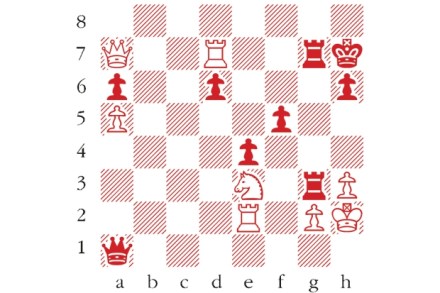
Black to play. This position is a variation from Maslak-Smerdon, Pardubice 2007. Black has powered through on the kingside. How can he finish off? Answers to me at The Spectator by Tuesday 8 September or via email to victoria@spectator.co.uk or by fax on 020 7681 3773. The winner will be the first correct answer out of a hat, and each week there is a prize of £20. Please include a postal address and allow six weeks for prize delivery. Last week’s solution 1 ...

Piratical

From our UK edition

I have never met David Smerdon, the Australian grandmaster and author of Smerdon’s Scandinavian (Everyman Chess). Last week I gave a ringing endorsement of his new book and I must say that in my mind’s eye I visualise him as some swashbuckling buccaneer of the chessboard, complete with eyepatch, wooden leg, tricorn hat and probably a parrot. Under Fidé’s regulations this dress code would probably have him thrown out of any tournament, so I am sure that the real-life Smerdon is far more unobtrusive. Here, though, is a further example of the freebooting style which characterises Smerdon’s new publication.   Moylan-Smerdon; Sydney 2003; Scandinavian Defence   1 e4 d5 2 exd5 Nf6 3 d4 Bg4 4 Be2 Bxe2 5 Qxe2 Qxd5 6 Nf3 e6 7 0-0 Be7 7 ...

No. 376

From our UK edition

Black to play. This position is a variation from variation from Maslak-Smerdon, Pardubice 2007. Black has powered through on the kingside. How can he finish off? Answers to me at The Spectator by Tuesday 1 September or via email to victoria@spectator.co.uk or by fax on 020 7681 3773. The winner will be the first correct answer out of a hat, and each week there is a prize of £20. Please include a postal address and allow six weeks for prize delivery. Last week’s solution 1 ...

Viking trail

From our UK edition

The Australian grandmaster David Smerdon has written a truly exciting book about some of the byways in the Centre Counter or Scandinavian Defence. The old main lines started 1 e4 d5 exd5 Qxd5 3 Nc3 and generally condemned Black to a long defence. The apparent activity of the black queen tended to be outweighed by White’s lead in development and the fact that the queen itself, more often than not, degenerated into a target rather than a great and mobile force.   Smerdon is quite candid about the dangers which his advocated move of 2 ... Nf6 would entail. But the variations are dramatic, it represents a one-stop shop as a black defence against 1 e4, and in spite of heavily computerised analysis, the tactics never conclusively work out in White’s favour.

No. 375

From our UK edition

Black to play. This position is from Kosmo-Smerdon, Goa 2002. Can you spot Black’s beautiful winning move? Answers to me at The Spectator by Tuesday 25 August or via email to victoria@spectator.co.uk or by fax on 020 7681 3773. The winner will be the first correct answer out of a hat, and each week there is a prize of £20. Please include a postal address and allow six weeks for prize delivery.

Buried treasure | 13 August 2015

From our UK edition

Jonathan Hawkins has emerged as the winner of this year’s British Championship, which finished last week at the University of Warwick in Coventry. Several players were in contention for the laurels as they entered the final round, but Hawkins’s rivals could only draw, and his win clinched the title. In the past there was a clearly defined cursus honorum for aspiring players. Win the national championship, and the odds were that you would be selected for the World Championship zonal tournament. If you qualified from that stage to the interzonal then the path was clear, if you were successful, to proceed to the Candidates tournament for the world title. Nowadays, with variegated World Chess Federation qualifying routes, the climb to the top has become more opaque.

No. 374

From our UK edition

Black to play. This is a variation from Osborne-Hawkins, British Championship, Coventry 2015. Black is a piece down. What is his idea? Answers to me at The Spectator by Tuesday 18 August or via email to victoria@spectator.co.uk or by fax on 020 7681 3773. The winner will be the first correct answer out of a hat, and each week there is a prize of £20. Please include a postal address and allow six weeks for prize delivery.

1 Samuel 18:7

From our UK edition

David Howell is on a roll. At the halfway stage of the British Championship he looks set to retain his title, and he has shot to no. 2 in the British rankings, behind Michael Adams. His recent successes include a share of first prize in the Dubai Open and a stunning outright first in the tournament at Leiden, with the colossal score of 8½/9. Howell’s games are not only producing effective results but are beginning to display those signs of luminosity which characterise the creative efforts of the great masters. This week’s game is a case in point.

No. 373

From our UK edition

White to play. This is a variation from Williams-Howell, British Championship, Warwick 2015. Howell won this game but the puzzle shows what might have happened if he had gone wrong. How can White regain his material to achieve a winning position? Answers to me at The Spectator by Tuesday 11 August or via email to victoria@spectator.co.uk. The winner will be the first correct answer out of a hat, and each week there is a prize of £20. Please include a postal address.

Stormy Petroff

From our UK edition

Alexander Petroff (1794-1867) is often remembered as the first great Russian chess master. He became the strongest player in Russia at the age of 15 and produced the first chess book in Russian. His main legacy, however, is the Petroff Defence (1 e4 e5 2 Nf3 Nf6), an opening which has been seen consistently at the highest level ever since he invented it. A new book, The Petroff Move by Move (Everyman Chess) by Cyrus Lakdawala, explores this opening in great detail. Due to the potentially symmetrical nature of the positions that can arise, the Petroff has an undeserved reputation as an unadventurous opening. The following dramatic encounter shows that this is far from the truth.

No. 372

From our UK edition

White to play. This position is from Howell-Sokolov, Staunton Memorial 2009. How can White finish off his attack with a fine flourish? Answers to me at The Spectator by Tuesday 4 August or via email to victoria@spectator.co.uk or by fax on 020 7681 3773. The winner will be the first correct answer out of a hat, and each week there is a prize of £20. Please include a postal address and allow six weeks for prize delivery. Last week’s solution 1 ...

Arachnid

From our UK edition

Sadly, Michael Adams, for many years Britain’s leading grandmaster, will not be playing in the British Championship, which starts next week. Michael is often referred to as ‘Spidey’ because of the way he spins a web to ensnare his opponents. The most spidery player ever was Anatoly Karpov, world champion from 1975, when he beat Bobby Fischer by default, to 1985, when the young genius Garry Kasparov took over. A new book by international master Sam Collins, in the well-known Everyman Move by Move teaching format, brings out these refined qualities in Karpov’s play and shows how he was able to reduce even the most formidable opposition to utter helplessness. Notes to the following game are based on those in the book.

No. 371

From our UK edition

Black to play. This is from Williams-Hawkins, -British Championship 2014. How can Black finish off his attack with a fine flourish? Answers to me at The Spectator by Tuesday 28 July or via email to victoria@spectator.co.uk or by fax on 020 7681 3773. The winner will be the first correct answer out of a hat, and each week there is a prize of £20. Please include a postal address and allow six weeks for prize delivery. Last week’s solution 1 ...