Peter Hoskin

The joys of DIY government

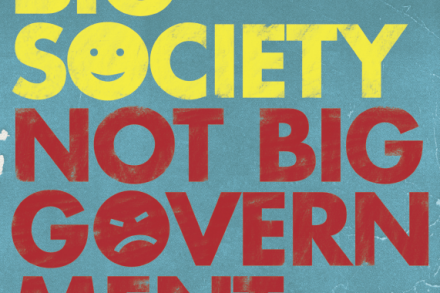
One of the main problems with the Tories' Big Society/post-bureaucratic/responsibility agenda is how to sell it to the public. At the moment, it all sounds a bit too metropolitan, a bit too vanilla latte, a bit too wonkish. How do you better convey the often solid thinking that lies behind the management consultancy speak? Well, I think Grant Shapps has just given it a good go. He described the warm feeling that he gets from DIY work – from, say, putting up his own shelves – and then expanded this to wider society. Imagine being the person who helped rejuvenate a post office, or who set up a school, or who runs the local library. It's DIY government, so to speak. The analogy also highlights some of the problems with this whole idea, though.

Hammond’s honesty

Philip Hammond gave the first presentation at this Big Society event, and he admitted something that the Tories don't admit too often.  First, he attacked Gordon Brown for doubling the national debt. And then he added that, "unfortunately, we're on a trajectory where the national debt will double again over the next few years." Hammond's right to highlight this. The danger for a Tory government is that their attacks on Brown in 2010 could look hypocritical in 2015, when they would have presided over rising debt as well. The key thing is to pin the blame for this situation on Brown, and ask whether he can be trusted to keep it under some sort of control.

The speed of schools reform

Michael Gove is always worth listening to when he speaks on schools reform – offering passionate rhetoric supported by detailed policy. But this morning he excelled himself. If you want a clear sense of what the Tories have in mind for making "opportunity more equal," then I'd recommend you track down a copy of his presentation. I'll try to link to it, if it appears online later. One point that jumped out at me was when Gove said a Tory government would introduce a bill "within days" of entering power, aimed at "making it harder for bureaucracies to block the creation of new schools".  He added that he'd hope to get this signed off before Parliament breaks up for the summer.

Take that, Tony

Yesterday, David Cameron offered a punchy response to Tony Blair's return to the frontline of British politics, saying: “It's nice to see him make a speech he's not being paid for”. But I reckon the more stinging rebuke might come today. Nestled in the schedule at today's Tory 'Big Society' event are two video messages from a couple of the most prominent independent political figures of the Blair era. The first is Anthony Seldon, the reform-minded headmaster of Wellington College, who has written numerous books on Blair, and who has recently done some eyecatching work on the big subject of Trust. And the second is Ray Mallon, the zero-tolerance elected mayor of Middlesbrough, who has been working to help communities and local groups act against youth crime.

Tomorrow is a Big Day for the Tories

Tomorrow's Word of the Day is 'Big'.  That is to say: the Tories are holding a Big Event, on the theme of the Big Society, and they've got all their Big Hitters out for the occasion.  In all, there'll be presentations from eleven shadow Cabinet members, followed by a speech from David Cameron.  You don't often see such a concentration of Tory firepower outside of conference season. What's clear, then, is that the Tories regard tomorrow as an important day for their election campaign.  And so they should.  Their Big Society agenda – aka, decentralisation – spans across some of their most encouraging policy ideas.

Guess who’s back

Yep, you guessed right: Tony Blair was doing his bit for the Labour cause this morning, with a speech in his old constituency.  In truth, there was little in it of any note – or that we haven't heard countless times from his successor.  Thus the Tories were derided as either the "old Tory party," or as confused about their direction of travel.  Gordon Brown and Alistair Darling were hailed as the men who brought us through the worst of the economic storm.  And even the soundbites ("meeting not just future challenges, but seizing future opportunities") sounded as if they had come from straight from the Brownite copybook.

Labour have moved on from the death tax for now – and so should the Tories

Labour's plans for a national care service aren't looking too sharp this morning.  Andy Burnham is expected to announce a cap on residential costs for the elderly later today – to be funded by freezing inheritance tax bands, raising the statutory retirement age, and (lo!) efficiency savings.  But the full, free-for-everyone-at-the-point-of-use service will have to wait some time – or at least until a new independent commission has decided on how it can be funded in the long-term.  In other words, the government has decided to park the death tax issue until well after the election. Presentationally speaking, this is proving difficult for the government.

Tory poll lead widens further

I'll spare you the nitty-gritty, but suffice to say that three separate polls tonight record growing leads for the Tories – of 7, 7 and 10 points, respectively.  One of the 7-point leads is from the YouGov Daily Tracker, which has been hovering around the 4 point mark for the past few weeks.  You could argue that we're still operating more or less within the margin of error.  That's true.  But throw in the polls from the weekend, and you'd be hard-pressed not to conclude that the tide is turning, at least momentarily, in Cameron & Co.'s favour.  Either way, Tory folk around Westminster certainly seem more relaxed than they have been for months.

Few fireworks – but solid performances from Cable and Osborne<br />

So now we know what happens when you put three would-be finance ministers into a room, and start asking them questions.  There's plenty of esoteric language, a good dash of posturing – and next to no fireworks.  Thinking about it, perhaps we shouldn't have expected much else. Not that the pyrotechnics were completely absent, of course.  Both Cable and Darling rounded on Osborne over the Tories' national insurance plans, and Osborne hit back with some well-directed attacks on Labour's own tax and spend agenda – even getting Darling to waver and admit that a "death tax" is no longer on the cards.   But, for the most part, calm and civility ruled the day.  I lost count of how many times the participants said "I agree with...

Chancellor’s debate: live blog

2057, PH: We'll sign off for now. I'll be back with a summary post shortly. 2057, JF: Osborne gets his closing statement just right, sounding humble and emphasising this is the voter's choice. I expect Osborne will be very satsified with his night's work. 2055, PH: And Osborne has the closing word.  He's not quite as direct as Cable - saying that the Lib Dems won't be in government, and that the Tories have "shown, under the leadership of David Cameron" that they've got what it takes - but its a neat enough closer. 2054. PH: Punchy stuff from Cable, who says that you can't trust Labour because they got us into this mess - and that you can't trust the Tories because they presided over recessions in the past.

A smart move by Osborne – but he needs to ready himself for his opponents’ attacks

There's little doubting it: the Tory plan to (at least partially) reverse Labour's national insurance hike has handed George Osborne a high-calibre weapon for tonight's TV debate.  It is, I suspect, an attractive and attention-grapping policy in itself.  But it also helps the shadow Chancellor paint the Tories as the party of aspiration.  Or, as Tim Montgomerie has put it: "Seven out of ten working people will be better off if Cameron becomes Prime Minister." But announcing the policy this morning has also given Alistair Darling and Vince Cable a chance to very publicly denounce it later today.  We've already had a preview of what's likely to form the central thrust of Darling's counterattack, courtesy of Patrick McFadden on GMTV earlier.

Confirmed: Tories to “block” Labour’s planned national insurance hike 

We'll have more details tomorrow but, for now, Tim Montgomerie has the lowdown.  As I said a few days ago, this is a smart move from the Tories, and gives them a good message to deploy on the doorsteps.  Indeed, Tim has already drafted it for them: "Seven out of ten working people will be better off if Cameron becomes Prime Minister." UPDATE: The Telegraph has more information here.  Looks as though the Tories might keep the rise for those above a certain income (the Telegraph speculates £37,400).  Either way, we'll know for sure tomorrow morning.

Osborne must ask: why trust the party which ran up the credit card bill in the first place?

Public sector net borrowing, public sector net debt, total managed expenditure, departmental expenditure limits ... zzzzz.  One of the main reasons why Labour has been able to fashion an economic narrative, against all odds, is because they can rely on some pretty esoteric language.  Thus debt becomes interchangeable with deficit, and cuts can be hidden under layers and layers of different spending metrics.  Perhaps more than anything, this almost-casual deception is Brown's greatest skill. Which is why it's encouraging that the Tories have tried to demystify some of the fiscal debate, putting it into language that everyone can follow.  They've set out their "more for less" argument by referring to the practices of supermarkets.

Three Sunday polls have growing Tory leads

We're operating in or around the margin of error here, so we can't be certain whether this is truly the result of the Budget – but it's still striking that three polls in tomorrow's papers have growing Tory leads.  The ICM poll for the News of the World has the Tories up one to 39 percent, Labour down one to 31, and the Lib Dems on 19.   YouGov's daily tracker has the the Tories unchanged on 37 percent, Labour down one to 32, and the Lib Dems on 19.  And Anthony Wells is reporting a BPIX poll for the Mail on Sunday, which has the Tories on 37 percent, and Labour on 30 percent.  So that's Tory leads of 8 points, 5 points and 7 points, respectively.  Enough to calm a few Tory nerves.

How Brown would get Darling out of the Treasury

After reading Brown's claims in the Guardian today, this Kill A Minister mechanism in his speech today rather jumped out at me: "I will set out a clear and public annual contract for each new Cabinet Minister, detailing what I expect them and their department to deliver to the British people, and that their continued appointment is dependent on their delivery just as it would be in a business or any other organisation." I mean, you can just imagine what Alistair Darling's first "contract" would look like: You, the Chancellor, will undertake to deliver the following to the British people: i) Economic growth of 5 percent in 2010-11 ii) A sufficient level of investment in our schools, hospitals and families, to be determined by Number 10.

Will anyone take any notice of Labour’s five pledges?

So the Labour pledge card is back – and, this time, it's a good deal more nebulous than in 1997 or 2001, but quite similar to 2005.*  Here are the themes that Brown & Co. will be campaigning on: i) Secure our recovery ii) Raise family living standards iii) Build a high tech economy iv) Protect frontline services v) Strengthen fairness in communities There's another key difference with previous elections too: one of trust.  Sure, voters have always been reluctant to take politicians' promises and exhortations at face value.  But it's a safe bet that they're even more sceptical and uninterested this time around. *Although, as Alastair Campbell points out, there is more detail on the back of the card – but a bit too much to be immediately memorable.

What did Darling mean by his “deeper and tougher” cuts claim?

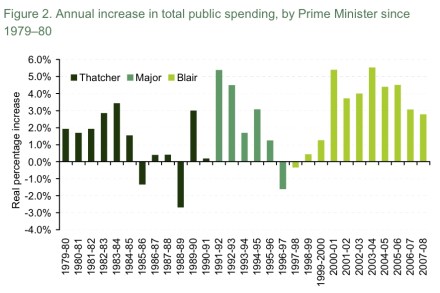
There's been some hubbub on the good ol' blogosphere about Darling's claim that Labour spending cuts would be "deeper and tougher" than Thatcher's.  Did Thatcher actually cut spending?  What would that indicatate about Labour's plans?  And so on. Part of the confusion is caused by the different metrics that are referred to as "spending".  So here's a quick guide to what Darling might have had in mind: OPTION 1: Real-terms total spending.  As the below graph from the IFS shows (taken from this excellent blogpost by the FT's Alex Barker), real-terms total public spending only fell in two years of the Thatcher premiership.  In all the other years it rose.  Indeed, spending increased by an average of 1.

The two sides of Alistair Darling

After delivering an insipid, insufficient Budget yesterday, Alistair Darling has now smuggled a little bit of honesty into the fiscal debate.  In interview with Nick Robinson, he has claimed that if Labour is re-elected its spending cuts "will be deeper and tougher" than Thatcher's.  Needless to say, that's a message which will not sit well with his Cabinet colleagues like Ed "investment vs cuts" Balls. And this is precisely why Darling is such a confusing figure.  Yes, he deserves some praise for being more upfront about the public finances than his predecessor ever could be, and for restricting the wilder excesses of Brown and Balls.  But it's hard to forget that he, as Chancellor, hasn't delivered a spending review when we need one most.

How to foil a Dispatches sting

The producer and director behind the Dispatches lobbying sting, Philip Clothier, has a snappy article over at Prospect, in which he basically asks the question: how could MPs have been so stupid?  But it's his suggestion that some former ministers may have got off lightly which really caught my eye: "Meanwhile, one former Labour cabinet minister was interviewed, but the sound was so poor that we could only hear appetising phrases. He had the good fortune to be sitting in front of a brightly lit window, over-exposing the shot. And we just couldn't understand much of what another former minister said because of his thick accent." Cue all MPs adopting impenetrable accents, and sitting in front of windows, from now on.

A glass of clear, blue water?

One of the most eye-catching stories this morning comes courtesy of ConservativeHome: "As part of the pre-election package, ConservativeHome expects Mr Osborne to announce that a Tory government will cancel Labour's National Insurance tax rise. The Tories will announce an alternative way of plugging the hole. Earlier this week Policy Exchange argued that the NI rise was a very damaging way of raising extra revenue." Sure, Cameron has hinted at this before, and there will be questions about how the Tories would fill the fiscal gap.  But that doesn't make this anything less of a smart move.  Not only does it makes sense economically, but it would give the Tories a clear, positive message to deploy on the doorstep.  I'd be astonished if Team Osborne didn't move on it.