Peter Hoskin

An escalation | 8 January 2009

From our UK edition

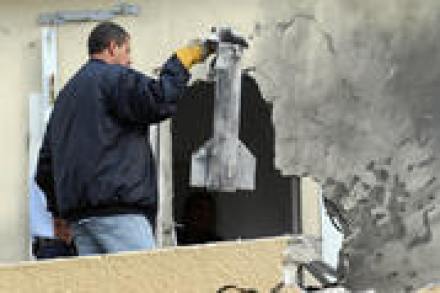
A dangerous escalation of the Middle Eastern conflict this morning, as rockets are fired into northern Israel from Lebanon.  As far as I can tell, no group has yet claimed responsibility for the attacks - although suspicion has to fall on Hezbollah.  The fear now is that this represents the opening of another sustained front in the current conflict.  And the key question is of how Israel will respond. Any response will partly be a function of scope and ambition.  Does the Israeli administration feel it's already dealt enough damage to Hamas in Gaza?  Does it want to spend more time to effectively wipe out Hamas?  Or does it want to tackle other terrorist groups, such as Hezbollah, as well?

The latest round of “do nothing” jibes

From our UK edition

Gordon Brown's interview with Sky earlier today is significant insofar as it represents the latest front in his war of words with the Tories.  Our PM's central claim was that the key dividing line between him and the Cameroons is over unemployment; with - suprise, suprise - Labour wanting to "help people get back into work," and the Tories happy to "do nothing". It's highly disingenuous, of course, but it does highlight one of those areas where Brown's at a particular advantage by being in power.  By "bringing forward" this or that spending project he can misleadingly claim to have created 1,000s of new jobs with a flick of his world-saving wand.

The problem with blaming the world

From our UK edition

Alistair Darling goes into full "blame the world" mode in his interview with the FT today - saying that international coordination will be "crucial" to get credit flowing through the financial system and to help our economy recover from the recession.  As Iain Dale noted, similar claims littered Gordon Brown's weekend interviews; so we're seeing something of a new Labour spin line - or at least one that's been reheated since last October.

Spelman in the clear

From our UK edition

Team Cameron will be delighted with the news that Caroline Spelman is to be cleared of any wrongdoing over the 'Nannygate' affair – the Tories can well do without any "sleaze" accusataions being fired in their direction –  and the expectation now is that she'll be kept in the shadow cabinet, although not necessarily as party chairman.  To my mind, Cameron would be best-advised to move her to an alternative brief.  Although it may have been partially down to the allegations hanging over her, Spelman has been a near-invisible figure over the past year-and-a-half.

Tories on tour

From our UK edition

One of the charges most frequently levelled at the Tory shadow cabinet is that their commitment to the cause isn't quite great enough; that they lack the same out-of-power-obsessiveness that drove New Labour between 1994 and 1997.  Revelations about second jobs and the like have often made this argument quite persuasive.  But Tory supporters can take heart today from the fact that most of the shadow cabinet is spread across the country, making the case for their party's economic approach. As Tim Montgomerie points out, this caps what has been - bar one or two caveats - an effective Tory performance over the Christmas and New Year break.

Targeting Iran

From our UK edition

I missed Robert Kaplan's latest dispatch yesterday, but this passage is still worth flagging up: "How do you fight unconventional, sub-state armies empowered by ideas? You undermine them subtly over time, or you crush them utterly, brutally. Israel, unable to tolerate continued rocket attacks on its people, has decided on the latter course. Our own diplomacy with Iran now rests on whether or not Israel succeeds. We need to create leverage before we can negotiate with the clerical regime, and that leverage can only come from an Israeli moral victory—one that leaves Hamas sufficiently reeling to scare even the pro-Iranian Syrians from coming to its aid. In defense of its own territorial integrity, Israel has, in effect, launched the war on the Iranian empire that President George W.

A relationship on the wane?

From our UK edition

A typically insightful piece by Rachel Sylvester today; this time on the Obama administration's precarious commitment to the "special relationship".  The key revelation is about a report doing the rounds among British defence and diplomatic officials: "Perhaps most important of all, the military alliance between Britain and America - which has cemented the political alliance since the First World War - is beginning to crack. I am told that a report circulating at the highest level in the Ministry of Defence concludes that there are now serious doubts in Washington about the effectiveness of the British Armed Forces. Senior military figures are said to have been surprised, and shocked, by feedback that arrived in Whitehall last month.

Claiming the future

From our UK edition

I wrote yesterday that the race is on between Brown and Cameron to appear the best to lead us through the post-recessionary landscape.  That race became even more competitive today, with both Brown and Cameron serving up their "optimistic" visions for the future.  Our Dear Leader's came in a speech to the Regional Economic Council, which was packed with nods to a "prosperous future" and to "investment in the future".  Whilst Cameron's came in the press conference that Fraser blogged about earlier, during which there was much ado about "increased productivity," "more efficiency," and "greener technology".

Slower to demonise, faster to fix

From our UK edition

Although I agree with the ultimate conclusion of Yasmin Alibhai-Brown's column today - that we shouldn't, as a nation, "blame the outsider," and that we should work towards greater integration - the tirade she launches before it is astonishing, and not in a good sense: "A new government report finds that [the white, working classes] feel "betrayed" and abandoned. Ruined by "ethnic minorities" they cry into their antimacassars and threaten to vote for fascists. The British working classes include people of every shade. But only white grievances matter. Nobody seeks to find out what life is like for the incomers living in the fog of nativist bitterness.

Brown smiles for the camera

From our UK edition

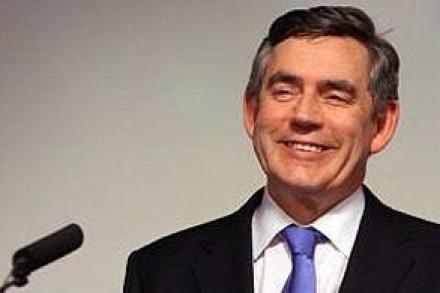
Optimism, optimism, optimism.  That's the line that Gordon Brown pushes in his interview with the Observer today.  He quotes Barack Obama; says he's going to create jobs the Roosevelt way; claims that British goods are "the products the world will want to buy"; and seems dismissive of any black clouds on the horizon, as in this (quite worrying) passage: "[Brown] mocks the Observer for being too pessimistic in our questions: 'Can we afford this, can we afford that'! I'm more optimistic about our ability to be a successful economy creating large amounts of wealth in the future.'" The politics of all this optimism is fairly clear.

This is the end

From our UK edition

Thanks to David Brooks's Sidney Awards, I've just caught up with Michael Lewis's article 'The End', which appeared in Portfolio magazine last month.  It's one of the most incisive and exhaustive pieces on the credit crunch that I've read so far - exactly what you'd expect from the man who wrote the supremely readable account of 1980s Wall Street life, Liar's Poker - and I'd recommend it to all CoffeeHousers.  As with most of these accounts, it's stuffed with debt-bubble anecdotes which still have the capacity to astonish.  This one, concerning pre-crunch mortgage-lending, jumped out at me: "In Bakersfield, California, a Mexican strawberry picker with an income of $14,000 and no English was lent every penny he needed to buy a house for $720,000.

A second bailout?

From our UK edition

So there we have it.  The first substantial rumblings that Alistair Darling's going to sanction a second banking bailout, after the first one didn't free up credit as intended.  According to the Times, the Chancellor will "decide within weeks" whether to pump £billions more into the sector.  One option being considered is the creation of a "bad bank"; by which the state would take over bad loans from the banks, thereby detoxifying the main banking system.  It was an attractive idea when Hank Paulson first suggested it in the US, but would practice match the theory with Brown at the helm? Should a second bailout be necessary, the Government will spin it as proof that they're doing "everything it takes".

Here’s to a transparent 2009

From our UK edition

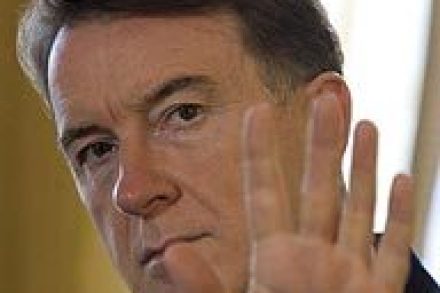
What's this?  Yet another delay to the publication of ministers' private interests?  Yep, and this time it's because some of the "new minsters" introduced during the last reshuffle have - according to the Times's source - "required quite a bit of investigation".  The Times adds 2 + 2 together and comes up with Peter Mandelson; who's "declared the bare minimum in a voluntary entry to the Lords Register of Interests." Sure, it's easy to speculate over this kind of thing; especially with the prompt that Mandelson hasn't yet clarified his "links to Oleg Deripaska".  But even if the situation's completely innocent, it's still rather disspiriting.

The Tories’ message for 2009

From our UK edition

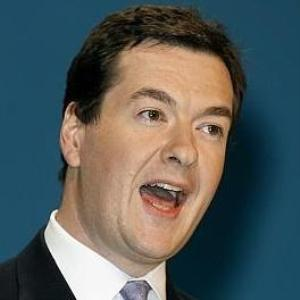
Over at Conservative Home, Jonathan Isaby flags up George Osborne's response to some of today's gloomy economic and financial indicators.  Here are the shadow chancellor's words: "First we discovered that there were fewer shoppers in December despite the VAT cut, now we discover house prices are falling sharply and mortgage approvals at a record low despite the stamp duty holiday introduced three months ago. The new year shows that Gordon Brown’s policies are not working and the recession is getting worse not better. That is because an economic recovery depends on confidence in the future, and people do not have that confidence while we have a Labour Government in power bankrupting the country.

Has the death knell sounded for the Euro?

From our UK edition

Peter Oborne makes a bold prediction in today's Mail: that the Euro - ten years old yesterday - won't live to see its twentieth anniversary.  Whether or not you agree with that prognosis, Oborne's case is compelling: "Indeed, far from being the staggering success its supporters claim, the euro-zone is already inflicting huge damage on the nations within it. Many currency market experts believe that some of these struggling members may be forced to peel away from the euro - with devastating consequences for the rest of the world. The greatest problems, in the short term at least, are in the four Mediterranean economies known as the PIGS - Portugal, Italy, Greece and Spain. For each of these countries, the euro has already proved a disaster.

The race to recovery in 2009

From our UK edition

Among the things to look out for in 2009 is whether - and when - our economy starts to recover.  Thanks to Alistair Darling's optimistic prognoses in the Pre-Budget Report, there's already plenty of room for embarrassment for the Government over this.  Their growth forecast for 2009 (of between -0.75 and -1.25 percent of GDP) is out of whack with the forecasts of almost every other major analyst (which averaged -1.7 percent in December).  And the idea that the economy will start recovering by the third-quarter of 2009 has also been widely scoffed at. Accordingly, then, Brown is already making noises that the Treasury forecasts will have to be readjusted.  But, even so, the open goals will remain for the Tories to exploit.

The cost of the downturn

From our UK edition

A useful piece of research in today's Mail: "The financial crisis has slashed an average of £60,000 from each family's wealth over the past year, it has been claimed. Sliding equity prices and dramatic falls in property values have shaved more than 18 per cent off savings and assets, according to estimates by Capital Economics. That is the equivalent of an average £60,000 fall in the wealth of every household in the country and adds up to £1.5trillion. The 2008 plunge exceeds an entire year of British economic output." Such numbers could prove politicaly costly for Labour, too.

The defeat of Hamas is a humanitarian cause

From our UK edition

There's very little to add on the situation in Gaza that hasn't already been said by James and Daniel, both today and yesterday. Although I would like to remind CoffeeHousers of the post I wrote earlier this year from the Israeli town of Sderot - you can read it here.  For those who haven't heard the name before, Sderot sits near the Israel-Gaza border and is under frequent rocket attack by Hamas.  Its citizens live under a constant pall of fear and helplessness; something that was brought into sharp focus for me when I witnessed the immediate aftermath of one of Hamas's random barrages. Of course, the situation's horrible inside Gaza too, and its residents are most likely just as fearful.

The year of Balls?

From our UK edition

Iain Dale's ten predictions for 2009 are well worth a read.  One, in particular, jumped out at me: namely, Iain's suggestion that "Ed Balls will be Chancellor by the end of the year". Now, I think that's an unlikely scenario; especially given that a change of Chancellor (or Shadow Chancellor) is often taken as an admission that a party hasn't got its economic message right. But, to be fair, stranger things have happened recently, and there's always the chance that Brown will try to make Darling a scapegoat as the real economy nosedives even further. Many of the Tories I've spoken with recently would be delighted with a Chancellor Balls.  For one, they think Balls' ascension would provoke a fair amount of disgruntlement among Labour ranks.

What you can get for $100 billion

From our UK edition

We all know about the damage the credit crunch has wreaked on financial institutions, but this anecdote in Anatole Kaletsky's column today is still pretty astonishing: "An even more spectacular case came to my attention in an e-mail I received in mid-November, when global stock markets hit their low-point (so far). Royal Bank of Scotland, my reader pointed out, spent $100 billion to buy ABN Amro, the second-biggest bank in the Netherlands, in October 2007. If only the directors of RBS had been a bit more patient, this is what they could have bought for the same $100 billion a year later: Citibank ($22 billion) plus Goldman Sachs ($21 billion) plus Merrill Lynch ($12 billion) plus Morgan Stanley ($11 billion) plus Deutsche Bank ($13 billion) plus Barclays ($13 billion).