Peter Hoskin

Setting a timetable for reprivatisation

From our UK edition

Niall Ferguson's article in today's FT may concentrate on the case of US banks, but it contains much food for thought for UK policymakers.  Here are a few key paragraphs: "The US could end up running a deficit of more than 10 per cent of gross domestic product this year (adding the cost of the stimulus package to the Congressional Budget Office’s optimistic 8.3 per cent forecast). Today’s born-again Keynesians seem to have forgotten that their prescription of a deficit-financed fiscal stimulus stood the best chance of working in a more or less closed economy. But this is a globalised world, where unco-ordinated profligacy by national governments is more likely to generate bond market and currency market volatility than a return to growth.

A vanguard for the Tories’ waste-cutting message

From our UK edition

What with the snow, it's been a testing couple of days for Transport for London.  But the interview with the organisation's head, Peter Hendy, in today's Standard paints a encouraging picture.  I was particularly struck by this passage: "It doesn't help either that TfL, which employs 28,000 people, has just announced swingeing job cuts of up to 1,800 staff. 'People have said it's because of the recession but these cuts have nothing to do with the credit crunch,' [Hendy] says. 'In fact, the latest figures show that journeys taken on the Tube and bus are up one per cent and three per cent respectively on the previous year.

Mind the pay gap

From our UK edition

Given the worries that many in the private sector have over both their financial and job security, the 'pay gap' figures highlighted by Francis Maude could well provoke a bit of anger.  Here's how the Mail reports them: State workers now earn an average £62 a week more than their private sector counterparts  -  a 50 per cent increase in the differential since 2004. ... It comes at a time when public sector employment is rising while private workers are losing their jobs at a rate of more than 1,000 a day. ... In 2004, estimated median public sector earnings  -  those in the middle range of pay  -  were £452 a week, figures from the Office for National Statistics show.

Snow: the last thing Gordon wanted?

From our UK edition

Right, I've been determined to avoid posting about the snow, but this FT article is just too eye-catching to go unnoted.  It reports that today's snowfall, and the increased absenteeism it's precipitated, has cost the economy around £1 billion.  Hardly ideal during a recession, and things could get worse.  Here's a quote from Stephen Alambritis of the Federation of Small Businesses: "If this goes on for a few days or even a week that could sink into the recession and make it longer than it would have been. This has knocked back the spring feel good factor, which we hoped would kick start the economy." For once, Brown may be in luck.  The Met Office's severe weather warnings don't last beyond tomorrow...

Osborne banks on “debt responsibility”

From our UK edition

Competent performance from George Osborne just now, setting out the Tories' "new banking settlement" by which - among other things - the Bank of England would have greater powers to "call time on excessive debt".  It sounds promising enough.  But, as usual with regulatory systems, the proof of this particular pudding will come with the eating.  Only a Tory government will let us know how it works in practice. Aside from that, Osborne dwelt on the familiar touchstones - welfare reform, schools reform, an Office for Budget Responsibility etc.  Although it seems to me that the Tories are now taking greater pains to set out just how difficult things will remain for the next government.

Clarke on competitiveness

From our UK edition

So here I am at a conference put on today by my former colleagues at Reform.  It's all about 'A new economic agenda', and the speakers include George Osborne, Vince Cable, John McFall, Tony McNulty and Will Hutton.  First, though, Ken Clarke, who's just delivered a 15-minute address on competitiveness.  It demonstrated, perfectly, why Cameron's brought the Big Beast back.  He seems to have an easy understanding of the issues; gets his points across in simple, lingo-free English; and - rare for a politician - he raises a few laughs too. Two passages worth pulling out from Clarke's address. The first on Sterling: "Rapid movements in exchange rates are always disastrous ... There are upsides but, on this occasion, we've got most of the downside.

Does Balls have Mandelson’s backing?

From our UK edition

With Brown on the ropes, the battle to become Labour's next (post-election) leader is in full swing.  And, according to Patrick Hennessy's article in the Sunday Telegraph, it could be throwing up some odd alliances.  Here's how Hennessy describes the recent tussle over Heathrow: "Objecting to the third runway is a handy way of appealing to Labour's left, who will be important in any contest. Mr Miliband came up against his former brother-in-arms Mr Balls. The Schools Secretary, who had no departmental interest in Heathrow, used the same meeting for a brutal assault on Mr Miliband's stance. It was a telling moment. Mr Balls, 41, did so knowing he had the support of Lord Mandelson.

A roadblock to even more debt?

From our UK edition

A snippet from the Times report on Brown's "building programme" for council houses: Mr Brown has the support of Margaret Beckett, the Housing Minister, in pushing through new regulations, according to government sources, but Alistair Darling, the Chancellor, is said to be resisting proposals that could add billions of pounds to public debt. If you remember, there were numerous reports of tension between PM and Chancellor over debt 'round PBR time.  Of course, nothing may come of it - and it certainly hasn't done much to restrain our eye-watering levels of public debt - but the idea that Darling is in some way a roadblock to Brown's plans will surely fuel the 'Cable for Chancellor' speculation.

Olympic tax burden to skyrocket?

From our UK edition

In an interview in today's Independent, John Armitage, the chairman of the Olympic Delivery Authority (ODA), admits taxpayers may shoulder a greater burden for the 2012 Games as private finance options dry up.  Here's how the Indy puts it in an accompanying article: John Armitt said it was possible that no private sector money would be found for the £1bn Olympic village in the heart of the park, the most high-profile victim of the global downturn which has already cost the taxpayer £326m more than was planned for. The authority has already given up hope of securing funding for the £355m international media centre, which will now be paid for entirely by the Exchequer.

Lib-Lab-love?

From our UK edition

Sunder Katwala, General Secretary of the Fabian Society, makes the case for a pre-election Lib-Lab coaltion in this week's New Statesman.  His central points are that it could save Labour from electoral wipeout and would enable the two parties to outflank the Tories on "progressive" policy.  This paragraph pretty much sums it up: "The coalition would not mean guaranteed re-election but - going into it with a majority of over 150 - it would have more than a decent shot.

The challenge facing the Republicans

From our UK edition

Just in case the GOP needs another reminder to broaden its coalition if wants to make headway in 2012, here's a new study from Gallup.  It finds that just 5 states - representing 2 percent of the population - can be classed as Republican (i.e. a significant plurality of adults there identify themselves as Republicans).  Against that, there are 35 Democratic states and 10 "competitive" ones.

Mandy for Prime Minister?

From our UK edition

Matthew Parris on top form in today's Times: Fact: unsourced rumours circulated in the media last weekend that Lord Mandelson had rescued the Government by smoothing ruffled feathers in India after the Foreign Secretary, David Miliband, “mishandled” his visit there. Surmise: The source of these rumours was Peter Mandelson. Fact: Miliband has entertained ambitions for the Labour leadership. Surmise: Mandelson wants to finish off Miliband's hopes. Fact: It has been reported that Mandelson believes Gordon Brown is rubbish. Surmise: His Lordship has somebody else in mind as leader. I'm serious. Labour's Christmas sugar-rush of optimism that all might not be lost is fading. The polls are tipping back down. Next will come despair. After despair comes mutiny.

Labour’s strategy is stuck in the past

From our UK edition

As numerous Labour MPs have been saying recently, Brown needs to start doing something different if Labour are to reverse the Tories' momentum in the the polls.  But, interviewed in the latest New Statesman, Alistair Darling indicates that Labour High Command are happy to stick by the old, tried-and-tested methods which are no longer getting them anywhere: Darling believes that the battle lines at the ­election will be clear: a simple choice between Labour investment versus Tory cuts. "The Tories seem to be going back to where they were in the early 1980s - saying the government's role is pretty limited. They have set themselves significant cuts in public spending. I think that's incredibly short-sighted." From Labour's perspective, there are two main problems with this.

A graph to scare future governments

From our UK edition

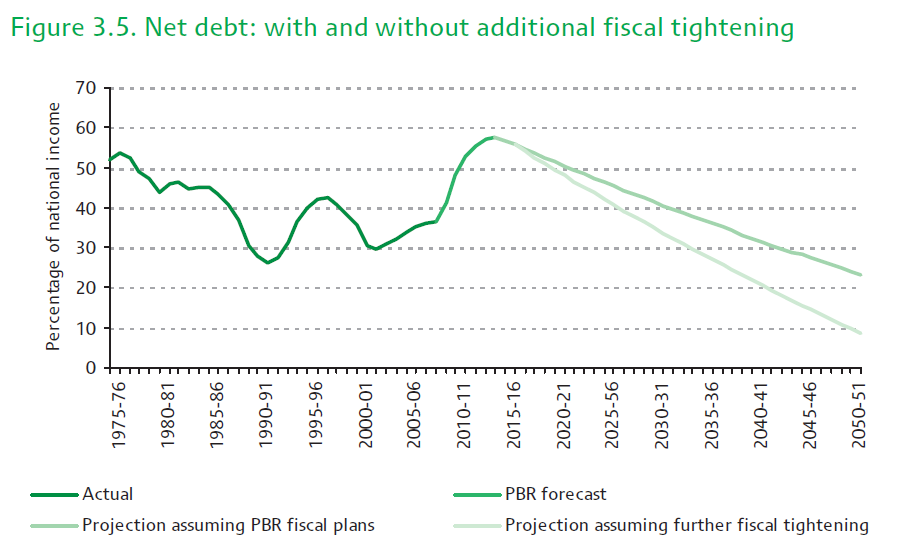
Earlier, from the IFS Green Budget launch, I wrote of how long it's going to take for future governments to pay off Brown's debt binge.  Above is the graph, from the Green Budget, which illustrates the point.  As you can see, it will take until around  2032 for us to get back to the 40% debt-GDP ratio that (officially) prevailed under Brown's fiscal rules - and that's assuming that governments between now and then embark on a fiscal tightening programme of spending cuts and tax hikes.  Even with more severe fiscal tightening, it's going to take until around 2025.  One thing this fails to account for, though, is how much debt Brown's hidden off balance-sheet.  The real prospect facing future governments may well be far more horrific.

Uncertain times as the IFS delivers its Green Budget

From our UK edition

I'm embedded at the IFS/Morgan Stanley Green Budget event - at which the two organisations present their own prognoses for the UK economy and public finances - and my head's swimming with numbers, forecasts and graphs.  Two things are standing out, though: just how much uncertainty there is about where we're headed, and how restricted future governments are going to be because of Brown's stewardship of the public finances. First, the uncertainty.  As Morgan Stanley's David Miles put it, there is "an unusally large amount of uncertainty about the UK economy" right now.  Even the experts just don't know what's coming next, and they're having to come up with numerous "pessimistic", "optimistic" and "central" forecasts to account for this.

Expanding Heathrow would ground expansion at every other airport in Britain

From our UK edition

If you want to know how anti-competitive a third runway at Heathrow could be, then check out this article in today's Times.  It highlights a study by the Campaign for Better Transport which claims that - thanks to the Government's climate change target - Heathrow expansion would mean every other airport in Britain having to abandon their own expansion plans.  I wonder whether  Gordon Brown's factored that in when he boasts about how many jobs would be "created" by a third runway at Heathrow?  Somehow, I doubt it...

The attack that Labour fears

From our UK edition

This article in today's FT is an intriguing addendum to my post yesterday about Labour accepting the "headless chicken" charge.  It points out that Gordon Brown has now been "warned by Labour ministers and MPs to stop churning out initiatives to tackle the recession".  And then goes on to describe an "anxious" parliamentary meeting of Labour MPs on Monday night, where one backbencher lamented Brown's "blizzard" of initiatives. Increasingly, it seems like Labour fear the "headless chicken" attack more than the Tories fear the "do nothing" counter.  The political tides certainly favour the Tories here - the "do nothing" tag was always disingenuous, and would become less effective as Team Cameron developed its response to the economic crisis.

Now Straw’s name comes up in the Lords-for-hire scandal

From our UK edition

Just how far-reaching could the Lords-for-hire scandal turn out to be?  Pretty far, if the latest reports are anything to go by.  This morning's Mail revealed that 1-in-5 Lords act as consultants or advisers to "outside interests".  And now the Standard discloses that Jack Straw has received money from one of the peers at the centre of the row - in one case, as a "personal gift".  Of course, we should reserve judgement until after any proper inquiry, but the Straw connection will almost certainly cause a few headaches on Downing Street.  Given Labour's faltering poll position, they'll be worried by any indication - however slight or tangential - that the Government itself is embroiled in this scandal.

Is the Bank’s independence under threat?

From our UK edition

Over at his blog, Robert Peston sees the independence of the Bank of England being eroded as the recession progresses.  Basically, the worry is that once the Bank embarks on quantitative easing the Treasury will have to steer monetary policy in order to safeguard taxpayers' cash.  Here's a sizeable excerpt from Peston's rather more detailed explanation: "Perhaps the important point is that Mervyn King and the chancellor have both made clear that it won't be long before the Bank of England starts to use money, rather then Treasury bills, to buy corporate debt and other financial assets. At that point, even the governor would call that monetary policy.