Peter Hoskin

Yet another broadside against Brown’s economic management

From our UK edition

For the third day in a row, the head of a prominent independent body has given Gordon Brown a kicking.  After Lord Turner's attack on Brown's regulatory system, and Mervyn King's comments yesterday, Steven Bundred, the chief executive of the Audit Commission, today laments our massive public debt.  His article in the Times (headline: 'Our public debt is hitting Armageddon levels') is well worth reading in full, but here are a few key passages: "Those who are too young to remember [1975-76 and 1993-94] would do well to learn about them fast - because even the dark years of the mid-1970s and the early 1990s may look like days of wine and roses quite soon... ...

King weighs in to attack the regulatory system

From our UK edition

Plenty of interesting comments have come out of Mervyn King's appearance before the Treasury Select Committee - Reuters collects some of the highlights here.  But, after the claims Lord Turner made yesterday, King's criticism of the regulatory system is particularly eye-catching.  Here's how the Telegraph's James Kirkup reports it:  Mervyn King, the Governor of the Bank of England, has said that financial regulators were unable to stop City banks taking huge risks because they did not get support from the British Government and MPs. Regulators who had criticised banks lending in 2006 or 07 would have had "a massively difficult task" persuading politicians to back them.

How crime could pave the way for quantitative easing

From our UK edition

The story of Adolf Burger, a Slovakian Jew forced by the Nazis to produce counterfeit British banknotes, is utterly compelling.  To a lesser degree, so is this statistic mentioned in the Times analysis accompanying a report of his visit to the Bank of England yesterday:   "Counterfeiters continue to ply their trade in Britain and are so adept at producing pound coins that more than one in 50 in circulation are fakes, according to reports released by the Royal Mint. The Mint estimated last year that 33 million of the 1.47 billion pound coins in circulation are fake, a proportion regarded by one currency expert as dangerously high.

Firefighting the bankers

From our UK edition

In terms of the cash involved, the controversy surrounding Fred Goodwin's £650,000 a year pension is a mere footnote to the massive RBS bailout announced this morning.  But, politically, it could be far more damaging for the Government. Their attempted solution to the problem is beyond parody - as Alistair Darling revealed this morning, the banking Minister, Lord Myners, has left a message with Goodwin that the pension doesn't look good and asking whether he could decline some of it.  Goodwin hasn't yet replied. Despite all the tough talk on bonuses, this lazy firefighting hardly creates the impression that the Government's cracking down on corporate failure.

The bailouts get bigger and bigger

From our UK edition

Today's yet another downturn milestone.  As RBS announces the largest annual loss in UK corporate history, the Treasury's set to make the bank the beneficiary of what could be the biggest bailout so far.  Robert Peston sets it out thus: "The Treasury has announced that we as taxpayers will provide insurance to Royal Bank against future losses on £325bn of loans and investments. First losses of up to £19.5bn on those impaired assets will be taken by Royal Bank. But to prevent the losses wrecking the bank, we as taxpayers will be injecting up to £19bn of new capital into it, in the form of non-voting shares. Also, losses greater than £19.5bn will be born by us - by taxpayers. In a prolonged severe recession, those losses could be substantial.

The Eye of God

From our UK edition

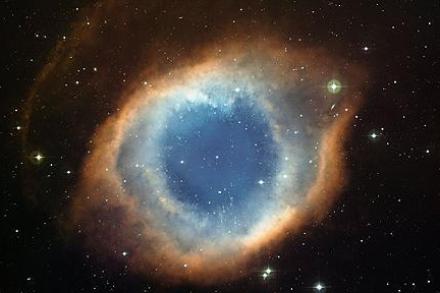
Ok, so I have a bit of a fascination with space and space travel, which I manfully try not to inflict on CoffeeHousers.  But indulge me just this once, as this image taken by the European Southern Observatory - and reported by the Telegraph here - is too stunning not to share.  For obvious reasons, it's been nicknamed the Eye of God: Truth is, it's a "shell of gas and dust that has been blown off by a faint central star".  Even so, an arresting reminder of the beauty of our universe.

PMQs cancelled

From our UK edition

Following the tragic death of Ivan Cameron, PMQs has been cancelled today. Instead, Gordon Brown, William Hague and Vince Cable will make brief statements at 1200. You can watch them here.

This week’s Cabinet row

From our UK edition

O to be a fly on the wall of the Brown Bunker, and watch the grim soap-opera unfold in real time. After the infamous Cabinet meeting over bankers' bonuses - which triggered much of the Harriet Harman speculation - the Daily Mail's reporting yet another angry meeting between Brown and his ministers, this time over the Government's plans for Royal Mail.  Harman was again a dissenting voice:   "It emerged last night that a blistering row broke out at a Cabinet meeting yesterday, with ministers arguing over whether the plans should be rammed through Parliament before the summer. Lord Mandelson, who is championing the legislation, found himself facing fierce opposition from Commons Leader Harriet Harman and Chief Whip Nick Brown.

Byrne comes across as complacent

From our UK edition

With all the subtlety of a bludgeon, Liam Byrne goes on the attack against those warning about the hole in our public finances.  His primary target is Iain Martin's column last week, but he also takes aim at Malcolm Offord's recent report claiming that £100 billion of public spending cuts may be needed by 2020 to get the public finances in an acceptable state.  This kind of thinking, Byrne suggests, represents an "underground movement" behind David Cameron; proof that "The marketing is all progressive; but the product is all conservative." So far as the spin cycle's concerned, Byrne's remarks are striking for two reasons.  First, they show just how determined Labour are to stick with a "Tory cuts" attack.

Real airbrushing now

From our UK edition

From Stalin to Mr Bean back to Stalin again?  Turns out that Gordon Brown's new 'Real Help Now' website has already been airbrushed to delete references to action being taken by his political foes, in this case the SNP.  Here's how they report it:  Efforts taken by the Scottish Government to help the economy through the recession have been “airbrushed” from a UK Government website less than twenty-four hours after they were listed on a site launched by the prime minister.

Dragging a Rock

From our UK edition

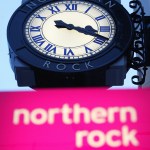
There's plenty in today's papers about Alistair Darling's U-turn on Northern Rock.  The Lombard column in the FT sums it up: the Rock has become a "dangerous laboratory for banking policy", screeching from reining in its business one minute to expanding back into the mortgage market the next.  To my mind, it's a clear demonstration of what can happen when something becomes political.  The government knows it's open to criticism over its handling of NR, so it's flapping around to find something - anything - that will work. Problem is, what grabs the short-term headlines may result in medium-term embarassment.  Take the figure the Government have slapped on Northern Rock's new lending capacity: a hefty £14 billion.

Some Monday night viewing

From our UK edition

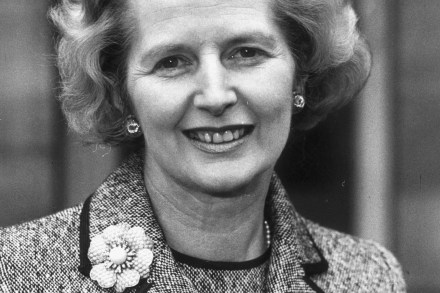
This is as nectar for political anoraks: a new collection of BBC archive videos charting Margaret Thatcher's rise to becoming Prime Minister.  Some nostalgic viewing in there for CoffeeHousers, I dare say.

Nuclear aspirations

From our UK edition

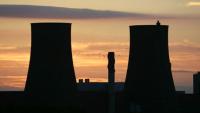
Well worth reading the splash story in today's Independent.  It reveals that four "leading environmentalists" have given their backing to nuclear power, despite being opposed to it in the past.  One of them - Stephen Tindale, the former director of Greenpeace - relates his experience thus: "It was kind of like a religious conversion. Being anti-nuclear was an essential part of being an environmentalist for a long time but now that I’m talking to a number of environmentalists about this, it’s actually quite widespread this view that nuclear power is not ideal but it’s better than climate change." Now, I imagine a few CoffeeHousers might be thinking: "Who cares what these jumped-up climate-change crusaders believe?

Lib-Con love after the next election?

From our UK edition

An intriguing insight from Tim Montgomerie, about some potential Lib-Con love after the next election:  "I understand that a group of shadow ministers believe that one of Tony Blair's bigger strategic mistakes was to row back on co-operation with the Liberal Democrats when he won such a large Commons majority in 1997.  These shadow ministers believe that - contrary to Labour's 'under-delivery' to the LibDems - the Conservatives should deliver more in practical co-operation in government than they promise in opposition. The discussion is not of ministerial positions - although there might be some significant appointments to policy reviews - but of working groups on issues of shared interest.  Action on civil liberties and on green issues are on the table.

The return of rage

From our UK edition

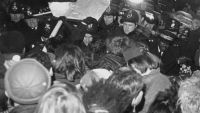
One of the few things missing from our country's, and Gordon Brown's, cocktail of woes has been major civic unrest.  Sure, we've seen strikes - most notably at the Lindsey oil refinery - but nothing as vitriolic, or as large, as the riots in Greece or Saturday's protest in Dublin.  That could be about to change.  According to today's important Guardian cover story, police are gearing up for a "summer of rage", the timing of which could dent Brown's Last Great Hope to rescue his premiership:   [Superintendent David] Hartshorn[, chief of the Met's public order branch] identified April's G20 meeting of the group of leading and developing nations in London as an event that could kick-start a challenging summer.

Brown still doing “everything it takes”

From our UK edition

Brace yourselves.  It looks as though the next couple of weeks are going to be among Brown's busiest and - so far as the taxpayer's concerned - costliest yet.  As the Sunday Times sets out, the flurry of initiatives and announcements may include: a call to ban 100 percent mortgages; a cash injection of £10 billion for Northern Rock; the start of a £100 billion programme of "quantitative easing"; and the establishment of a "bad bank".  The final tab could hit an eye-watering £500 billion. It's the proposal to ban 100 percent mortgages which catches the eye and, to be fair to Brown, it makes a great deal of sense.

The extent of Stanford’s fakery

From our UK edition

In case the English Cricket Board isn't embarrassed enough, today's Times has a fresh set of revelations about Allen Stanford and his tawdry cricket spectacular: It was an iconic and now infamous moment as Allen Stanford’s helicopter touched down on the perfectly trimmed grass of Lord’s, the home of English cricket. But the alarm bells should already have been ringing in the ground’s panelled corridors as the aircraft, with its gold flashes and the Stanford name emblazoned along its flanks, emerged from the clouds over London. Despite its impressive logos, there was no Stanford company helicopter.