Owen Matthews

Owen Matthews

Owen Matthews is an Associate Editor of The Spectator and the author of Overreach: The Inside Story of Putin’s war on Ukraine.

Will US businesses profit from a return to the Russian market?

From our US edition

Rome Will peace in Ukraine also prove to be a great deal for US business? Vladimir Putin would certainly like Donald Trump to think so. Within days of Trump’s election victory last November, the Kremlin ordered major Russian corporations to prepare detailed proposals for economic cooperation with Washington. Coordinating these efforts were Maxim Oreshkin, deputy head of Putin’s presidential administration, and Kirill Dmitriev, the US-educated Harvard, Stanford and Goldman Sachs alumnus who heads Russia’s sovereign investment fund.

Europe’s kind words and bear hugs can’t save Zelensky

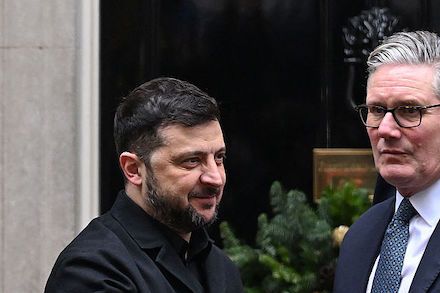
If bear hugs were army divisions and brave words cash euros, Volodymyr Zelensky would have ended his tour of European capitals this week the best-armed and best-funded leader in the world. Zelensky faces the danger that giving too much to Putin would make Ukraine ungovernable 'We stand with Ukraine,' vowed Sir Keir Starmer after hosting a summit for President Zelensky and top European allies at Downing Street on Monday. 'We support you in the conflict and support you in the negotiations to make sure that this is a just and lasting settlement.' Germany’s Chancellor Friedrich Merz declared that 'nobody should doubt our support for Ukraine' and that 'the destiny of this country is the destiny of Europe'.

What Ukraine really needs from Europe

From our US edition

If bear hugs were army divisions and brave words cash euros, Volodymyr Zelensky would have ended his tour of European capitals this week the best-armed and best-funded leader in the world. "We stand with Ukraine," vowed British Prime Minister Sir Keir Starmer after hosting a summit for Zelensky and top European allies at Downing Street on Monday. "We support you in the conflict and support you in the negotiations to make sure that this is a just and lasting settlement." Germany’s Chancellor Friedrich Merz declared that "nobody should doubt our support for Ukraine" and added that "the destiny of this country is the destiny of Europe." France’s President Emmanuel Macron promised that Europe has "a lot of cards in our hands.

Why Putin thinks he’s winning

From our US edition

The Kremlin pulled out all the stops for the visit of Donald Trump’s son-in-law Jared Kushner and special envoy Steve Witkoff to Moscow yesterday. Accompanied by Putin’s envoy Kirill Dmitriev, Witkoff and Kushner strolled through crowds on Red Square with minimal security after lunching at a fancy restaurant on Petrovka street. Not coincidentally, Chinese foreign minister Wang Yi was also in town for a meeting with Russian Security Council head Sergei Shoigu, where Russia affirmed its support for Beijing’s One China policy.  It was a sophisticated piece of great power signaling intended to send a multi-part message to Donald Trump.

Why Putin thinks destiny is on his side

The Kremlin pulled out all the stops for the visit of Donald Trump’s son-in-law Jared Kushner and special envoy Steve Witkoff to Moscow today. Accompanied by Putin’s envoy Kirill Dmitriev, Witkoff and Kushner strolled through crowds on Red Square with minimal security after lunching at a fancy restaurant on Petrovka street. Not coincidentally, Chinese foreign minister Wang Yi was also in town for a meeting with Russian Security Council head Sergei Shoigu, where Russia affirmed its support for Beijing’s One China policy.  It was a sophisticated piece of great power signalling intended to send a multi-part message to Donald Trump.

The path to peace in Ukraine will be tortuous

In order to impose peace terms, you first need to win the war. That fundamental principle seems, for the moment, to elude Ukraine’s European allies. Donald Trump, on the other hand, has taken the more pragmatic – some would say more cynical – view that Ukraine will never defeat Russia and therefore needs to make the best of a bad lot. Trump’s strategy for peace in Ukraine has been to browbeat Volodymyr Zelensky into approving a deal acceptable to Vladimir Putin. In fairness, Trump has also gone some way to putting the squeeze on the Kremlin too, by sanctioning the oil giants Rosneft and Lukoil, authorising the Ukrainians to use US--provided long-range weapons against Russian targets, and threatening to provide Kyiv with Tomahawk cruise missiles.

Was Nathan Gill recruited by the Kremlin?

Was 52-year old Anglesey man Nathan Gill, a member of the European parliament, taking money from the Kremlin, or just from a corrupt Ukrainian oligarch? We may never know. But on Friday Gill was sent down for ten-and-a-half years at the Old Bailey, after he was found guilty of accepting bribes from Ukrainian operatives in exchange for delivering scripted speeches in the European Parliament defending pro-Kremlin TV channels and hosting an event for Viktor Medvedchuk, a close ally of Vladimir Putin. Gill sat in Strasbourg as an MEP for North Wales representing the Brexit party, and was later leader of the Welsh branch of Reform UK.

Labour’s toxic budget, Zelensky in trouble & Hitler’s genitalia

39 min listen

It’s time to scrap the budget, argues political editor Tim Shipman this week. An annual fiscal event only allows the Chancellor to tinker round the edges, faced with a backdrop of global uncertainty. Endless potential tax rises have been trailed, from taxes on mansions, pensions, savings, gambling, and business partnerships, and nothing appears designed to fix Britain’s structural problems. Does our economics editor Michael Simmons agree? Host Lara Prendergast is joined by co-host – and the Spectator’s features editor – William Moore, alongside associate editor Owen Matthews and economics editor Michael Simmons.

Zelensky cannot agree to the Witkoff peace deal

With Ukrainian president Volodymyr Zelensky’s political authority already under grave assault in the wake of a major corruption scandal, he now faces a new challenge – this time from his erstwhile ally, the United States. A high-level US delegation led by army secretary Daniel Driscoll is meeting Zelensky in Kyiv today to present the latest version of a peace plan aimed at ending the war. The contents of the plan have not been officially revealed and so far it has not been publicly endorsed by Donald Trump. But two things are already clear. One is that there’s nothing new in it. And two, there’s nothing good in it for Zelensky.

Ukraine is on the verge of political collapse

Defeat, political implosion and civil war – those are the jeopardies that Volodymyr Zelensky faces as Ukraine heads into the most difficult and probably the last winter of the war. Evermore effective Russian strikes against Ukraine’s energy and transport infrastructure are likely to plunge swaths of the country into cold and darkness. Russian troops continue to push forwards slowly and bloodily in Donbas and, more dangerously, on the southern flank in Zaporizhzhia. Desertions from the Ukrainian army are up four times since last year and the number of deserters now matches the number of active fighters. The US has turned off the money taps and Europe struggles to produce the cash Kyiv needs to keep its war effort going.

Europe can’t fix Ukraine’s cash crisis

Who will pay for Ukraine’s war effort now the Trump administration has turned off the financial taps? European leaders have expressed themselves ready and willing to take up the burden, with European Commission President Ursula von der Leyen affirming that ‘if we continue to believe that Ukraine is our first line of defence, we need to step up our assistance.’ Individual countries have come up with generous funding packages – most open-handed of all being Germany, which has recently pledged more than €3 billion in direct funding. But that’s just a drop in the ocean compared to what Ukraine says it needs.

The scandal that could bring down Volodymyr Zelensky

A solid gold toilet and cupboards loaded with bagfuls of €200 bills are among the treasures linked to the prominent Ukrainian businessman Timur Mindich, after an investigation by Ukraine’s National Anti-Corruption Bureau (Nabu). Mindich is big in real estate, fertilisers, banking and diamond trading – but he is best known as a long-time co-owner of Volodymyr Zelensky’s Kvartal 95 television production company. Nabu’s 15-month long investigation into what it describes as ‘high level’ corruption at the top of Ukraine’s political elite is likely to have momentous consequences for Zelensky’s political future.

Putin thinks time is on his side

From our US edition

Very well then – war. That is the bottom line of Vladimir Putin’s response to Donald Trump’s latest attempts at mediating an end to Russia’s invasion of Ukraine. In August, Putin rejected the peace deal that Trump lined up in Alaska. Now, the Kremlin has scuttled the White House’s plan for a summit in Budapest by insisting that Russia’s demands for Ukrainian demilitarization and “de-nazification” remain in force. Clearly, the Russian President still believes that he can win the war on the battlefield – and terrorize Ukraine’s civilians. What is Putin’s plan?

putin

Trump is getting serious about punishing Putin

Donald Trump’s on-again, off-again threats to sanction Russia for its intransigence over peace talks in Ukraine solidified today into concrete action. The US has announced sanctions against Rosneft and Lukoil, two of Russia’s largest oil companies, and their dozens of subsidiaries. Between them, the two giants are responsible for nearly half of Russia’s oil exports – and a serious crackdown on their ability to export crude could deal a serious blow to Russia’s war economy. How serious that blow is depends entirely on how far the White House is prepared to pursue the sanctions. And whether it will cause Putin to cease and desist from his offensive against Ukraine is another question.  The immediate context for Trump’s unexpected move appears to be personal.

Will peace in Ukraine elude Trump?

28 min listen

With a Gaza ceasefire deal, President Trump's attention has turned to ending the war in Ukraine. A meeting with Putin was suggested, before coming to nothing. Owen Matthews joins Freddy Gray to talk about the fundamental differences between Trump and Putin, the limits on Ukraine's President Zelensky when it comes to negotiation and why the global west keeps misunderstanding Russia time and time again. Produced by Patrick Gibbons and Megan McElroy.

Should the Nord Stream saboteurs be extradited to Germany?

From our US edition

The identity of the saboteurs who blew up the Nord Stream pipelines in September 2022 was for years the western security establishment’s worst-kept secret. Just two weeks after a series of explosions within the economic zones of Sweden and Denmark crippled three of the four undersea natural-gas pipelines linking Russia to Germany, Scandinavian diplomats in Brussels were already being quietly briefed that the most likely culprits were Ukrainian. By January 2023, a forensic investigation by German police had discovered traces of the explosives on board the charter yacht Andromeda and found that the vessel’s movements aligned exactly with the location of the blasts.

Nord Stream

Trump doesn’t understand what Putin wants

Is Donald Trump’s peace process in Ukraine moving forward – or it is merely going around in circles in a series of gut-wrenching loop-the-loops? Less than a fortnight ago Trump raised Ukrainian hopes by dangling the possibility of sending Tomahawk cruise missiles, describing the Kremlin as a ‘Paper Tiger’ and warning that the Russian economy was on the verge of collapse. But when Ukraine's president Volodimir Zelensky arrived late last week in Washington for face to-face talks at the White House instead of Tomahawks he received a lecture on how he had to accede to many of Putin’s demands or face ‘annihilation’. Land – or ‘property’ as Trump puts it – is not what Putin really wants at all What changed?

Would taking back lost territories make Ukraine whole again?

From our US edition

For many of Ukraine’s supporters, Donald Trump’s recent declaration that Ukraine “is in a position to fight and WIN all of Ukraine back in its original form” came as a welcome – and unexpected – turnaround in US policy. “Ukraine would be able to take back their Country in its original form and, who knows, maybe even go further than that!” wrote Trump in a Truth Social post in late September. “Putin and Russia are in BIG Economic trouble, and this is the time for Ukraine to act.” But would taking back the lost territories of the Donbas, Zaporizhzhia, Kherson and Crimea make Ukraine whole again – or could a reconquest instead condemn Ukraine to perpetual civil war against itself and prolong the conflict with Russia indefinitely?

Ukraine

The ‘shadow fleet’ tanker raid was pure theatre

The news footage was satisfyingly reminiscent of Mission: Impossible. Masked French commandoes swarmed up the side of the rusty oil tanker Boracay, assault rifles drawn, and commenced their search for evidence the vessel had been responsible for launching Russian drones at Danish airports. The captain and first officer – both Chinese nationals – were taken into custody. France’s president Emmanuel Macron could not confirm that the Boracay was responsible for the drone attacks – but did make it clear that stopping the vessel off the coast of St Nazaire was intended as ‘a step moving towards a policy of obstruction of suspicious ships in our waters that are involved in trafficking’ Russian oil.

Moldova has been saved from Russian influence, but at what cost?

The European Union, guardian and champion of democracy, rightly takes a dim view when ruling parties ban their opponents, refuse to open polling stations in areas likely to vote against them, censor opposition news channels and allow a large staff of foreign election monitors to police social media in the run-up. If Serbia, say, or Georgia tried systematic election rigging of this kind, Brussels would be the first to call foul and disregard the result as illegitimate. But when it’s the EU that’s running the interference, as in Moldova this week, the rules are apparently quite different. This week the pro-EU party of Maia Sandu, Moldova’s President and a former World Bank official, won a slim majority in a general election.