Michael Gove

Michael Gove

Michael Gove is editor of The Spectator.

Q&A: Boris, Cameron or May? Plus, our most left-wing beliefs revealed

35 min listen

To submit your urgent questions to Michael and Maddie, go to: spectator.co.uk/quiteright This week on the first ever Quite right! Q&A: What’s your most left-wing belief? Michael & Maddie confess their guilty liberal secrets on the Elgin Marbles, prison reform and private equity – or ‘the unacceptable face of capitalism’. Also this week: who would you trust to save your life on a desert island – Boris Johnson, Theresa May or David Cameron? And finally, a literary turn: from John Donne to Thomas Hardy, Michael and Maddie share their favourite poems, and make the case for learning verse by heart. Produced by Oscar Edmondson.

Rachel Reeves’s Budget ‘bollocks’ & Britain’s everyday crime crisis

48 min listen

To submit your urgent questions to Michael and Maddie, go to: spectator.co.uk/quiteright This week on Quite right!: Rachel Reeves goes on the offensive – and the defensive. After her surprise Downing Street address, Michael and Maddie pick over the many kites that have been flying in advance of the Budget at the end of the month. Was she softening the public up for tax rises, or trying to save her own job? Michael explains why Reeves is wrong to say that Labour’s inheritance is the reason for our current economic misfortune and says that it is ‘absolute bollocks’ that Brexit is to blame. Next, a chilling weekend of violence sparks a bigger question: are we witnessing the rise of nihilistic crime in Britain?

‘I was reported for bullying!’: inside the Home Office dysfunction & collapsed grooming gangs inquiry

55 min listen

To submit your urgent questions to Michael & Maddie, go to: spectator.co.uk/quiteright This week on Quite right!: the great Home Office meltdown. After a week of fiascos – from the accidental release of a convicted migrant to the collapse of the grooming gangs inquiry – Michael and Maddie ask: is the Home Office now beyond repair? Why is Britain’s most important department also its most dysfunctional? And what does it say about a civil service more obsessed with ‘listening circles’ and ‘wellbeing surveys’ than actually running the country? Then to Westminster, where Jess Phillips faces fury over the grooming gangs inquiry. Are ministers diluting the investigation to avoid awkward truths about race and culture?

Should Prince Andrew be exiled? And how multiculturalism failed in Birmingham

45 min listen

This week on Quite right!: the slow-motion disgrace of Prince Andrew. As Virginia Giuffre’s new book reignites the Epstein scandal, Michael and Maddie ask: how much longer can the monarchy carry its most toxic member? Or should the Duke of York be stripped of his titles and sent into exile? Then to Birmingham, where sectarian politics, bin strikes and football collide. After Israeli fans were barred from attending a Europa League match, Michael and Maddie debate how Britain’s second city became a byword for failed multiculturalism. Has the country finally started telling the truth about integration – or just found new ways to divide itself? Finally, the British Museum’s attempt to out-glamour the Met Gala.

Thatcher & Reagan’s special relationship

40 min listen

To mark the centenary of Thatcher’s birth, Michael Gove is joined by Charles Moore, her biographer, and Peggy Noonan, speechwriter to Ronald Reagan, to reflect on the chemistry that bound the two conservative leaders. Both outsiders turned reformers, they shared not only ideology but temperament – ‘They were partners in crime,’ says Peggy. Yet it wasn’t all harmony. As Charles notes, the pair weathered serious rifts – over nuclear weapons, Grenada and the Falklands. Even in disagreement, they ‘wanted the same thing … to defeat the Soviet Union without fighting’. How did they navigate their differences? And what lessons can we learn from their special relationship? Produced by Natasha Feroze and Oscar Edmondson.

Lab leaks & spy scandals: was Cameron wrong about China?

48 min listen

This week on Quite right! Michael and Maddie turn their sights to Westminster’s latest espionage scandal – and the collapse of the case to prosecute two men accused of spying for China. Was the case dropped out of incompetence, or out of fear of offending Beijing? As Michael puts it, ‘Either we’re not being told the truth, or this is a government of staggering incompetence.’ They also unpick the growing row over Jonathan Powell, Keir Starmer’s National Security Adviser, and his alleged role in shelving the case. What does his re-emergence, along with Peter Mandelson and other ‘Sith Lords of Blairism’, tell us about the return of New Labour’s old moral compromises?

Who is the greatest ever conservative?

40 min listen

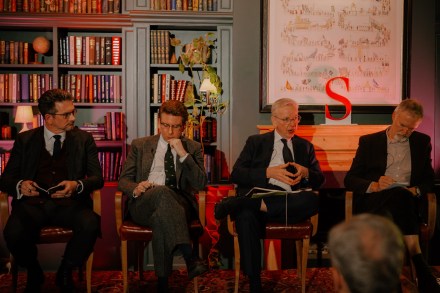
From wartime leadership to economic revolutions, Conservative figures have shaped Britain’s past and present. But who stands out as the greatest of them all? In this conversation, recorded live at Conservative Party Conference: Katie Lam makes the case for William Pitt the Younger, Camilla Tominay nominates Margaret Thatcher, William Atkinson points out the number of young Tories who now idolise Enoch Powell, and Neil O’Brien explains why all conservatives should know about Jerzy Popieluszko. Who wins? You decide.

How can the Tories turn it around? Live

40 min listen

Recorded live in Manchester, during the Conservative Party conference, Michael Gove sits down with Tim Shipman, Madeline Grant and Tim Montgomerie to discuss how the Tories can turn their fortunes around. Do the Tories need to show contrition for their record in government? Has the party basically been split ever since the Coalition years? And does Nigel Farage need to set a deadline for Tory to Reform defectors? Plus – from Canada to Italy – which countries do British Conservatives need to look towards for inspiration? Produced by Patrick Gibbons.

Was that Kemi Badenoch’s last conference? Quite right! live from Manchester

42 min listen

This week, Michael and Maddie record Quite right! in front of a live audience at the Conservative Party conference in Manchester – with attendance down, the big question is whether Kemi Badenoch can survive as leader of the opposition. There is the unmistakable air of fatalism among MPs staring down electoral annihilation – but would another change in leadership cement the Tories as pathologically regicidal? They also debate Badenoch’s bold pledge to bar candidates who won’t back leaving the European Convention on Human Rights – a ‘calculated risk’ that could redefine the party’s identity or too little too late? Then, in the wake of the horrific Manchester synagogue attack, they turn to the rise of anti-Semitism and the crisis of policing.

Speaker series: Jeffrey Archer – End Game

51 min listen

Michael Gove speaks to Jeffrey Archer about his life, career and his new novel End Game, which marks the gripping finale of the William Warwick series. This discussion was part of the Spectator's speaker series. To see more on our upcoming events – including with Charles Moore and with Bernard Cornwell – go to events.spectator.co.

Manchester attack: Michael Gove on the rise of antisemitism

24 min listen

On today’s Coffee House Shots, Tim Shipman is joined by Michael Gove to reflect on the terrorist attack at Heaton Park Synagogue in Manchester, which left two people dead. They discuss how the Jewish community has long warned of rising anti-Semitism, often forced to fund its own security, and how inflammatory rhetoric on recent pro-Palestinian marches has deepened the sense of vulnerability. Michael warns that Britain remains naive about Islamist ideology and risks only ever reacting to violence, rather than preventing it. While there are capable people in government and the security services, he says, real leadership is needed to confront the ideology that fuels attacks before more tragedies occur. Does the Prevent system need reform?

Is Labour ‘racist’ too? Plus Trump’s Gaza gamble & Rowling vs Watson

48 min listen

This week, Michael and Maddie report from the Labour party conference in Liverpool and unpick Keir Starmer’s big speech. Was his attempt to reclaim patriotism for Labour a genuine statement of values – or a clumsy exercise in stereotypes about steelworkers, chip shops and football nostalgia? And why does Labour’s attack line on Nigel Farage risk sounding like political ‘nuclear warfare’ that could backfire outside the conference hall? And what about the Tories? With Labour bringing the fight to the Reform party, where does this leave Kemi Badenoch and the Conservatives ahead of their conference later this week? They then turn to Donald Trump’s extraordinary new Middle East peace initiative.

Shabana Mahmood in conversation with Michael Gove – Labour Conference 2025

49 min listen

Whilst a certain noisy northern mayor has positioned himself as the problem child of conference 2025, The Spectator finds another Labour politician far more interesting. All around Liverpool the newsstands are decorated by the image of the Home Secretary Shabana Mahmood, dubbed the ‘Terminator’ by Tim Shipman in the most recent issue of The Spectator. As one strategist notes: ‘Shabana is not afraid to use power. That’s what we need.’ In this special edition of Coffee House Shots we present a wide-ranging in-conversation between Shabana Mahmood and Spectator editor Michael Gove.

Labour’s ‘levelling up’ agenda – Michael Gove interviews Steve Reed

28 min listen

On the eve of Labour’s party conference, the Spectator's editor Michael Gove sits down with Steve Reed MP, the new Secretary of State for Housing, Communities, and Local Government. The government has announced an historic £5 billion package of funding for 'national renewal' – designed to revive high streets, parks and public spaces. Reed explains how he thinks Labour can win back 'forgotten' communities through building 1.5 million houses through this Parliament, allocating fair funding for councils and devolving more powers to local government. Is this Labour's own 'levelling up' agenda?

Labour’s Terminator, Silicon Valley’s ‘Antichrist’ obsession & can charity shops survive?

37 min listen

First: who has the Home Secretary got in her sights? Political editor Tim Shipman profiles Shabana Mahmood in the Spectator’s cover article this week. Given Keir Starmer’s dismal approval ratings, politicos are consumed by gossip about who could be his heir-apparent – even more so, following Angela Rayner’s defenestration a few weeks ago. Mahmood may not be the most high-profile of the Starmer movement, but she is now talked about alongside Wes Streeting and Andy Burnham as a potential successor to Starmer. But – it all depends on what she can achieve at the Home Office. So, who does she have in her sights?

Where Blair is wrong, but Farage is right & why recognising Palestine is ‘politics at its worst’

48 min listen

This week, Michael and Maddie lift the lid on the strange rituals of party conference season and why the ‘goldfish bowl’ reality of a week in Birmingham (or Manchester, or Liverpool) often leaves politicians with ‘PTSD’.  They then turn to the government’s revived enthusiasm for digital ID cards. Is this a sensible fix for illegal immigration – or, as Michael puts it, ‘snake oil rubbed onto an already weak idea’? And why does Tony Blair always seem to be the ghost whispering ‘ID cards’ into Westminster’s ear? Next, Keir Starmer’s recognition of a Palestinian state: a principled step, or a political stunt designed to placate his backbenchers?

Weimar Britain, the war on science & are you a competitive reader?

36 min listen

First: a warning from history Politics moving increasingly from the corridors of power into the streets, economic insecurity exacerbating tensions and the centre of politics failing to hold; these are just some of the echoes from Weimar Germany that the Spectator’s editor Michael Gove sees when looking at present-day Britain. But, he says, ‘there are grounds for hope’ – what are they? Michael joined the podcast to discuss.   Next: why did science succumb to the ‘culture wars’? Biologist and peer Matt Ridley bemoans the ‘cultification of science’, arguing that ‘left-wing ideological nonsense’ ended up permeating through all scientific disciplines.

Weimar Britain: lessons from history in radical times

The Ancient Greeks believed the past was in front of us and the future behind. Man could look history in the face and learn from it, while the future was unknowable, hidden, the wind whistling at our back. It is in history, its patterns, and what it reveals about human nature, that we have the best guide to our times and how they might develop. The government may wish us to focus on innovation this week – new nuclear reactors, AI data centres, OpenAI’s Sam Altman and Nvidia’s Jensen Huang at the state banquet – but if we really want to understand the convulsions gripping our society it is to the past we should look for signs.

Why Danny Kruger’s defection changes everything & could Boris Johnson be next?

54 min listen

This week Michael and Madeline unpick the shock defection of Danny Kruger to Reform UK’s ‘pirate ship’ – as described by Michael – and ask whether this coup could mark the beginning of the end for the Conservative party. They also dive into Westminster’s most charged moral debates: the assisted dying bill in the Lords and the quiet decriminalisation of abortion up to birth. What do these changes say about parliament’s ‘intoxicated liberal hubris’ – and the protections given to the vulnerable? Also, Donald Trump lands in Britain this week – but why is it that the Prime Minister acts ‘like Carson the butler’ in his presence, and who exactly is the ‘diplomatic secret weapon’ that the Palace deploys to manage ‘the Donald’?

Why Mandelson had to go & the legacy of Charlie Kirk

40 min listen

In this bonus episode Michael and Madeline tackle two extraordinary political stories. First, the dramatic resignation of Peter Mandelson as Britain’s US ambassador, following renewed scrutiny of his links to Jeffrey Epstein. Why did Keir Starmer take so long to act – and what does the debacle reveal about his leadership style? Then, across the Atlantic, America is reeling from the assassination of conservative activist Charlie Kirk. Michael and Madeline reflect on the tragedy, what it means for free speech, and whether political violence is reshaping the way debate happens in the public square. Produced by Oscar Edmondson, Oscar Bicket and Matt Miszczak.