Michael Evans

Michael Evans was defence editor of the Times for 12 years. He wrote a memoir called First With the News and is author of Agent Redruth, a new spy thriller which has a strong Russian theme.

Get ready for Epic Fury Part II

It could be the shortest negotiation in history. The United States and Iran, with their respective peace plans, are so far apart that it’s difficult to see how their differences can ever be squared.  A two-week ceasefire, which has already been broken, brought relief after five weeks of war and steadied the oil and stock markets. But the agreed ceasefire is looking fragile, as US Vice President J.D. Vance admitted. There had been “legitimate misunderstanding,” he said yesterday, over whether the ceasefire extended to Israeli action in Lebanon.

Can America persuade Putin to give up the Donbas?

Last week was one of realpolitik, Trump-style. Greenland was sorted, the ‘New Gaza’ unveiled, and all that was left was Ukraine and Russia. Donald Trump went from Davos back to the US but ordered his special envoys to Abu Dhabi, armed with the president’s formula for ending the war in Europe, to get a deal to stop the killing and destruction. As the envoys from the US, Russia and Ukraine opened the talks on Friday in the capital of the United Arab Emirates, none of the pre-signalling indicated that a breakthrough was in the offing. Two days were allotted for the meetings, in the expectation that it wouldn’t just be a round-robin of the same, familiar arguments.

What will Trump do in Venezuela?

Venezuela has been on tenterhooks for weeks, waiting as the United States gathers an armada of warships. The world’s largest aircraft carrier, USS Gerald R. Ford, looks likely to arrive in the Caribbean from the Mediterranean early next week to join the assortment of destroyers, frigates, amphibious assault vessels and a nuclear-powered submarine.  No one seems to know exactly what this magnificent display of American naval firepower is all about. Has it been sent to destroy the cocaine smuggling networks in Venezuela, or topple President Nicolas Maduro, the egregious leader of that poor country? Or is its purpose to remind the Latin American region that the US under Donald Trump could come in guns a-blazing whenever it wants?

Zelensky faces a dilemma

From our UK edition

Keeping abreast of President Trump’s changing moods has never been so challenging, especially for Volodymyr Zelensky, his Ukrainian counterpart. Judging by reports emerging of their meeting last Friday in the Oval Office, Trump made it clear in somewhat candid language that Zelensky should give up the eastern Donbas region of his country or face destruction by Russia. Gone was the sunny prediction made by Trump only three weeks or so earlier that if Zelensky pursued the war with Russia, backed by Europe and Nato, he could win a famous victory and drive the Russians out of all the occupied territories.

Has Trump really turned on Putin?

From our UK edition

Donald Trump has been doing his homework. Much has been written about Russia’s war economy, painting the picture that the military-industrial infrastructure is booming. But Trump is discovering that the war in Ukraine has wrecked Russia’s finances, and made any prospect of a straightforward return to a civilian economy unlikely. It has taken Trump a long time, but he has come round to the view repeated endlessly by European leaders: provided military and economic support for Kyiv is maintained, Putin at some stage will be forced to call it quits. If that backing is not guaranteed, the Russian president will continue to believe that aggression pays.

Trump is living in Putin’s world

From our UK edition

It all began with such promise. Donald Trump would sweep away all the failures of past administrations, sit astride the globe like a Nobel Prize winner in the making and solve the world’s seemingly unresolvable security challenges. To be fair, it has only been eight months since he began his second term in the White House. But it is a fact that Trump has struggled to bring the force of his personality and chutzpah to bear in trying to end the wars in Ukraine and Gaza, as he pledged he would in short shrift during his presidential campaign. His return to the White House was supposed to be the start of a Trump era on the world stage, a period in which dramatic diplomatic breakthroughs would cement his legacy as a peacemaker.

What will happen in Alaska?

From our UK edition

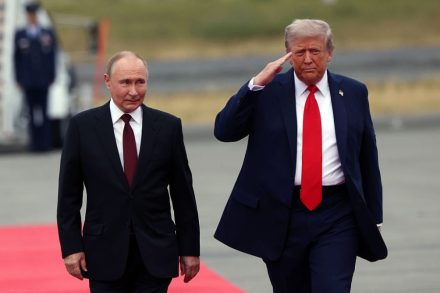
The Trump-Putin summit in Alaska could be the flop of the century or turn out to be the first step towards negotiating a ceasefire in Ukraine and eventually an end to the war. The White House has been trying to downgrade expectations of any breakthrough and has described the meeting on Friday as an opportunity for President Trump to listen to President Putin’s pitch and assess whether the Russian leader actually wants peace or not. Trump says he will be able to do this within two minutes. While it might be sensible to lower expectations, always a favourite ploy of political leaders, the Anchorage summit might just be different. First of all, Putin asked for it, and secondly, he has hanging over his head Trump’s threats to ratchet up economic sanctions.

The origin of the Thailand-Cambodia conflict

From our UK edition

A border dispute between Thailand and Cambodia which goes back more than a century has once again erupted in fatal clashes, leading to diplomatic alarm and appeals for international help. There has long been a schism between the two countries over an arbitrarily-drawn, 817-kilometre border conceived by the French in 1907. The present confrontation began in May, when a Cambodian soldier was killed during an exchange of fire between Thai and Cambodian troops in a border region known as the Emerald Triangle because it also shares a frontier with Laos. Despite attempts to prevent escalation, tensions continued to rise.

Ukraine is going to suffer without US Patriot missiles

From our UK edition

Ukraine has survived more than three years of Vladimir Putin’s war because of massive western arms supplies, an appreciation and exploitation of Russian military weaknesses, audacious special forces missions and an extraordinarily successful development of home-grown drones. All these ingredients have helped Kyiv hold off the Russian forces, saved Volodymyr Zelensky from having to capitulate and prevented Putin from marching further into Europe.

Trump could bomb Iran again

From our UK edition

President Trump has already warned Tehran that he’ll be back if Iran tries to revive and advance its nuclear programme, following the strikes by B-2 stealth bombers. Judging by the comments of the head of the International Atomic Energy Agency (IAEA), Trump may find himself with this dilemma sooner than he thinks. Iran could return to enriching uranium in ‘a matter of months’, according to Rafael Mariano Grossi, IAEA’s director-general, in an interview with CBS News at the weekend. However, a number of questions need to be asked before the B-2s take off again from their Whiteman Air Force base in Missouri.

Will Trump respond to Iran damaging the US embassy?

From our UK edition

The US embassy in Tel Aviv has been damaged by an Iranian ballistic missile attack which landed close by, raising the prospect of President Trump retaliating against Tehran. The overnight incident, during a barrage of Iranian missiles fired at Tel Aviv and the port city of Haifa, came after Trump warned the US would attack Iran with its ‘full force’ if any American assets were targeted. The prospect of a military response to the overnight damage to the American embassy building is possible but unlikely It seemed the building was not directly targeted but the blast from the missiles caused minor damage at the branch office building. Mike Huckabee, the US ambassador to Israel, confirmed the damage overnight but said no one had been hurt.

Bibi has run rings around Trump

From our UK edition

Donald Trump likes to see himself as the Great Negotiator but on this occasion Benjamin Netanyahu, Israel’s prime minister, appears to have outplayed him. Since April, the Israeli leader had been pressurising Trump and his White House aides to give him the green light for a large-scale attack on Iran’s nuclear facilities. While Netanyahu was reassured by his military advisers that Israel could go it alone to target Iran’s four nuclear sites, he wanted not just US backing but also American firepower to achieve what Trump and his predecessors all agreed on: that Iran must never be allowed to build a nuclear bomb. However, Trump entered the White House for his second term on a no-war ticket.

The red lines delaying an American nuclear deal with Iran

From our UK edition

Speaking to reporters on his Middle East diplomatic tour, Donald Trump hinted at what could be his biggest foreign policy achievement to date. A nuclear deal with Iran is ‘close’, he said. Tehran has ‘sort of’ agreed to curbing its suspected clandestine atomic weapons programme. The US and Iran have now had four rounds of indirect negotiations in Oman, and although the content has remained confidential, the atmosphere between the two sides has been candid but amicable, raising expectations that a deal to stop Tehran ‘breaking out’ and building a nuclear bomb could be brokered diplomatically without the need for Trump to resort to military force.

Trump has given Syria’s new leader the ultimate gift

From our UK edition

President Donald Trump was in a generous mood on the first day of his Middle East tour, announcing the lifting of sanctions against Syria and offering a similar gesture to Iran, though with strict conditions. The decision to end sanctions on Syria came as a surprise and was greeted with applause by his audience in Riyadh. Trump said he had been asked by the leaders of Saudi Arabia and Turkey to consider lifting sanctions to help the new government in Damascus which took over after the ousting of President Bashar al-Assad on 8 December last year.  To underline the changed strategy by the Trump administration, the US president will meet with President Ahmed al-Sharaa, the new Syrian leader, in Saudi Arabia today.

Hamas is using Edan Alexander to win favour with Trump

From our UK edition

The last surviving American hostage held by Hamas in Gaza is set to be released as early as today, coinciding with the arrival tomorrow of President Trump in the Middle East. The timing could not be more significant. Previous attempts to negotiate the release of Edan Alexander, a 21-year-old Israeli-American soldier from an elite army unit, failed despite high-level talks in Qatar. However, Hamas – not a terror organisation known for its nuanced approach to diplomacy – clearly realised that with Trump in the region, their 'gesture of good will' might pay additional dividends. Alexander was serving on the border with Gaza on 7 October 2023 when Hamas gunmen arrived in force, killed 1,200 Israelis and other nationals and seized 251 hostages.

Are India and Pakistan heading for war?

From our UK edition

Last night, India launched missile attacks on ‘militant’ sites in Pakistan and in Pakistani-controlled Kashmir in retaliation for the terrorist attacks two weeks ago which killed more than two dozen Indian tourists. The military action, named ‘Operation Sindoor’, raises already heightened tensions between India and Pakistan, both of whom are nuclear weapon states. India said in a statement that it had attacked nine locations. Pakistan countered by claiming three sites had been hit and that eight civilians were killed, including a child. It has described the attacks as ‘an act of war’.

Waltz set to take the blame for Signalgate

From our UK edition

Mike Waltz, the national security adviser, is set to lose his job over what came to be called Signalgate. He was the one who set up the ‘Houthi PC small group’ and either he or a member of his staff in error invited Jeffrey Goldberg, editor-in-chief of the Atlantic magazine, to participate. Goldberg blew the whistle after the raids had taken place. Others in the group included Pete Hegseth, the defence secretary, who obliged with all the operational data such as airstrike timings and particular aircraft to be involved, Vice President JD Vance, Marco Rubio, secretary of state, John Ratcliffe, CIA director, and Tulsi Gabbard, director of national intelligence.  Waltz has been selected to take the wrap.

Can Pete Hegseth remain at the Pentagon?

From our UK edition

The moment the Senate confirmed Pete Hegseth, President Trump’s nomination for defence secretary, the Pentagon community knew it was in trouble. One horrified defence official said at the time: ‘He may have been educated at Princeton and Harvard, but does he know anything about running a huge organisation like the Pentagon? No, he doesn’t.’ As both Trump and Hegseth have said in recent days, the Pentagon establishment was against this controversial appointment from the beginning and have claimed this is why the defence department is going through its current turmoil, with summary sackings, accusations of intimidation and unauthorised leaks to sympathetic, ‘establishment’ newspapers. There is a degree of truth in this. Hegseth, aged 45, was not a popular choice.

Israel is gambling that military action can end the war in Gaza

From our UK edition

The Israel Defence Forces (IDF) is to launch a large-scale expansion of its military operations to seize and occupy more territory. This is to exploit what the Israeli government sees as growing antipathy towards Hamas among Palestinians in Gaza. It’s the biggest gamble taken by Benjamin Netanyahu, the Israeli prime minister, since the ceasefire deal between Israel and Hamas was agreed on January 17. Outlining the military plan, Israel Katz, the defence minister, announced that large areas of the Strip would be seized, with Rafah and Khan Yunis in the south appearing to be the principal targets.

America’s involvement in Ukraine is finally being revealed

From our UK edition

The US-led coalition to help Ukraine was always more than just a production line of arms deliveries to the Kyiv government. Much of what has been going on over the last three years has been secret: a covert collaboration between Ukraine and the West involving commanders at the highest level, and special forces out of uniform. Now the full extent of the extraordinary partnership between Ukraine and the West has been revealed after a year-long investigation by Adam Entous, a reporter at the New York Times.