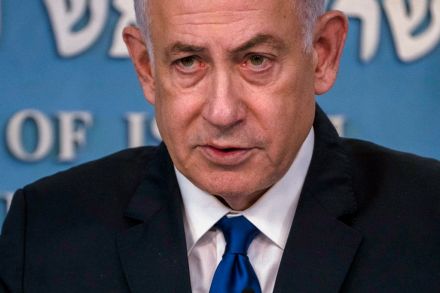
Michael Evans

Michael Evans was defence editor of the Times for 12 years. He wrote a memoir called First With the News and is author of Agent Redruth, a new spy thriller which has a strong Russian theme.

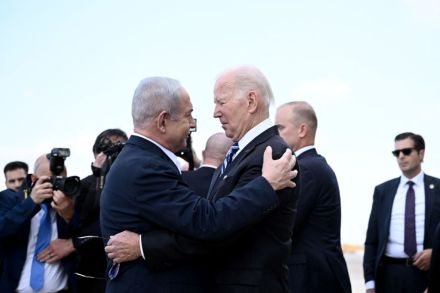
Benjamin Netanyahu and Joe Biden are on a collision course

From our UK edition

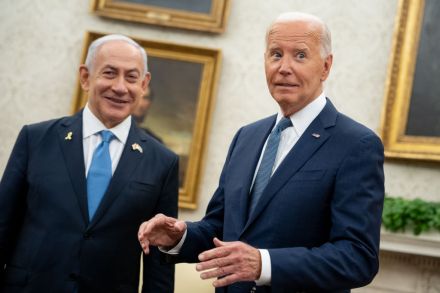
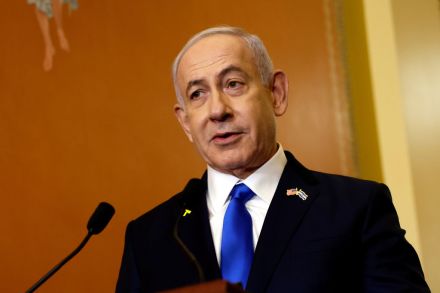
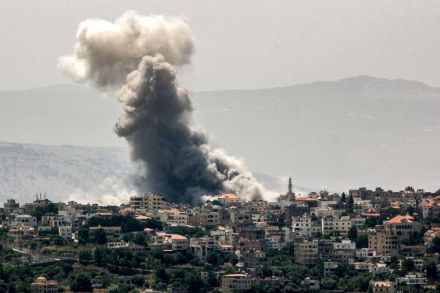
Benjamin Netanyahu is set on a path which brooks no deviation. He wants victory against Hamas, victory against Hezbollah and, ultimately, victory against Iran. Over the year since the 7 October massacre, Netanyahu has played the diplomatic game with the United States: receiving constant visits from American officials from the State Department and Pentagon, listening to entreaties by President Biden for limited military action and appeals to protect civilians, and making encouraging noises about ceasefires. When trust breaks down between two such important allies, the winners can only be Israel’s opponents However, all along, the Israeli leader has been relentless in focusing, and then expanding on, his principal objectives.

Joe Biden has tried and failed to fix the Middle East

From our UK edition

No one can accuse President Joe Biden of failing to do his utmost to prevent a full-scale war from breaking out in the Middle East. He and his indefatigable envoys must have spent more time this year working on the Middle East than any other issue.  The intensive diplomatic efforts by Antony Blinken, secretary of state, Jake Sullivan, national security adviser, Bill Burns, CIA director, and Amos Hochstein, Biden’s man covering Lebanon, among others, were supposed not only to find a workable solution to the myriad of crises but also enhance the President’s foreign policy legacy after what has turned out to be only one term in office.

What is Zelensky’s ‘victory plan’?

From our UK edition

President Zelensky is in the United States for his latest, possibly last, throw of the dice before the American election, in his attempt to prove that victory can be achieved against Ukraine’s Russian invaders. The redoubtable leader of Ukraine has brought what he calls his ‘victory plan’, which embraces every facet of his nation’s future. It includes his strategy for forcing President Putin to end the war and for the West to guarantee his beleaguered country’s long-term security and economic prosperity. It’s a grand vision which he will present to President Biden in the White House on Thursday. There are a number of conditions which are dependent on American support, whoever wins the election in November.

Biden inches towards authorising Storm Shadows in Russia

From our UK edition

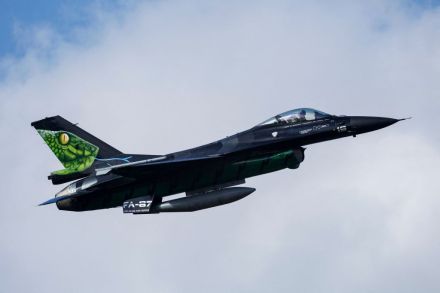
Storm Shadow, Britain’s highly-prized, air-launched cruise missile, is not going to win the war for Kyiv against the Russian invaders. However, this particular weapon, along with the American ATACMS (Army Tactical Missile System) are literally waiting in the wings for Kyiv to launch a new-style, more deadly and more provocative strike on air bases and missile sites deep inside Russia. They could transform the near-31-month war into the biggest confrontation between Moscow and the West since the Cuban Missile Crisis of 1962. President Putin has warned that if authority is given for these weapons to be used against targets inside Russia, it would mean war between Russia and Nato.

Will Israel and Hamas sign a peace deal?

From our UK edition

The omens for a ceasefire deal in Gaza between Israel and Hamas are looking alarmingly bleak following the latest shuttle diplomacy by Antony Blinken, the US secretary of state. The US ‘bridging proposal’ aimed at resolving contested issues raised after the three-stage peace formula offered by President Biden on 31 May appears to be dead in the water. Central to the impasse is the insistence by Benjamin Netanyahu that Israeli troops must be allowed to remain in two security corridors in Gaza to ensure that even if the fighting has stopped Israel will retain the ability to watch for and deter any future attempts by Hamas to rearm or launch attacks across the border.  They are identified by Israel as the Philadelphi Corridor, which runs for 8.

American diplomacy might not stop a Middle East war

From our UK edition

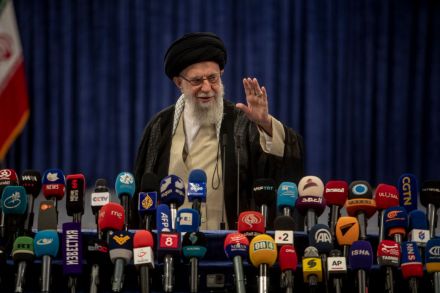
On the face of it, the assassination of Hamas leader Ismael Haniyeh in Tehran on 31 July was a brilliant, opportunistic strike by one of the world’s most dedicated and fearless intelligence services. The presumed targeting by Mossad, however, has disrupted negotiations to bring a ceasefire to Gaza and the release of more Israeli hostages, has provoked a sharp telephone call between President Biden and Benjamin Netanyahu, and has inflamed the Middle East to such a dangerous level that a full-scale war cannot be ruled out. It’s a deja vu crisis Much is being made of the urgent diplomatic efforts underway to try and persuade Iran, now with a new president, to hold back or limit its promised retaliation against Israel for the killing of the Hamas leader on its soil.

Will Trump defend Taiwan?

From our UK edition

The prospect of a second Donald Trump administration has put the fear of God into America’s allies around the world. The biggest question being raised is: would the United States heave up the drawbridge and let others do the dirty work to keep the planet safe from global war? Comments made by Trump seem to suggest he still has no love for Nato, that Taiwan should fend for itself if attacked by mainland China, and that Ukraine should give up the territory it has lost to the Russian invaders in return for a ceasefire and forgo any ambition to join the western alliance. On the face of it, even if elements of this Trumpian foreign policy vision were to be implemented, it would represent one of the starkest changes in America’s relations with allies and partners in modern times.

Is America fit to lead the West?

From our UK edition

Foreign policy rarely plays a significant role in a US presidential election. Domestic issues, the economy, money in the pocket, jobs, immigration, these are what voters are most concerned about. But this time, it could be different. The first TV debate between President Biden and Donald Trump seemed focused on one thing: is Biden the man to trust to lead the western alliance for another four-year term? Or, as Trump insinuated, is he so weakened and fragile that none of the adversarial leaders in the world have any respect for him, let alone fear him? For America’s allies, Biden’s lacklustre performance will have caused considerable anxiety Fear, it seems, is the former president’s trump card.

Sending US contractors to Ukraine could provoke Moscow

From our UK edition

Call it ‘slippery slope’ or ‘mission creep’, America’s strategy for helping Ukraine defend itself against the Russian invasion has adapted and expanded many times in the last 28 months. However, there was a golden rule laid down by President Biden almost on the first day of Russia’s aggression against its neighbour. There would be no ‘boots on the ground’, he said. No US troops would be deployed to fight the Russians. Civil contractors have played a significant role in the field in every US war in modern times. But the US is not at war in Ukraine That Biden doctrine has not changed.

Is Israel ready for war with Hezbollah?

From our UK edition

Whenever the great Shakespearean actor Sir Donald Wolfit had to exit the stage during a performance, he would always take a step back, showing the audience that he was reluctant to leave, before moving forward and departing into the wings on his left or right. The policy of the United States towards Israel and the war in Gaza has followed a similar series of forward and backward steps, with the Biden administration not leaving the stage, but eternally frustrated by the cuts and thrusts of Middle Eastern politics. Netanyahu believes that Israel’s survival, and his own political future, depend on winning in Gaza Another week has gone and little has been resolved to end a war which even Israel admits could last at least another six months.

Why Biden’s Gaza ceasefire proposal failed

From our UK edition

Ceasefire deals to end the war in Gaza have come and gone. President Biden’s unexpected announcement of the latest formula for a settlement, supposedly proposed by Israel, has already fallen by the wayside. In fact, Biden’s three-stage ceasefire deal looked remarkably like the previous ones: a six-week halt to fighting and withdrawal of Israeli troops from populated areas, with a release of some hostages in return for hundreds of Palestinian prisoners; a negotiated Israel/Hamas settlement for a permanent end to the war; and finally, comprehensive reconstruction of Gaza.

How Benjamin Netanyahu and Joe Biden fell out

From our UK edition

After the atrocities committed by Hamas in southern Israel on 7 October, President Biden offered his total and unflinching support for retribution against the terrorist-designated rulers of the Gaza Strip. Benjamin ‘Bibi’ Netanyahu vowed to annihilate every member of Hamas and to gain the release of the 252 Israeli and foreign hostages abducted and taken into Gaza. Biden agreed that these objectives were right and proper. So, too, did the UK government and other like-minded nations, appalled by the images and reports of slaughter, rape and brutality by Hamas. Relations between Washington and Tel Aviv are not beyond repair Nearly eight months later, that policy of unflinching support for Israel has gone through several stages of doubt, alarm, dismay and anger.

How Ukraine will use American aid

From our UK edition

The Kyiv government will need to rush to make use of the new batch of American weapons coming to Ukraine. With the much-delayed aid available at last, Ukraine will have to build up its defences to withstand a Russian offensive in the summer, and make enough headway to prove to the US – and in particular a sceptical Donald Trump – that all this taxpayers’ money is being well spent. US officials say the objectives have not changed. But there is less talk of victory for Kyiv But whether the money and weapons will buy victory for Kyiv remains doubtful. Russia’s invading force has been making limited but steady territorial gains.